Why your windshield looks wavy after a replacement
When you sit behind the wheel of your vehicle after a fresh installation, the last thing you expect is to feel like you are looking through a funhouse mirror. Yet, I see this daily in the glazing industry. A homeowner or driver calls me because their vision is swimming while they drive. As a glazier with over 25 years in the field, I can tell you that a window is never just a piece of glass. It is a complex optical component. If your windshield looks wavy, you are likely dealing with secondary images or optical deviation caused by inferior manufacturing or a botched installation process. This is not just an aesthetic annoyance; it is a safety hazard that affects your depth perception and reaction time. In my decades of experience, I have seen every shortcut in the book, from the mobile service technician who rushes a set to the factory that skips the crucial annealing phase of the glass ribbon.
The Rot Under the Surface: An Installation Story
I remember a case where I was called to inspect a windshield on a high-end SUV in a humid coastal environment. I pulled that glass out and found the pinch weld was completely pitted with rust. The previous glass installer had relied on a standard mobile service approach without proper corrosion protection. They had scratched the paint down to the bare metal while removing the old urethane and then simply slapped the new glass on top. Why does this matter for waviness? Because the structural integrity of that bond determines how the glass sits. If the pinch weld is compromised, the glass can experience stress points that slightly flex the laminate, leading to visual distortion. In the architectural world, we talk about the rough opening being square and plumb. In the automotive world, that pinch weld is your rough opening, and if it is not prepared with the precision of a surgeon, the entire unit is compromised from day one.
The Physics of the Float Glass Process
To understand why glass looks wavy, we have to look at how it is made. Modern glazing is produced using the float glass process, where molten glass is poured onto a bed of molten tin. In a perfect world, the glass is perfectly flat. However, as the glass ribbon moves along the rollers, any variation in temperature or speed can introduce subtle ripples. This is where the difference between an OEM (Original Equipment Manufacturer) part and a cheap aftermarket alternative becomes clear. High-quality glass undergoes rigorous testing for refractive power. When light hits the glass, it should pass through without bending in unexpected directions. If the glass has variations in thickness, even by a fraction of a millimeter, it acts like a lens. This is what we call optical distortion. When you choose a same-day glass installer, you must ask where the glass is sourced. Not all glass is created equal. Cheap glass often skips the extended cooling process, leading to internal stresses that manifest as those annoying waves.
“Installation is just as critical as the window performance itself. A high-performance window installed poorly will fail.” – AAMA Installation Masters Guide
The Solar Heat Factor and Surface Coatings
In hot climates, the glass serves as a thermal barrier. We analyze the Solar Heat Gain Coefficient (SHGC) to determine how much heat is entering the cabin. For a windshield, we are looking at Low-E coatings that are usually applied on Surface #2 of the laminated sandwich. This coating reflects long-wave infrared radiation. If this coating is applied unevenly, it can create a localized ‘haze’ or contribute to the wavy appearance of the glass. In places like Texas or Florida, a low SHGC is king. You want to block the sun’s heat before it even enters the vehicle. If you are using a mobile service in the middle of a 100-degree day, the heat can actually affect how the urethane cures. If the urethane sags or skins over too quickly, the glass might not settle into the frame properly, resulting in a slight tilt that creates an optical shift for the driver.
Understanding the Laminated Sandwich
A windshield is not a single pane of glass. It is a laminate, consisting of two layers of glass bonded by a Polyvinyl Butyral (PVB) interlayer. This is where most ‘waviness’ originates. If the PVB layer is of poor quality or if the lamination process occurs in a non-cleanroom environment, you get thickness variations. Think of the sash in a home window. It must hold the glass perfectly flat. In a vehicle, the curvature of the glass is achieved through a bending furnace. If the two pieces of glass are not bent at perfectly matching temperatures, they will fight each other once they are bonded. This creates ‘ghosting’ where you see a double image of headlights at night. This is a sign of a failed manufacturing process, and as a master glazier, I refuse to install glass that shows any sign of this deviation.
“Standard Practice for Installation of Exterior Windows requires a level of precision that many modern ‘fast-fix’ services simply cannot provide without proper environmental controls.” – ASTM E2112
The Myth of the Cheap Fix
Many people think a chip repair is a permanent solution for all glass issues. While a chip repair can stop a crack from spreading, it cannot fix the fundamental optical properties of a low-quality windshield. If you have already replaced your glass and it looks wavy, the only real fix is another replacement using a higher grade of glass. Do not let a high-pressure salesman tell you that the glass will ‘settle’ over time. Glass is an amorphous solid, but it does not flow or flatten out once it has been annealed and laminated. If it is wavy on day one, it will be wavy on day one thousand. When you are looking for a glass installer, look for one who understands the importance of the sill pan and flashing tape in a house, because that same level of detail is required for the damming and priming of an automotive glass seal. You want a professional who views the car as a high-performance envelope, not just a job to be finished in thirty minutes.
Technical Specifications: What the Numbers Mean
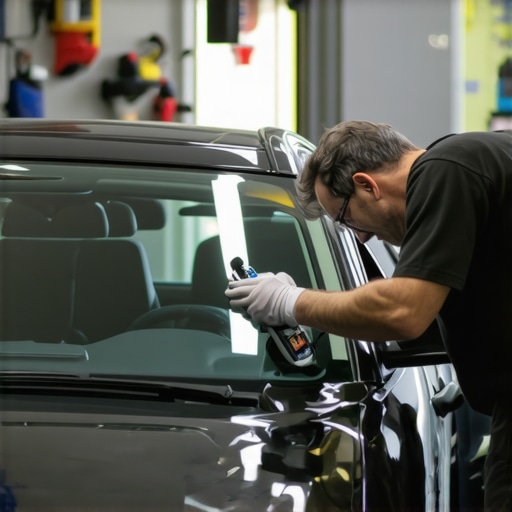
When we look at the NFRC labels on home windows, we focus on the U-Factor. In the glass installer world for vehicles, we look at the DOT (Department of Transportation) code. This code tells you which factory produced the glass. I tell my clients to look for reputable DOT codes that signify the glass meets higher standards for optical clarity. If the glass lacks these markings or uses an unknown code, you are rolling the dice with your vision. The refractive index of light through the glass should be uniform. Any ‘draw’ or ‘muntin’ effect in the glass indicates a failure in the cooling lehr. A quality glass installer will check the glass for these defects before they even pull your old windshield out. They will look through the glass at a grid pattern, often called a Zebraboard, to see if the lines stay straight. If those lines bend, that glass stays on the rack.
The Critical Role of the Installer
The best glass in the world will still fail if the installation is botched. I have seen installers fail to use a proper shim when necessary or ignore the tolerances of the rough opening. In automotive glass, the ‘shim’ is effectively the bead of urethane. If the bead is inconsistent, the glass sits at an angle. This angle changes your point of view through the laminate, effectively creating distortion. Furthermore, if the glass is handled with bare hands, the oils from the skin can interfere with the bond, leading to future leaks. A master glazier knows that water management is a science. Just as we use weep holes in a window sash to manage moisture, a windshield relies on a perfect, unbroken seal to prevent the very rot I described earlier. If you see waves, it might not just be the glass; it might be the way the glass is being stressed by an improper mounting position.
Final Verdict on Wavy Glass
Do not settle for inferior vision. The waviness you see is a physical manifestation of poor quality control. Whether it is a result of a rushed mobile service, a lack of climate-controlled installation, or simply a cheap aftermarket part, it is a defect. A professional glass installer will stand by their work and the quality of their materials. Always insist on glass that meets or exceeds OEM specifications and ensure your installer uses a full-strip method for the old urethane to provide a clean, flat surface for the new glass. Your safety depends on the clarity of your view, and in the world of glazing, clarity is the ultimate mark of craftsmanship.