The reason your phone screen feels rough to the touch
You run your thumb across your smartphone and instead of the slick, buttery glide you remember from the day you unboxed it, you feel a gritty, tactile resistance. It feels like fine-grit sandpaper or a microscopic topographical map. As a master glazier with a quarter-century of experience handling everything from monolithic plate glass to tempered high-rise units, I can tell you that your phone is essentially a miniature architectural glazing unit subjected to extreme environmental stress. When you ask why a screen feels rough, you are asking about the degradation of chemical coatings and the physical pitting of aluminosilicate glass. In my world, we don’t just look at glass; we look through it to understand the molecular battle happening on the surface.
The Condensation Crisis: A Lesson in Surface Chemistry
Before we break down the physics of your mobile device, let me share a story that illustrates the ignorance most people have regarding glass performance. A homeowner called me in a panic because their new windows were ‘sweating’ and the glass felt ‘sticky’ to the touch. I walked in with my hygrometer and showed them the humidity was 60 percent. It wasn’t the windows; it was their lifestyle. They were boiling pasta and running a humidifier in a sealed environment. Glass is a thermal bridge. Whether it is a triple-pane window in a living room or the glass on your phone, it reacts to the environment. The roughness you feel on your phone is often the result of a similar environmental misunderstanding. You are not just dealing with glass; you are dealing with a complex system of coatings designed to repel oils, which, like a poorly managed HVAC system in a house, eventually fails under the pressure of daily use.
The Physics of the Rough Touch: Oleophobic Failure
The primary reason for that rough sensation is the depletion of the oleophobic coating. In the glazing industry, we use similar fluoropolymer coatings on high-end commercial glass to reduce maintenance. On a phone, this coating is typically a thin layer of fluorinated silane. It is bonded to the glass to create a low-energy surface that prevents sebum (skin oil) from sticking. Over time, friction from your pocket and the acidity of your sweat act as an abrasive. Imagine a window installer using a steel wool pad on a Low-E coating; that is what your thumb does over six months. Once that coating is gone, you are touching the raw silica. Without the lubricant of the coating, every microscopic pit and scratch becomes tactile. This is especially prevalent in South and Hot climates, where high ambient heat and UV radiation accelerate the chemical breakdown of these polymers. In regions like Phoenix or Miami, the Solar Heat Gain Coefficient (SHGC) isn’t just a number for your house; it is a factor in how fast your mobile device’s surface chemistry degrades. Heat increases the kinetic energy of the molecules in the coating, making them easier to strip away through simple mechanical friction.
“Installation is just as critical as the window performance itself. A high-performance window installed poorly will fail.” – AAMA Installation Masters Guide
This industry standard applies perfectly to the mobile glass world. If the glass was not properly tempered or if the chemical strengthening process was rushed during manufacturing, the structural integrity of the surface is compromised from day one.
Ion-Exchange and the Anatomy of a Chip
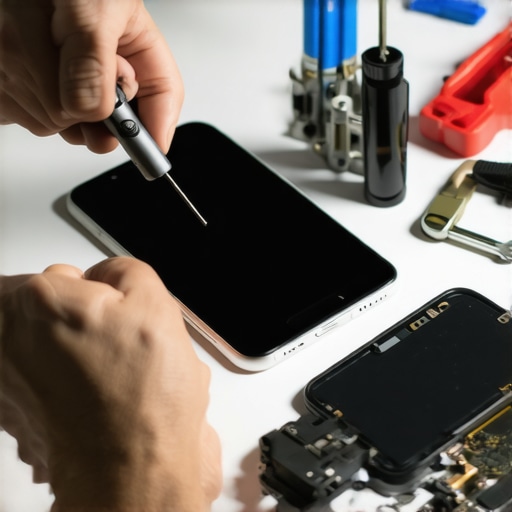
Most modern mobile screens are not standard soda-lime glass. They are aluminosilicate glass that has undergone an ion-exchange process. During this process, the glass is submerged in a molten potassium salt bath at roughly 400 degrees Celsius. Smaller sodium ions leave the glass, and larger potassium ions take their place. Because these larger ions take up more space, they create a state of high compressive stress. This is what makes the glass hard. However, when you get a chip, you are breaching that compression layer. This is where mobile service and same-day chip repair come into play. If a chip is not filled with a high-viscosity resin that matches the refractive index of the glass, the tension will eventually cause a structural failure. In the trade, we call the area where the glass meets the frame the Rough Opening. If your screen is not seated perfectly with the correct Glazing Bead of adhesive, the stress distribution becomes uneven, leading to those ‘unexplained’ cracks that start at the edge of the bezel.
Technical Performance: U-Factor and Thermal Stress
While we don’t usually worry about the U-Factor (heat transfer rate) of a phone screen, the thermal stress is real. If you leave your phone on a hot car dashboard in a southern climate, the glass expands. If the frame (the Sash of your device) is made of a different material like aluminum with a different coefficient of expansion, it puts immense pressure on the edges of the glass. This can lead to microscopic ‘shaling’ or flaking at the edges, which contributes to that rough feeling. We see this in commercial glazing when a glass installer fails to use the proper Shim to allow for expansion. Without that clearance, the glass has nowhere to go but into a state of internal fracture.
“Glass surfaces must be protected from alkaline runoff and mechanical abrasion to maintain long-term optical and structural clarity.” – NFRC Performance Guidelines
When you feel roughness, you are often feeling the ‘alkaline runoff’ of your own skin and environment. The microscopic pits are essentially tiny craters where the glass has been chemically etched by environmental pollutants. This is why a mobile service specializing in glass installer techniques is required for a true fix. A simple wipe-on ‘liquid screen protector’ is the ‘caulk-and-walk’ equivalent of the window world. It hides the problem for a week but doesn’t address the underlying surface degradation.
The Solution: Beyond the Same-Day Patch
If your screen feels rough, your options depend on the severity. For minor coating loss, a high-quality oleophobic replacement kit can provide temporary relief. However, if the roughness is due to pitting (actual loss of glass material), you are looking at a full replacement. In the glazing trade, we distinguish between a ‘Pocket replacement’ and a ‘Full frame tear-out.’ A same-day chip repair is a pocket replacement; it’s a localized fix. But if the integrity of the ion-exchange layer is gone, you need the mobile equivalent of a full tear-out. Ensure your installer understands the importance of the Sill Pan and the Flashing Tape of the mobile world—the internal gaskets and seals that prevent moisture from entering the Weep Hole-less environment of a modern smartphone. If the seal is broken during a screen swap, you lose the atmospheric control of the device, leading to internal condensation and eventual logic board failure. Don’t buy the marketing hype of ‘indestructible’ glass; buy the physics of a properly maintained surface and professional installation.