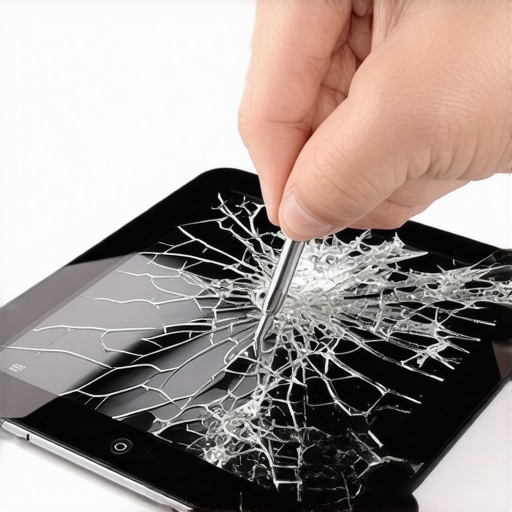
The 30-minute fix for a shattered tablet screen
You hear it before you see it. That sharp, crystalline snap of chemically-strengthened glass meeting concrete. As a glazier with over 25 years in the trade, I’ve heard that sound in every possible context, from a 40th-story curtain wall failing under wind-load to the sickening crack of a tablet screen hitting a shop floor. Most people see a shattered tablet and think of it as a tech failure. I see it as a glazing failure. A tablet is essentially a micro-scale architectural installation: you have a rough opening (the bezel), a glazing bead (the adhesive gasket), and a high-performance lite of glass that must manage thermal stress and impact. When that glass fails, you don’t just need a technician; you need a glass installer who understands the physics of the bond.
The Condensation Crisis: Why Physics Governs Every Pane
Before we break down the 30-minute fix, you need to understand the authority of physics. I remember a homeowner in Houston who called me in a panic because their brand-new, high-performance windows were ‘sweating’ on the inside. They were convinced the seals had failed. I walked in with my hygrometer and showed them the humidity in their living room was 60 percent. It wasn’t the windows; it was their lifestyle. They were boiling pasta and running a humidifier while it was 40 degrees outside. The dew point was being reached on the glass surface because the interior air was saturated. I bring this up because the same principles apply to your mobile device. When a mobile service tech performs a chip repair or screen swap in a humid environment, they often trap that moisture behind the glass. The moment you step into a cold car or an air-conditioned office, that trapped vapor reaches its dew point, creating a fog between the digitizer and the glass. This is why a controlled environment is non-negotiable for a professional glass installer.
“Installation is just as critical as the window performance itself. A high-performance window installed poorly will fail.” – AAMA Installation Masters Guide
The Anatomy of a Shattered Screen
When we talk about a 30-minute fix, we aren’t talking about a ‘caulk-and-walk’ hack job. We are talking about a precision-engineered replacement. Most modern tablets use aluminosilicate glass, which has been submerged in a molten potassium salt bath to create a deep compression layer. This is the same logic we use in tempered safety glass, but on a much thinner scale. When the surface tension is breached by a micro-crack or chip, the internal stresses are released, resulting in the characteristic spiderweb pattern. To fix this properly, the glass installer must treat the device bezel like a rough opening. If the frame is bent even a fraction of a millimeter, the new glass will be under constant tension. This is where most mall kiosks fail; they don’t check the tolerances of the rough opening. If I’m shimming a window, I’m looking for level, square, and plumb. If I’m fixing a tablet, I’m looking for a flat mating surface. Any deviation means the new glass will crack again within a week due to thermal expansion.
[IMAGE_PLACEHOLDER]
Thermal Stress and the Southern Climate
In a hot climate like Texas or Florida, Solar Heat Gain Coefficient (SHGC) is the metric that determines whether an installation succeeds or fails. Your tablet spends its life in a high-thermal-stress environment. If you leave your device in a car in Phoenix, the interior temperature can reach 170 degrees Fahrenheit. The aluminum chassis of the tablet has a different coefficient of thermal expansion than the glass. This is why we use a ‘thermally broken’ approach in commercial glazing, and it is why the adhesive choice in your tablet repair is critical. A professional mobile service uses Liquid Optical Clear Adhesive (LOCA) or specialized acrylic tapes that act as a buffer. If the adhesive is too rigid, the glass will buckle as the aluminum frame expands in the heat. In the South, we prioritize the Low-E properties of the glass, often looking for Surface #2 coatings that can reflect infrared radiation. While your tablet doesn’t have a Low-E coating in the traditional architectural sense, the principle of heat rejection remains the same. You want a glass installer who understands that the glass is a thermal barrier first and a touch interface second.
The Shingle Principle: Water and Dust Management
In the glazing world, we live by the ‘Shingle Principle’: everything must lap in a way that sheds water. This is why we use sill pans and drip caps. In a tablet, the ‘sill pan’ is the internal gasket system that protects the logic board. When a screen is shattered, the structural integrity of this moisture barrier is gone. A same-day mobile service must do more than just swap the glass; they must reconstruct the seal. This involves cleaning the ‘glazing bead’ area with high-purity isopropyl alcohol and applying a new perimeter seal that mimics the original factory specification. We look for weep hole equivalents in the device design to ensure that any pressure changes don’t result in air-gap distortion. Without this, the ‘operable’ parts of your device—the buttons and ports—become entry points for contaminants.
“The NFRC provides a reliable way to compare the energy performance of window, door, and skylight products.” – NFRC
The Physics of the 30-Minute Fix
How do we achieve a 30-minute fix without compromising quality? It comes down to preparation and the right chemistry. A master glazier doesn’t guess; they measure. The mobile service van is a mobile clean-room. First, the broken glass is stabilized with a high-tack film to prevent shards from entering the ‘rough opening.’ Then, localized heat is applied to soften the existing adhesive. This is a delicate balance. Too much heat and you damage the LCD; too little and you stress the frame. Once the old pane is removed, the installer must inspect the ‘sash’ of the device for any burrs or glass dust. The new glass unit, often an assembly of the glass, digitizer, and frame, is then dry-fitted. If the tolerances are correct, the final bond is made using UV-cured adhesives that reach full structural strength in seconds. This isn’t magic; it’s glazing science. We are managing the bond line thickness to ensure the refractive index matches the glass, providing that crystal-clear view that you expect from a high-performance window.
Why the Installer Matters More Than the Sticker
You can buy a high-end triple-pane window, but if the guy installing it uses cheap caulk and no flashing tape, you have a hole in your wall that will rot your house. The same is true for mobile glass. You can buy the ‘OEM’ glass, but if the installer doesn’t understand the physics of the bond or the importance of a clean mating surface, you are wasting your money. A real glass installer looks at the ‘weep holes,’ the ‘sash’ tension, and the ‘shim’ requirements of the internal components. We don’t just fix a screen; we restore a structural system. When you choose a same-day service, you are choosing a specialist who can diagnose why the glass broke in the first place and ensure that the replacement is better than the original. In the end, glass is a liquid that thinks it’s a solid. It requires a steady hand and a deep understanding of thermodynamics to manage correctly. Don’t trust your high-performance device to a ‘Tin Man’ salesman or a mall kiosk amateur. Trust the glazier who knows that every pane of glass, no matter how small, is a masterpiece of engineering.