Why mobile repair is safer than driving with a spiderweb crack
The Structural Physics of Glass Failure: Why Mobile Glass Repair is Safer Than Driving with a Spiderweb Crack
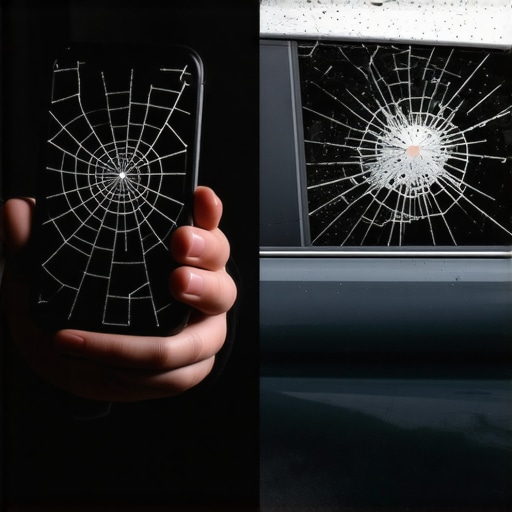
When you look at a spiderweb crack on a piece of laminated safety glass, you are not just looking at an aesthetic blemish. You are looking at a catastrophic failure of a structural system. As a master glazier with a quarter-century in the field, I have seen every possible iteration of glass fatigue. Most people view glass as a solid, immutable substance until it breaks, but in the glazing world, we understand it as an amorphous solid that is constantly under the influence of internal and external stresses. A chip repair is not a suggestion. It is a necessary intervention to restore the tensile strength of the glazing unit before the physics of crack propagation takes over.
A homeowner in Minneapolis called me in a panic last February because their large fixed-lite window, which had a minor stone chip from a lawnmower months prior, suddenly ‘screamed’ and split across the entire width of the sash. I walked in with my hygrometer and thermal camera. The indoor humidity was at 55 percent, while the exterior temperature was hovering at minus ten degrees. I had to explain that the windows were not defective. Their lifestyle, specifically the high moisture content from a humidifier combined with the extreme thermal gradient, had turned that tiny chip into a pressure release valve. The glass did not just break. It failed under the weight of a 60-degree temperature differential that the compromised annealed layer could no longer support.
“Installation and maintenance are just as critical as the window performance itself. A high-performance window installed poorly or left in a state of disrepair will fail under environmental load.” AAMA Installation Masters Guide
To understand why a glass installer insists on same-day mobile service for a spiderweb crack, we must first Glaze Zoom into the molecular reality of the material. Most modern safety glass, whether in a high-end architectural window or a vehicle, utilizes a lamination process. This involves a Polyvinyl Butyral (PVB) interlayer sandwiched between two sheets of glass. When a rock hits the surface, it creates what we call a Hertzian cone failure. This chip creates a point of stress concentration. In the glazing trade, we know that glass is incredibly strong under compression but notoriously weak under tension. A crack tip is essentially a point of near-infinite stress. Every time the frame flexes, or the temperature shifts, that crack tip is driven further into the healthy glass.
In northern climates, the enemy is the Delta-T. When you turn on your defroster or your interior heater, you are creating a massive thermal gradient across the thickness of the glass. The inner layer of glass attempts to expand as it warms, while the outer layer remains contracted by the freezing air. If the glass is intact, it can handle this expansion through its natural elastic modulus. However, if there is a spiderweb crack, the expansion forces the crack to ‘run.’ This is why driving to a shop is often the worst thing you can do. The mere vibration of the road, combined with the wind pressure against the glass, acts like a wedge, driving the crack deeper into the rough opening of the frame.
Let’s talk about the mechanics of chip repair. A professional glass installer does not just ‘fill’ a hole. We use a vacuum-pressure process to extract air from the break and inject a specialized resin that has a refractive index nearly identical to the glass itself. This resin must then be cured using specific UV wavelengths to ensure it bonds with the glazing bead and the surrounding molecular structure. If you wait, dirt, moisture, and road oils migrate into the crack. Once the PVB interlayer is contaminated, a ‘clear’ repair becomes impossible. You are then looking at a full replacement, which is far more invasive and expensive.
“The load resistance of glass is significantly reduced when the surface integrity is compromised by scratches, chips, or cracks, which act as stress risers.” ASTM E1300 Standard Practice for Determining Load Resistance of Glass
Why is mobile service the industry standard for these repairs? It comes down to the torsion of the frame. Every time a vehicle or a building settles, the frame undergoes twisting forces. In a vehicle, the windshield is a structural component that contributes up to 60 percent of the roof’s structural integrity during a rollover. If you are driving with a spiderweb crack, you are operating a machine with a compromised safety cage. By choosing a mobile service, the repair happens while the glass is in a static state, free from the dynamic loads of travel. We come to you because the glass is too unstable to be moved safely.
When we examine the frame material science, we see that the sash or the mounting frame plays a massive role. In residential settings, vinyl frames expand and contract significantly more than fiberglass or wood. This movement puts constant pressure on the shim points and the sill pan. If the glass has a crack, this frame movement will eventually force the glass out of the glazing bead. I have seen instances where the glass literally popped out of the frame because the structural adhesive could no longer hold the fragmented pieces together against the thermal expansion of the vinyl.
The ROI of a same-day repair is indisputable. A chip repair is a fraction of the cost of a full glazing unit replacement. More importantly, it maintains the original factory seal. In my 25 years, I have seen too many ‘caulk-and-walk’ installers ruin a perfectly good rough opening by improperly flashing a replacement window. By repairing the existing glass via mobile service, you avoid the risk of a technician messing with your flashing tape or weep hole system, which are your primary defenses against water intrusion and rot.
Don’t be fooled by high-pressure sales tactics that suggest every crack requires a new window. However, don’t be a fool who ignores the physics of a spiderweb crack. The moment the integrity of the surface is breached, the clock starts ticking. The humidity, the temperature, and the vibration are all working against you. If you see a star break or a bullseye, you need a glass installer immediately. The goal is to arrest the crack before it reaches the edge of the glass. Once a crack touches the fritted edge or the frame, it can no longer be repaired and must be replaced to meet safety standards.