Why resin quality matters more than price for rock chips
When you hear the sharp crack of a stone hitting your windshield while driving down the highway, your first instinct is likely financial. You think about the cost of a full replacement versus the cost of a quick fix. As a master glazier with a quarter-century of experience handling everything from residential casements to high-performance laminated glass, I can tell you that the most expensive mistake you can make is choosing a repair based on the lowest price tag. In the world of glass, you aren’t just paying for a technician to show up: you are paying for the chemical integrity of the resin that keeps that glass from shattering. I remember pulling a repair job from a technician in Houston who had used a bargain-basement resin on a high-end luxury vehicle. The owner thought he saved sixty dollars. Within three months, the Texas sun had turned that resin into a yellowed, brittle mess that had completely delaminated from the inner surfaces of the crack. The header of the repair was effectively dead, and because the cheap resin had already cured and shrunk, I couldn’t even perform a proper re-fill. The entire windshield had to be scrapped. That is the cost of ‘cheap’ in this industry.
“The quality of the repair is directly proportional to the adhesive strength and optical clarity of the resin used. Substitutions of inferior materials lead to structural failure under thermal stress.” – NWRA (National Windshield Repair Association) Standard Practice
To understand why resin quality is the determining factor in a successful chip repair, we have to look at the physics of the glass itself. Most modern windshields are a sandwich of two layers of soda-lime glass with a Polyvinyl Butyral (PVB) interlayer. When a rock hits, it creates a ‘rough opening’ in that outer layer. This is not just a cosmetic blemish: it is a structural breach. A mobile service provider who understands the ‘Glass Class’ knows that a chip is essentially a miniature window frame that has lost its seal. In a hot climate like ours, the solar heat gain on a windshield can be immense. Surface #1 of your glass can reach temperatures exceeding 140 degrees Fahrenheit. If the resin used in the chip repair has a different coefficient of thermal expansion than the glass, it will expand at a different rate. Cheap resins are often simple acrylic monomers with high shrinkage rates. High-quality resins, however, are engineered with specific cross-linking densities that mimic the expansion properties of the glass itself. When the glass gets hot and expands, the resin expands with it. When you hit the defroster in the winter, and the glass suddenly contracts, a high-quality resin maintains its bond to the glass walls. A cheap resin will simply pop loose, allowing air and moisture to re-enter the break.
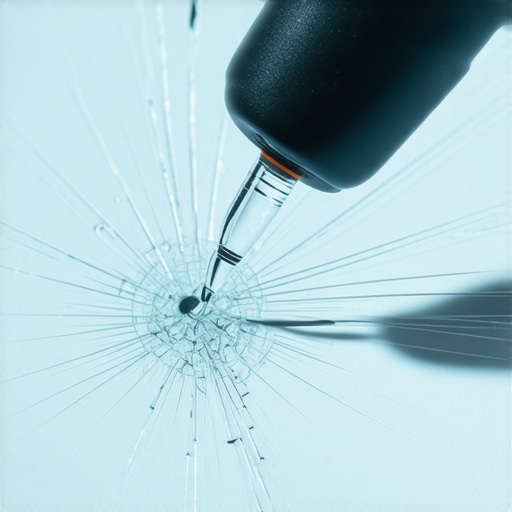
This leads us to the concept of the Refractive Index. Glass has a refractive index of approximately 1.51. For a chip repair to be virtually invisible, the resin must match this number almost perfectly. If a glass installer uses a resin with an index of 1.48 or 1.55, the light will bend differently as it passes through the repair, creating a visible scar or ‘ghost’ image. A premium resin is chemically tuned to match the optical density of the glass, ensuring that visible transmittance remains high and distortion remains low. This is especially critical for same-day repairs where the technician is working in varying light conditions. You want a product that performs as well at noon as it does at dusk. Furthermore, the viscosity of the resin is a major factor in the success of the repair. Think of viscosity like the ‘flow’ of the material. A professional-grade kit will include multiple resins with different viscosities. For a tight ‘star break,’ a low-viscosity resin is needed to penetrate the microscopic fissures. For a large ‘bullseye,’ a higher viscosity is required to provide structural support. A ‘one-size-fits-all’ resin sold by budget mobile service outfits simply cannot provide the same level of penetration or strength.
“Installation and repair materials must be compatible with the laminated glass assembly to prevent premature delamination or optical degradation over the life of the vehicle.” – ASTM E2112 Standard for Fenestration and Glass Systems
Let’s talk about the ‘Mobile Service’ and ‘Same-Day’ reality. Many customers think that because a technician can finish a job in twenty minutes, the materials don’t matter. The opposite is true. Because the glass installer is working in a mobile environment, they are dealing with uncontrolled variables: humidity, UV levels, and wind. A high-quality resin includes photo-initiators that are tuned to cure properly even under sub-optimal UV conditions. This ensures that the ‘Glazing Bead’ of the pit filler reaches full hardness quickly without becoming brittle. If you use a cheap resin in a high-humidity environment, moisture can become trapped within the molecular structure of the curing resin, leading to a cloudy finish. In my years on the job, I have seen ‘parking lot’ repairs where the tech didn’t even bother to use a vacuum cycle. They just dropped some resin in and hit it with a light. A real professional uses a bridge and injector system that acts like a shim to level the pressure, pulling a vacuum to remove all air from the ‘sash’ of the crack before injecting the resin under pressure. This ensures that every weep hole of the break is filled. Without this process, and without high-grade resin, the repair is just a temporary bandage on a wound that will eventually require a full, expensive replacement. You aren’t just buying a repair: you are buying the chemical science that keeps your family safe behind the glass. Don’t let a low price tag blind you to the technical reality of glazing science.