The trick to cleaning glass dust out of your vents
The Invisible Hazard of the Same-Day Fix
As a master glazier with over 25 years in the field, I have seen every imaginable failure in window maintenance and installation. From high-rise curtain walls to delicate historic wood sash restorations, the one thing that separates a true professional from a “splash-and-dash” mobile tech is what happens after the glass is set. Most homeowners are thrilled with a same-day chip repair or a mobile service that swaps a pane in an hour. But there is a silent byproduct of these quick fixes: glass dust. This fine silica particulate is often invisible to the naked eye but acts like a microscopic abrasive within your HVAC system. If your window sits near a floor or wall register, that dust isn’t just sitting on your floor; it is being pulled into your lungs and your furnace.
“Installation is just as critical as the window performance itself. A high-performance window installed poorly will fail, and a repair that leaves debris in the rough opening or ventilation system is fundamentally incomplete.” – AAMA Installation Masters Guide
The Condensation Crisis and the Dust Magnet
I recall a specific call-out last winter. A homeowner in a freezing northern climate contacted me in a panic because their brand-new, high-efficiency windows were “sweating” and they noticed a strange, glittering film on their baseboard heaters. I walked in with my hygrometer and a high-lumen inspection lamp. The humidity was hovering at 62 percent, which is a recipe for disaster in a cold climate where the U-factor of the glass must combat sub-zero exterior temperatures. But the real issue was the “glitter.” A previous mobile service technician had performed a chip repair right above the main return vent. Because they didn’t properly seal the work area, the suction of the HVAC system had inhaled the glass dust generated during the polishing phase. It wasn’t just a window issue; it was an indoor air quality emergency. The humidity was making the dust cling to the vent slats, creating a bio-trap for mold. It wasn’t the windows failing; it was a total lack of post-installation protocol.
The Technical Reality of Glass Dust
When a glass installer performs a chip repair or replaces an operable sash, they often use high-speed rotary tools. These tools create a fine mist of silica. In a cold climate like Minneapolis or Chicago, where we prioritize a low U-factor to keep heat inside, we often use triple-pane units with Low-E coatings on Surface #3. These coatings are designed to reflect long-wave infrared radiation back into the room. However, if glass dust is left to settle in the glazing bead or the weep hole of the frame, it can compromise the seal. Even worse, if it enters the vents, it can score the internal components of your blower motor. Glass dust is not like household dust; it is heavy, sharp, and chemically inert, meaning it won’t break down over time.
The Installation Autopsy: Why Traditional Cleaning Fails
If you try to vacuum glass dust with a standard household vacuum, you are likely making the problem worse. Most residential filters are not rated for sub-micron silica. You end up exhausting the finest particles back into the room air, where they stay suspended for hours. In my years of experience, the “shingle principle” applies to more than just water management; it applies to debris management. You must clean from the highest point down to the lowest, ensuring that no particulate can settle into the sill pan or the rough opening where it can cause future mechanical failure of the window’s hardware.
“Debris within the window track or adjacent ventilation systems can lead to premature seal failure and mechanical obstruction of operable components.” – ASTM E2112 Standard Practice
The Master Glazier’s Trick for Vent Cleanup
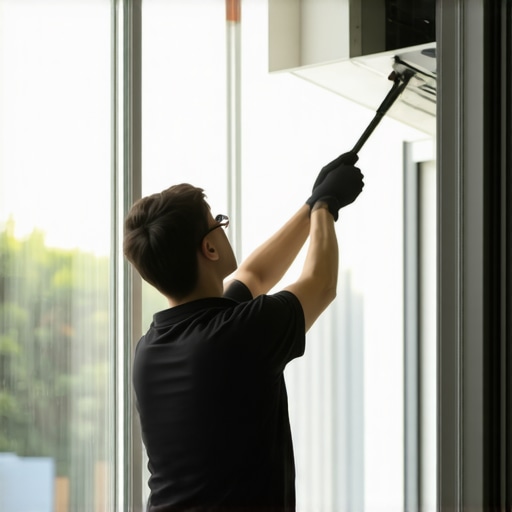
So, what is the professional trick to getting this grit out of your vents? It involves a three-stage localized containment strategy. First, you must never use a dry brush. This flicking motion launches the dust into the air. Instead, we use a “Static-Trap” method. By using a damp microfiber cloth charged with a slight static load, you can wipe the interior of the vent duct as far as your arm can reach. But the real secret is the **High-Pressure Pulsed Vacuum**. We seal off the vent with a magnetic cover, leaving only a small opening for a HEPA-rated vacuum nozzle. By creating a high-velocity localized vortex, we can pull the heavier silica particles out of the duct’s corrugations where they like to hide.
Climate Logic: The Cold Weather Factor
In northern regions, the enemy is heat loss and condensation. When you have a high-performance window with a warm-edge spacer, the goal is to keep the glass edge temperature above the dew point. However, if glass dust clogs the weep holes in your window frame, water cannot exit. This trapped water then freezes, expands, and can actually crack the glazing bead or even the glass itself. When this happens, the argon or krypton gas fill escapes, and your U-factor skyrockets. A simple failure to clean up dust during a mobile service can lead to a total thermal failure of the unit within two seasons. This is why I have no patience for “caulk-and-walk” installers who don’t understand the physics of the entire wall system.
Frame Material Science and Debris
Whether you have vinyl, fiberglass, or wood frames, glass dust is an enemy. Vinyl expands and contracts significantly with temperature swings. This movement can grind glass dust into the frame, creating permanent scratches that hold dirt and compromise the aesthetics of the window. Fiberglass is more stable, but it is also more abrasive; the last thing you want is silica dust acting as a grinding agent against the factory finish. If you have wood windows, the dust can settle into the grain and act as a desiccant, pulling moisture out of the wood and leading to premature rot in the sash or the muntins.
The Math of Professionalism
Many homeowners choose a mobile service based on the lowest bid for a chip repair. But consider the long-term ROI. If that technician leaves glass dust in your HVAC system or fails to properly shim the replacement glass, the cost of professional duct cleaning or a secondary window replacement will far exceed the initial savings. A real master glazier knows that the window is a hole in your thermal envelope. Every step, from checking the rough opening tolerances to the final HEPA vacuuming of the floor registers, is designed to protect that envelope. Don’t buy the sales pitch of a quick fix without asking about their particulate containment protocol. Technical precision is the only way to ensure that your home remains a sanctuary rather than a construction site. Water management, air sealing, and debris control are the three pillars of a successful glazing project. If your installer doesn’t mention the vents, they aren’t finishing the job.