The risk of parking in the sun with a fresh glass repair
The Physics of the Sun and Glass Repair Failures
As a master glazier with over 25 years of field experience, I have seen every imaginable failure in glass remediation. Many homeowners believe that once a chip repair is completed, the glass returns to its original structural integrity immediately. This is a dangerous misconception. A chip repair is a surgical intervention on a pressurized material, and the environmental conditions following that surgery are as critical as the repair itself. When you hire a mobile service for a same-day chip repair, you are essentially asking a glass installer to perform a high-precision chemical bond in an uncontrolled environment. The primary antagonist in this scenario is solar radiation.
The Thermal Stress Reality Check
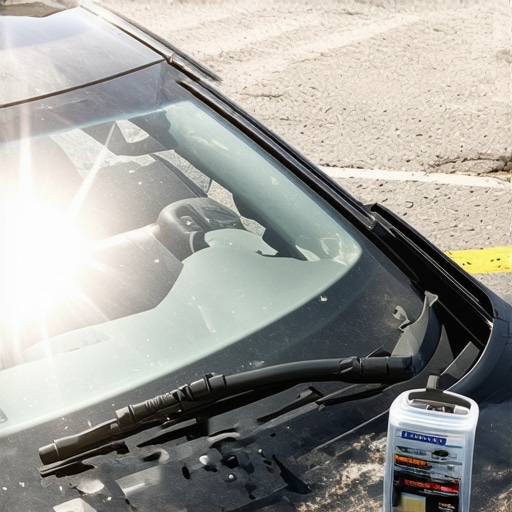
I recall a specific instance where a client called me in a total panic because their fresh repair had split across the entire pane within an hour of the technician leaving. I walked in with my infrared thermometer and hygrometer to perform a forensic analysis. The surface temperature of the glass was registering 158 degrees Fahrenheit. I had to explain to the homeowner that the humidity was only 20 percent, but the localized thermal expansion caused by the direct sun was more than the fresh resin could handle. It wasn’t the windows or the technician’s fault; it was the laws of thermodynamics. Glass has a specific linear coefficient of thermal expansion. When you park in the sun, the glass absorbs short-wave infrared radiation. This heat causes the glass molecules to vibrate and expand. If there is a fresh chip repair, the resin is still reaching its peak cross-linking density. The expansion of the glass around the repair site creates a massive amount of tension on the bond line. If the glass expands faster than the resin can stabilize, the crack will propagate, often resulting in a total loss of the pane.
“Installation is just as critical as the window performance itself. A high-performance window installed poorly will fail, and a repair subjected to extreme thermal gradients before curing will invariably compromise the structural seal.” – AAMA Installation Masters Guide
Understanding SHGC and Surface Temperatures
In hot climates like Phoenix or Miami, the Solar Heat Gain Coefficient (SHGC) is the most important metric we track. For a glass installer, the SHGC tells us how much solar radiation is being admitted through the glass. In a standard residential setting, we want the Low-E coating on Surface #2 to reflect that heat back outside. However, in an automotive or mobile service context, we are often dealing with clear or tinted tempered glass that lacks these sophisticated coatings. When you park a vehicle or leave an operable sash exposed to the sun after a repair, the glass becomes a heat sink. The heat isn’t just on the surface; it penetrates the entire thickness of the material. This is where the glazing bead and the rough opening come into play. As the glass expands, it needs room to move. If the glass is shimmed too tightly within the frame or the sash, the expansion has nowhere to go but inward, toward the weakest point: the recent repair.
The Chemistry of the Chip Repair
Modern mobile service technicians use high-viscosity resins that are cured using ultraviolet (UV) light. While the UV light from the sun helps in the curing process, it is accompanied by infrared (IR) light, which provides the heat. This is the catch-22 of glass repair. You need the UV for the chemical reaction, but the IR can destroy the physical bond. A professional glass installer will use a UV lamp to control the curing process, but the ambient heat from the sun is far less predictable. The resin must fill the microscopic voids in the glass. These voids, often referred to as Griffith Cracks, are the starting points for all glass failures. If the resin is heated too quickly, it can become too thin and leak out of the chip repair before it hardens, or it can become brittle. This is why we emphasize same-day care instructions that involve keeping the glass in a shaded, temperature-controlled environment for at least 24 hours.
“The Solar Heat Gain Coefficient is the primary driver of glass surface temperature in unshaded southern exposures. Failure to account for this leads to catastrophic glazing failure and the loss of the hermetic seal.” – NFRC 200-2020 Standards
Water Management and the Glass Interface
Many people forget that a repair isn’t just about the glass; it is about the entire system. In a residential operable window, the weep hole and the sill pan are designed to manage water. However, if you have a fresh chip repair and then it rains or you wash the car, the water can introduce minerals and moisture into the repair site if the resin hasn’t fully sealed. This is why we check the flashing tape and the integrity of the glazing bead during any service. We want to ensure that no moisture can get behind the glass. If water gets into a fresh repair and then the sun hits it, the water turns to steam, expands, and blows the repair apart. This is a classic failure mode that we see in the field when people don’t follow the 24-hour dry-and-shade rule.
Trade Secrets: Shims and Muntins
In the world of professional glazing, we often talk about the muntin and the shim. While a muntin is decorative, it can create uneven heating across a pane of glass by casting shadows. This uneven heating creates a thermal gradient. One part of the glass is 100 degrees, and the part under the shadow of the muntin is 80 degrees. This temperature difference causes internal stress. When you add a fresh chip repair to that equation, the stress concentrates at the repair site. Similarly, if a window was not properly leveled with a shim during its original installation in the rough opening, the frame might be putting slight twisting pressure on the glass. You might not notice it normally, but the moment you compromise the glass with a chip and then heat it up in the sun, that twisting pressure will cause the glass to fail. A mobile service technician can’t fix a bad original installation; they can only try to patch the symptom.
Recommendations for Post-Repair Success
If you have just had a mobile service tech finish a same-day chip repair, follow these steps to ensure the longevity of the fix. First, find a covered parking area or a garage. If you are at home, ensure the window is not in the direct path of the afternoon sun. Second, avoid using the air conditioning on high blast immediately. The contrast between the cold air on the inside and the hot sun on the outside creates a thermal shock that is often more destructive than the sun alone. Third, wait at least 48 hours before using any high-pressure car washes or chemical cleaners. The resin needs time to reach its full Shore D hardness. Finally, observe the glazing bead and the edges of the sash for any signs of movement. If you follow these expert guidelines, you can ensure that your repair remains a permanent part of the glass rather than a temporary fix that leads to a costly replacement.