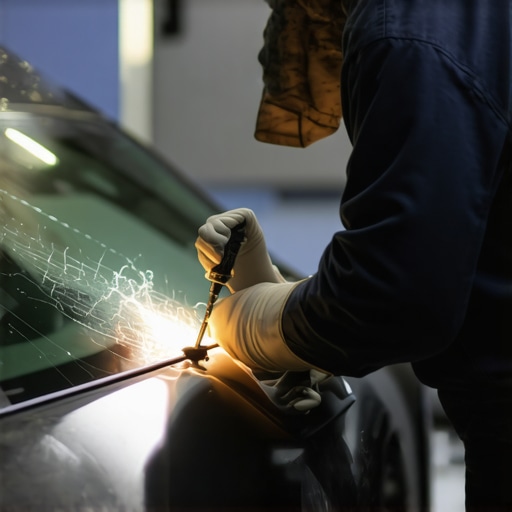
The risk of ignoring a small chip in your rear window
The Hidden Danger of the Rear Window Chip: A Master Glazier Perspective
In my 25 years as a master glazier, I have seen every type of glass failure imaginable, from massive curtain wall collapses to the microscopic stress fractures that bring down a residential sash. But one of the most overlooked hazards is the simple chip in a rear window. Most drivers treat a small pit in their glass like a cosmetic blemish, something to be ignored until it becomes a visible crack. This is a fundamental misunderstanding of glass physics. A window is not just a transparent barrier; it is a structural component under constant tension. When you ignore a chip, you are essentially waiting for a structural failure that can happen at the most inconvenient moment. In the world of glazing, we do not believe in luck; we believe in the integrity of the material and the precision of the installation.
[IMAGE_PLACEHOLDER]
The Condensation Crisis: A Lesson in Thermal Stress
A homeowner called me in a panic last winter because their rear window had seemingly exploded while the car was idling in the driveway. They were convinced it was vandalism. I walked out to the driveway with my hygrometer and a thermal imaging camera to show them the reality of the situation. The humidity inside the vehicle was high, and the temperature differential between the heated interior and the sub-zero exterior was extreme. I found a tiny, pre-existing chip near the bottom glazing bead. It was not a brick that broke the glass; it was the physics of the dew point and thermal expansion. The glass had a small point of weakness where moisture had entered. When they turned on the rear defroster, the localized heat caused the glass to expand at a different rate than the surrounding area. That chip acted as a stress riser, and because rear windows are typically tempered glass, the entire pane reached its limit and underwent a catastrophic failure. It was not the windows; it was a failure to address a minor vulnerability before the climate turned it into a crisis.
“Installation is just as critical as the window performance itself. A high-performance window installed poorly will fail.” AAMA Installation Masters Guide
Tempered Glass vs. Laminated Glass: Understanding the Tension
To understand why same-day chip repair is vital, you must understand the difference between the glass in your windshield and the glass in your rear window. Most windshields are laminated, meaning they have a layer of polyvinyl butyral (PVB) sandwiched between two sheets of glass. This holds the glass together when it cracks. However, the rear window is often a single sheet of tempered glass. During the manufacturing process, the glass is heated and then rapidly cooled, which creates a state of permanent compression on the surface and tension in the core. This makes the glass incredibly strong, but it also means that if a chip penetrates the compression layer and reaches the tension zone, the entire structure is compromised. There is no such thing as a stable crack in tempered glass. It is a binary state: it is either one piece or ten thousand pieces. This is why a mobile service for chip repair is not a luxury; it is the only way to prevent total loss. If you find a chip in the rough opening of your rear glass, you need a glass installer who understands how to stabilize that point before the internal stress takes over.
The Role of Climate and SHGC in Glass Integrity
In cold climates like Minneapolis or Chicago, the primary enemy of your glass is the U-Factor and heat loss. You are fighting to keep the interior warm while the exterior is punishingly cold. This creates a massive thermal gradient across the glass. The rear window defroster lines are effectively heating elements that increase this gradient. If a chip is present, the glass cannot distribute this thermal load evenly. However, the risk is not limited to the North. In hot climates like Phoenix or Florida, the Solar Heat Gain Coefficient (SHGC) is the driving force. The glass absorbs radiant heat from the sun, and the edges of the glass, tucked into the sill pan and flashing tape of the vehicle frame, stay cooler than the center. This temperature difference causes the glass to bow and flex. A chip acts as a pivot point for this flexing, leading to a crack that spreads with every mile you drive.
Professional Repair vs. The Caulk-and-Walk Method
I have an inherent intolerance for what I call caulk-and-walk installers. These are the individuals who use inferior resins or fail to properly clean the chip before injecting the bonding agent. A proper chip repair requires a vacuum process to remove air and moisture from the pit, followed by the injection of an optically matched resin that restores the structural continuity of the glazing. We use specialized shims and bridges to ensure the pressure is applied exactly where it is needed without further stressing the glass. This is not a task for a DIY kit from a big-box store. A master glazier looks for the weep holes in the frame to ensure no moisture is trapped behind the glass and checks the glazing bead to ensure the seal is airtight. Any compromise in the seal can lead to air infiltration, which complicates the repair and reduces the lifespan of the glass.
“The integrity of the glazing system is paramount to the safety of the entire structure. A failure in one component is a failure of the system.” ASTM E2112 Standard Practice
The Math of Early Intervention
Many people hesitate to call for a mobile service because they think they are saving money. This is a mathematical fallacy. The cost of a same-day chip repair is a fraction of the cost of a full rear window replacement. When you factor in the time required for a full tear-out, the cost of the new tempered glass, and the labor to correctly install the new pane with proper flashing tape and sealant, the ROI for chip repair is immediate. Furthermore, the original factory seal of your window is always superior to a field-installed seal. By repairing the chip, you are preserving the structural integrity of the original rough opening. Don’t buy the marketing hype of glass replacement companies that want to sell you a whole new unit; trust the numbers and fix the problem while it is still manageable. Whether you are dealing with an operable window or a fixed lite, the principle remains the same: manage the hole in the wall with precision and technical expertise.