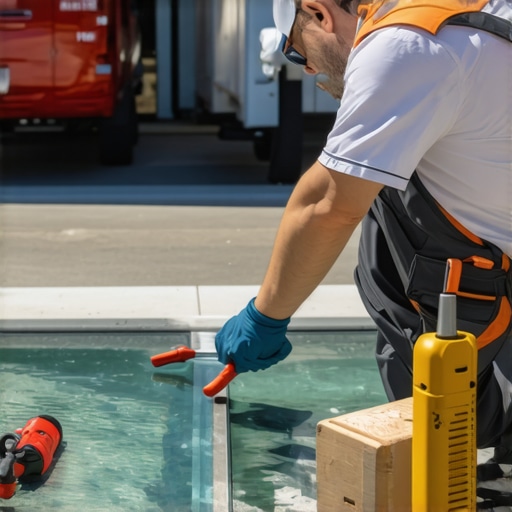
How to spot a lazy glass installation before the technician leaves your driveway
The Day the Header Rotted: A Master Glazier’s Warning
I pulled a wood sash window out of a house in Milwaukee last October and the header was completely black with rot. It crumbled in my hands like wet peat moss. Why? The previous glass installer, likely a high-volume mobile service outfit, relied on the nailing fin and a heavy bead of cheap latex caulk instead of proper flashing tape and a dedicated sill pan. They were in and out in forty minutes. They called it same-day efficiency; I called it structural sabotage. That experience defines my approach to every glazing project. If you are paying for a professional glass installer, you aren’t just paying for the glass; you are paying for the management of the rough opening, the thermal envelope, and the long-term integrity of your home’s substrate.
The Anatomy of a Lazy Installation
When a mobile service technician pulls into your driveway for a chip repair or a full unit replacement, the clock is usually their biggest enemy. But speed should never come at the expense of the shingle principle. Water always wins. It follows gravity and capillary action, and if your installer does not understand how to direct that water out of the building envelope, your wall is on a countdown to failure. A lazy installation often starts with the omission of the backer rod. In any joint wider than a quarter inch, a backer rod is essential to ensure the sealant only adheres to two surfaces, allowing it to expand and contract. Without it, the sealant undergoes three-sided adhesion, which causes it to tear and fail within two seasons of thermal expansion.
“Installation is just as critical as the window performance itself. A high-performance window installed poorly will fail.” AAMA Installation Masters Guide
Technical Depth: The Physics of the North
In our northern climate, the primary enemy is heat loss and the subsequent condensation that destroys sashes. We focus heavily on the U-Factor, which is the mathematical inverse of the R-value. A U-Factor of 0.25 is significantly better than 0.30, particularly when we talk about the dew point on the interior surface of the glass. If your installer is putting in a double-pane unit, you must verify the Low-E coating is on Surface #3. This reflects long-wave infrared radiation—the heat from your furnace—back into your living room. A lazy installer might flip the glass, putting the coating on Surface #2, which is more appropriate for a southern climate to reject solar gain. This mistake is invisible to the naked eye but will be felt in your heating bill for the next twenty years.
The Shim and the Rough Opening
Look at the shims. A professional glazier uses high-density plastic shims. Wood shims are common in cheap installs, but they are porous. If water bypasses the primary seal, those wood shims wick moisture and hold it against the rough opening, inviting mold. Furthermore, the shims must be placed at the setting blocks of the glass unit to transfer the weight of the IGU (Insulated Glass Unit) directly to the structure. If the technician just tosses a few shims in the corners to level the frame and ignores the dead load of the glass, the sash will eventually sag, the operable hardware will bind, and the air seals will fail.
Spotting the Same-Day Trap
We see a lot of same-day chip repair marketing. While the resin technology has improved, a lazy technician will skip the vacuum phase of the injection. To truly repair a chip, you must evacuate the air from the break before injecting the UV-curable resin. If they just dab the resin on and hit it with a light, they are leaving air pockets that will expand and contract with the sun, eventually turning that small chip into a full-length crack across your windshield or window. A proper glass installer knows that the preparation of the site—cleaning the glazing bead, ensuring the weep hole is clear of debris, and checking the plumb of the rough opening—takes twice as long as actually setting the glass.
“The window must be integrated into the water-resistive barrier using methods that provide a continuous path for drainage.” ASTM E2112 Standard Practice
The Sealant Science
Before the technician packs up their mobile service van, look at the caulking. A lazy installer uses cheap acrylic because it is easy to tool. A master glazier uses neutral-cure silicone or a high-performance hybrid polymer. If you smell vinegar, they are using an acetic-cure silicone, which can actually corrode the seals on certain types of insulated glass and damage the spacers. We want a material that maintains its elasticity at minus twenty degrees. Also, check the muntin alignment. If the decorative grids between the glass don’t line up with the adjacent windows, the unit was manufactured poorly or the frame is racked. Do not let them leave until the sash operates with a single finger. If it requires force to lock, the frame is bowed, and you will have air infiltration issues from day one.