The reason your windshield wipers leave a trail right over the repair
The Physics of the Streak: Why Your Repair Fails the Wiper Test
There is a specific kind of irritation that only a driver knows. You have just paid a mobile service for a same-day chip repair. The technician told you it was a professional job, yet the first time it rains, your windshield wipers leave a ghosting trail, a translucent smear right over the impact site. As a master glazier with a quarter-century in the trade, I can tell you that this is not a mystery of the weather. It is a failure of surface tension, resin chemistry, and mechanical leveling. When we talk about glass, we are talking about a material that is technically a supercooled liquid with a surface so flat it is measured in light waves. Any disruption to that plane, even a microscopic one, turns a precision instrument like a wiper blade into a vibrating mess.
The Anatomy of a Failed Bond
I remember pulling a piece of laminated glass out of a commercial storefront in Chicago years ago. The previous installer had tried to patch a star-crack with a standard retail-grade resin. By the time I arrived, the header was showing signs of moisture infiltration because the seal had failed completely. Why? Because the installer relied on the surface tension of the resin rather than a proper vacuum-pressure cycle. In the world of automotive glass, the stakes are different but the physics remain the same. If the resin used by your glass installer does not perfectly match the refractive index of the glass, or if it is not polished down to the exact micron of the surrounding surface, you are left with a physical speed bump. A wiper blade is essentially a squeegee under tension. When it hits a repair site that is even a fraction of a millimeter higher than the surrounding glass, it lifts. That lift creates a low-pressure pocket behind the blade, which sucks water and road oils back under the edge, leaving that infuriating trail.
“Installation is just as critical as the window performance itself. A high-performance window installed poorly will fail.” AAMA Installation Masters Guide
The Rough Opening of a Glass Chip
In architectural glazing, we talk about the rough opening as the space in the wall that must be managed for water and air. In chip repair, the chip itself is the rough opening. Most mobile service technicians rush the cleaning phase. If there is even a trace of moisture or hydrophobic windshield washer fluid trapped in the pit, the resin will never achieve a covalent bond with the silicate. It is like trying to use flashing tape on a wet house wrap: it might look stuck, but the first thermal cycle will break it loose. This is where the climate context becomes critical. In colder northern climates, the glass undergoes significant thermal contraction. If your glass installer uses a resin with a high coefficient of thermal expansion, the plug will literally grow and shrink at a different rate than the windshield. This creates a microscopic ledge. Every time your wipers pass over it, they are chipped away by the friction, eventually leading to the resin becoming pitted and dull, which holds onto grime and creates that permanent streak.
Surface #2 and the Refractive Index
We often discuss Low-E coatings on Surface #2 for solar heat gain coefficient management in residential windows. In a windshield, we are dealing with a laminate: two layers of glass with a PVB (Polyvinyl Butyral) interlayer. A chip repair is not just filling a hole; it is a structural restoration of the outer lite. If the resin does not have the same Mohs hardness as the glass, the wipers, which are often impregnated with road grit, will abrade the repair site faster than the surrounding glass. This creates a depression. Now, instead of a speed bump, the wiper is skipping over a pothole. Both scenarios result in a failure of the blade to clear the water. A true professional glass installer understands that the glazing bead of the repair must be finished with a cerium oxide polishing compound to ensure the friction coefficient is identical across the entire surface. Without this step, the same-day service you received is just a temporary cosmetic fix.
“The performance of a fenestration product is dependent on the integrity of the perimeter seal and the smoothness of the glass interface.” ASTM E2112 Standard Practice
The Mobile Service Myth vs. Controlled Curing
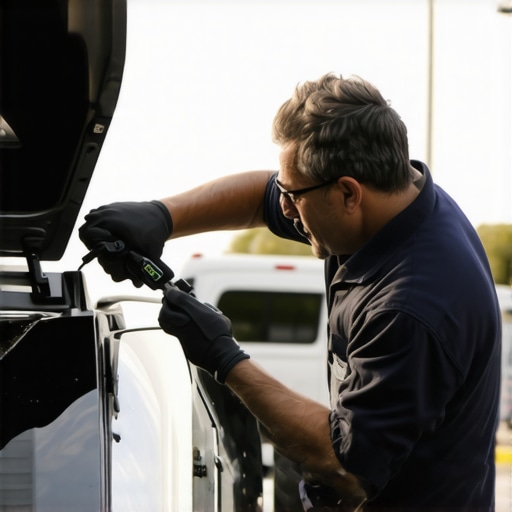
The allure of the mobile service is convenience, but the enemy of glass repair is the environment. If a technician is performing a chip repair in direct sunlight, the UV-curable resin begins to polymerize before it has fully permeated the microscopic fissures of the star-break. This leads to air pockets. In my 25 years, I have seen thousands of these repairs fail because the resin was shimmed into place rather than drawn in via vacuum. When the wiper blade passes over an air pocket, the pressure change can actually cause the pocket to expand, eventually cracking the repair. Furthermore, if the technician does not use a UV shield during the injection process, the resin at the top cures faster than the resin at the bottom, creating internal stress that distorts the light and the water flow. This distortion is exactly what you see when your wipers leave that trail. It is not just water; it is a visual representation of a mechanical mismatch.
The Math of Modern Wipers
Modern wiper blades are engineered with a specific curvature to distribute pressure evenly across the aerodynamic slope of the glass. When you have a repair that hasn’t been properly leveled, it disrupts the laminar flow of water. The blade, which is designed to glide on a thin film of moisture, suddenly experiences dry friction at the repair site. This causes the EPDM rubber to vibrate. This high-frequency vibration, or chatter, is what prevents the blade from cleanly shearing the water from the surface. To fix this, the repair site must be re-leveled and polished. You cannot simply buy better wipers to solve a poor glass repair. It is a substrate issue, not a tool issue. If your glass installer did not use a pit-filling resin specifically designed for high-abrasion environments, the repair will always be the weak link in your visibility chain.