Why your windshield wipers are streaking after a chip fix
The Surface Physics of the Failed Chip Repair
When you look through a windshield, you are not simply peering through a clear plate of silica. You are looking through a complex laminate consisting of two sheets of annealed glass bonded by a 0.76mm interlayer of polyvinyl butyral (PVB). As a glazier with over 25 years of experience in both architectural and specialty glass, I view every ‘hole’ in a structure as a management problem for heat, light, and friction. When a driver calls me complaining that their windshield wipers are streaking specifically over a recent chip fix, I know exactly what happened: the ‘fill-and-fly’ technician failed to respect the surface tension of the glass.
The Condensation Crisis and the Improper Cure
A driver once called me in a panic because their windows were ‘sweating’ and their wipers were skipping across the glass like a stone on a pond. I walked out with my hygrometer and a depth gauge. I showed them that the moisture wasn’t the glass’s fault; the mobile service tech had trapped humidity inside the break before injecting the resin. This happens constantly in cold climates like Chicago or Minneapolis where the dew point is ignored. If you don’t use a dry-out tool to remove every molecule of H2O from the rough opening of that crack, the resin will never achieve a true covalent bond with the silica. The result is a microscopic ‘hump’ or ‘void’ that the wiper blade hits, causing the streak you see every time it rains.
“Installation is just as critical as the window performance itself. A high-performance window installed poorly will fail.” – AAMA Installation Masters Guide
The Anatomy of the Streak: Pit Filler and Shore A Hardness
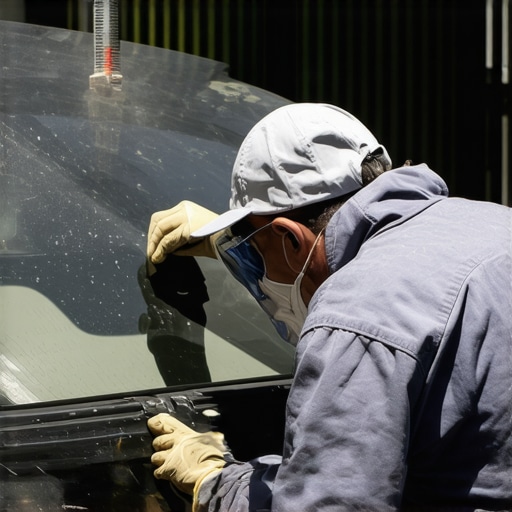
To understand the streak, we have to perform a technical autopsy on the repair site. A standard chip repair involves two types of resins: a low-viscosity injection resin that penetrates the legs of the break, and a high-viscosity ‘pit filler’ that seals the surface. The pit filler is designed to be harder than the surrounding glass once cured, often measured on the Shore D scale. If the glass installer fails to properly ‘block’ the repair site—using a razor blade at a 90-degree angle to level the surface—you are left with a protrusion. [image] Your wiper blade is likely made of EPDM rubber or silicone with a specific Shore A hardness. When that soft rubber hits the hardened, overfilled resin pit at 40 miles per hour, the blade lifts slightly. This lift creates a ‘hydroplaning’ effect for the wiper, leaving a trail of water behind it. This is not a blade failure; it is a finishing failure.
Thermal Logic: Why Cold Climates Ruin Quick Fixes
In northern regions, the U-Factor of your glass is king. While a windshield doesn’t have a traditional sash or muntin, the thermal stress on a repair is immense. When you turn on your defroster in January, the interior temperature of the glass rises rapidly while the exterior remains at sub-zero. This creates a thermal gradient that causes the glass to expand. If the resin used in the chip repair has a different coefficient of thermal expansion than the soda-lime glass, the repair will ‘bloom.’ This blooming creates a rough texture that shreds the microscopic edge of your wiper blades. Weep holes in architectural windows manage water; in a windshield, the ‘management’ is the perfect smoothness of the glass surface. Any deviation from that planarity results in mechanical interference.
“Standard Practice for Installation of Exterior Windows, Doors and Skylights requires precise adherence to sealant and substrate compatibility to ensure long-term performance.” – ASTM E2112
The Mobile Service Myth vs. Environmental Control
Many ‘same-day’ mobile service operators are ‘caulk-and-walk’ installers. They perform repairs in parking lots where they have zero control over the ambient humidity or UV index. To get a perfect, streak-free finish, the glass must be within a specific temperature range—typically 50 to 80 degrees Fahrenheit. If the glass is too hot, the resin ‘flashes’ or cures too quickly, leading to shrinkage. When resin shrinks, it pulls away from the edges of the pit, creating a microscopic ‘gutter’ that traps dirt and wiper fluid. This dirt then acts as an abrasive, further damaging your wiper blades and exacerbating the streaking. A true professional uses a bridge and injector system to vacuum the air out of the break before pressure-injecting the resin, ensuring the refractive index of the repair matches the 1.52 index of the glass perfectly.
The Glazier’s Verdict on Quality
Don’t be fooled by high-pressure sales tactics. A quality chip repair should be virtually invisible and perfectly flush with the glass surface. If you can feel the repair with your fingernail, your wipers will certainly feel it. If you are experiencing streaks, the fix is often a ‘re-pit.’ This involves carefully drilling out the top layer of contaminated or poorly cured resin and reapplying a high-quality pit filler under controlled conditions. Remember, the installer matters more than the resin. Whether you are dealing with a rough opening in a skyscraper or a star-break on your commute, water management and surface physics are the only laws that matter. Stop settling for subpar mobile service and demand a glazier who understands the science of the shim, the seal, and the cure.