Why your diesel’s vibration keeps cracking your windshield
The Harmonic Hammer: Why Diesel Engines Are Glass Killers
If you drive a heavy-duty diesel truck, you are not just operating a vehicle; you are sitting on top of a massive, low-frequency vibration generator. While most car owners worry about a stray rock on the highway, diesel owners have a different enemy: resonance. I have spent over two decades as a master glazier, and I can tell you that a windshield in a diesel rig faces mechanical stresses that would shatter a standard passenger car’s glass in weeks. When that 6.7L engine idles, it sends a specific frequency through the frame, into the pinchweld, and directly into the laminate. If there is even a microscopic defect in your glass, that vibration acts like a hammer, driving the crack deeper with every piston stroke.
The Sales Pitch Takedown: Why Cheap Resin Fails the Diesel Test
I recently sat across from a fleet manager who was getting pitched by a mobile service company promising ‘the cheapest chip repair in the county.’ This salesman was pushing a high-volume, low-viscosity resin that cured in seconds. I had to step in and explain the physics of why his ROI would be nonexistent. A diesel windshield isn’t static. It flexes. Using a brittle, cheap resin on a vibration-heavy platform is like trying to fix a bridge with superglue. Within a week of heavy idling, that ‘repair’ would pop, and the crack would spider across the entire viewable area. You don’t need the fastest cure; you need the most resilient bond that can handle the specific hertz produced by a compression-ignition engine.
“Installation is just as critical as the window performance itself. A high-performance window installed poorly will fail.” – AAMA Installation Masters Guide
The Physics of the Pinchweld and Rough Opening Tolerances
In the world of architectural glazing, we talk about the rough opening and how the frame sits within it. In your truck, the pinchweld is that rough opening. If the glass installer does not prepare this surface with the precision of a surgeon, the glass is doomed. Most ‘caulk-and-walk’ installers ignore the microscopic rust or old urethane left behind. When you drop a new piece of glass into a dirty pinchweld, you create ‘hot spots’ of pressure. For a gasoline engine, you might get away with it. For a diesel, those pressure points are where the vibration concentrates. I always tell my apprentices that the urethane bead is the only thing standing between the glass and the violent oscillations of the chassis. If that bead isn’t uniform, the glass becomes a structural member it was never meant to be, leading to a stress crack that starts right at the edge, under the molding.
Why Same-Day Chip Repair is Non-Negotiable
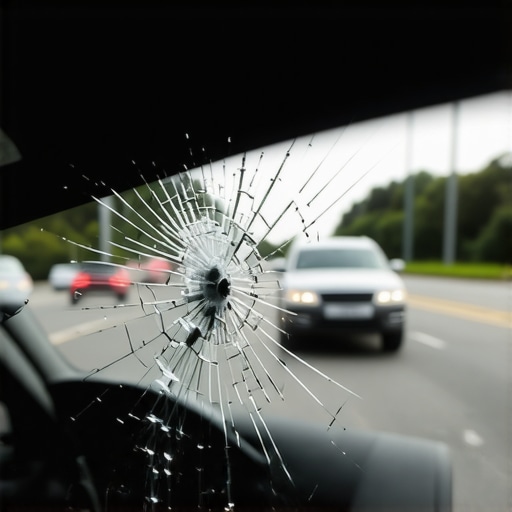
When a rock hits your glass, it creates a break in the outer layer of the laminate. This is a structural compromise. In a diesel vehicle, the time between ‘it’s just a chip’ and ‘I need a full replacement’ is measured in hours, not weeks. The constant thrum of the engine prevents the glass from ever being at rest. This movement allows moisture and dirt to be ‘pumped’ into the crack by the vibration itself. Once contaminants enter that space, the refractive index of the repair is ruined, and the bond strength drops by 50 percent. This is why a mobile service that offers same-day intervention is the only way to save a windshield on a heavy-duty rig. You need to displace the air with a high-tensile resin before the vibration expands the star break into a full-blown fracture.
“Adhesion failure in fenestration systems often stems from improper substrate preparation or the selection of materials that cannot accommodate the thermal and mechanical movements of the assembly.” – ASTM E2112 Standard Practice
The Climate Context: Cold Starts and Thermal Shock
In northern climates like Chicago or Minneapolis, the diesel vibration issue is compounded by thermal shock. You have a freezing cold windshield, and you turn the defroster on high while the engine is shaking the entire cab during a cold start. The U-Factor of the glass matters here. While we don’t use triple-pane glass in trucks, the PVB (polyvinyl butyral) interlayer acts as a thermal break. If that interlayer is compromised by a chip, the temperature differential between the warm air inside and the freezing air outside creates a tension line. Add the 1500 RPM of a warming diesel engine, and you have the perfect recipe for a ‘running crack.’ You aren’t just fighting physics; you are fighting thermodynamics. A master glass installer knows that the depth of the glazing bead and the quality of the primer are your only defenses against this seasonal expansion and contraction.
Beyond the Glass: Shims, Sashes, and Structural Integrity
While we aren’t dealing with a traditional wood sash or a muntin in a truck, the terminology of the master glazier still applies. We look at the glass as an operable part of the vehicle’s safety system. The windshield provides up to 60 percent of the structural integrity in a rollover accident. If your glass is cracked because of engine vibration, your safety cell is compromised. We don’t use a shim to level a windshield, but we do use setting blocks to ensure the glass is centered perfectly. If the glass is shifted even a millimeter too close to the metal frame, the vibration will transmit directly from the steel into the glass edge, bypassing the dampening effect of the urethane. This is the difference between a technician and a glazier. One installs a part; the other manages the interface between two incompatible materials.