
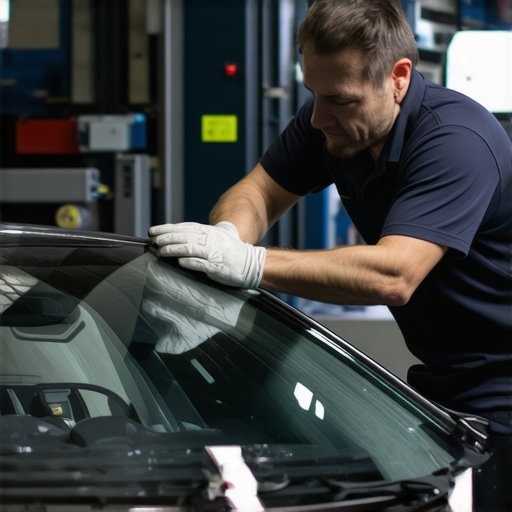
Why Your 2026 Mobile Glass Installer Needs Exactly 45 Minutes
The Precision of the Forty-Five Minute Window
In the world of professional glazing, speed is often confused with skill. As someone who has spent over twenty-five years staring through various grades of soda-lime and borosilicate glass, I can tell you that the obsession with the 15-minute fix is the bane of our industry. When a homeowner or a facility manager calls for a mobile glass installer to handle a chip repair or a small pane stabilization, they are often looking at their watch. But in 2026, the physics of glass science has not changed, even if our tools have. To do the job right, to ensure the structural integrity of the lamination is restored, and to prevent the dreaded ‘run-out,’ a technician needs exactly forty-five minutes. This is not a suggestion: it is a requirement dictated by polymer chemistry and atmospheric pressure.
I remember walking onto a job site in late October. A homeowner called me in a panic because their brand-new high-performance windows were ‘sweating’ only in the corners. I walked in with my hygrometer and showed them the humidity was 60 percent. It was not the windows; it was their lifestyle choices and a lack of proper ventilation. They wanted a quick fix, a bead of caulk to hide the moisture. I had to explain that if I just ‘caulked and walked,’ that moisture would eventually reach the rough opening, sit on the sill pan, and rot the jack studs within three seasons. Professional glazing is about managing the invisible: heat, moisture, and pressure. A mobile chip repair follows the exact same logic. You are not just filling a hole; you are performing micro-surgery on a structural component.
“Installation is just as critical as the window performance itself. A high-performance window installed poorly will fail.” AAMA Installation Masters Guide
The Physics of the Chip: More Than Meets the Eye
When an object strikes glass, it creates a localized area of intense tension. This is not just a cosmetic flaw. In a standard laminated glass assembly, you have two layers of glass bonded by a Polyvinyl Butyral (PVB) interlayer. The impact creates a ‘cone’ of air. To a glass installer, this is a pocket of contamination. If you simply squirt resin into that crack and shine a UV light on it, you are trapping air and moisture. In colder climates like Chicago or Minneapolis, that trapped moisture will hit its dew point, freeze, expand, and turn a 10mm chip into a 24-inch crack the moment you turn on the defroster or the furnace kicks in. This is why the same-day mobile service must prioritize the vacuum cycle. We are fighting the U-Factor of the glass itself. In northern zones, heat loss is the enemy. A compromised pane loses its ability to reflect long-wave infrared radiation, creating a cold spot that attracts condensation like a magnet.
The 45-Minute Breakdown: A Glazier’s Timeline
The first ten minutes of any professional mobile service are dedicated to stabilization and cleaning. We use a probe to remove microscopic shards from the pit of the damage. Without this, the resin cannot bond to the interior surfaces of the crack. We are looking for a clean ‘rough opening’ at a microscopic scale. If there is even a trace of rain repellent or glass cleaner in that pit, the chemical bond will fail within months. This is where many ‘quick-fix’ installers fail. They skip the deep clean because it takes time and specialized solvents that do not interfere with the resin’s refractive index.
Minutes eleven through twenty-five are the most critical. This is the vacuum and pressure cycle. Using a professional bridge and injector, the glass installer creates a vacuum over the break. This pulls the air out of the microscopic fissures. We then switch to pressure, forcing the high-viscosity resin into the voids. This cycle often needs to be repeated three or four times. Why? Because glass is a fluid-like solid. It ‘breathes’ with temperature changes. We have to ensure that the resin has reached the very tip of every radial crack. If you rush this, you leave ‘legs’ in the repair that will eventually spread. We are matching the refractive index of the glass (typically around 1.52) so that light passes through the repair rather than reflecting off the air pockets.
“Proper flashing and sealants are the only defense against structural rot. In glass repair, the resin acts as both the sealant and the structural bridge.” ASTM E2112 Standard Practice
The final fifteen minutes are for curing and polishing. In 2026, we use high-intensity UV lamps that output a specific wavelength, usually around 365nm, to trigger the photo-initiators in the resin. This causes the monomers to cross-link, turning a liquid into a hard, clear plastic that shares the thermal expansion characteristics of the glass. If you cure it too fast, the resin becomes brittle. If you cure it too slow, it stays tacky. The 45-minute mark is the ‘sweet spot’ where the chemical bond is maximized and the pit polish can be applied to create a flush, aerodynamic surface. For those in coastal regions, this surface must be perfectly smooth to prevent salt spray from accumulating and corroding the glass surface over time.
Climate Logic: Why Temperature Dictates the Clock
If you are in a cold climate, the glass must be pre-heated to a specific range (usually 60 to 70 degrees Fahrenheit) to ensure the resin viscosity is low enough to flow into the cracks. In hot climates like Phoenix or Texas, the glass must be shaded and cooled. You cannot perform a quality chip repair on glass that is 140 degrees. The resin will cure instantly upon contact with the injector, leading to a failed repair. A master glazier understands that they are not just working with glass; they are working with the ambient environment. This is why the mobile service requires a van equipped with climate-controlled storage for resins and specialized heating/cooling pads for the glass surface itself.
When you hire a mobile glass installer for same-day service, you are paying for their ability to manage these variables. A chip repair is not just a cosmetic fix; it is a way to maintain the safety glass’s ability to withstand positive and negative wind pressure. Whether it is a small sash in a historic home or a large tempered pane, the principles of adhesion remain the same. Do not trust the installer who promises a ten-minute miracle. They are likely skipping the vacuum cycle or using a low-grade, one-size-fits-all resin that will yellow and shrink under UV exposure. Demand the full 45 minutes. Your glass, and your safety, depend on it.