Why parking in direct sunlight turns tiny chips into total replacements
The Physics of Thermal Stress: Why Sunlight is the Enemy of Damaged Glass
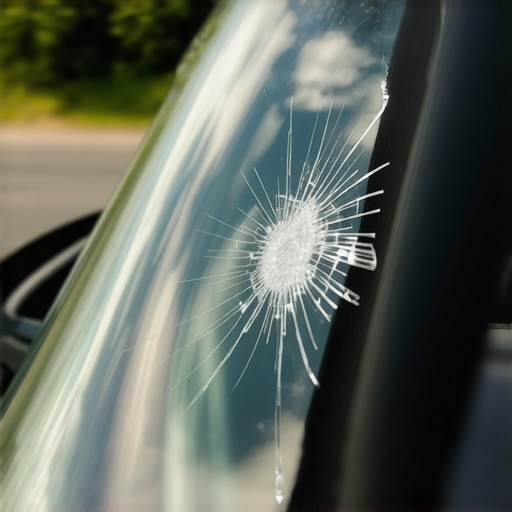
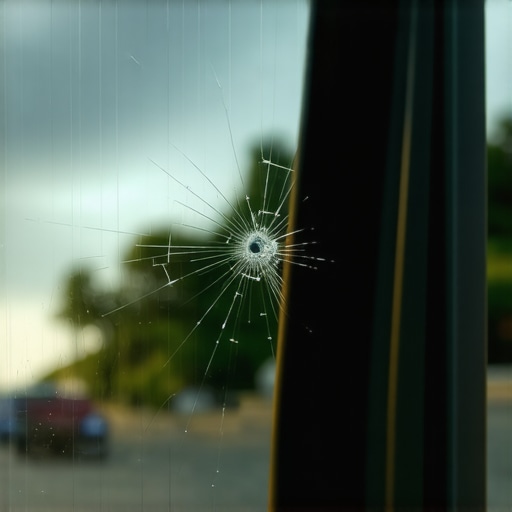
I recall a specific afternoon in late July when a client called me in a state of absolute disbelief. They had parked their SUV in a suburban parking lot for a three-hour lunch, leaving a pinhead-sized chip on the passenger side windshield. By the time they walked back to the vehicle, a jagged crack had migrated nearly twenty inches across the glass. They were convinced someone had vandalized the car. I had to pull out my infrared thermometer and explain that the culprit wasn’t a person, but the 160-degree surface temperature of the glass and the unforgiving laws of thermal expansion. This wasn’t a random failure; it was a textbook case of a neglected stress point reaching its breaking point under solar load. As a master glazier, I see this daily. People treat glass like a solid, inert block, but it is actually a dynamic material that moves, breathes, and reacts to every degree of temperature change.
Understanding the Laminated Sandwich
To understand why a chip repair is a race against the clock, you have to understand what a modern windshield actually is. Unlike the tempered glass used in your side windows, which is designed to shatter into tiny pebbles, the windshield is a laminated unit. It consists of two layers of annealed glass bonded together by a polyvinyl butyral (PVB) interlayer. This construction is designed for safety, but it also creates a complex thermal environment. When sunlight hits the glass, the exterior surface (Surface #1) begins to absorb radiant energy. If you are in a high-UV environment, the solar heat gain coefficient (SHGC) of that glass determines how much heat is passed through to the interior. In the south, we want that number as low as possible to prevent the cabin from becoming a kiln, but the glass itself still takes the brunt of the energy. The glass expands as it heats. However, it does not expand uniformly. The area of the glass covered by the black frit (the ceramic paint around the edges) heats up significantly faster than the clear center. This creates a massive thermal gradient across the Rough Opening of the vehicle frame.
“Glass is a brittle material that does not exhibit plastic deformation. Failure occurs when the tensile stress exceeds the local strength of the glass, often at a pre-existing flaw or surface damage.” – ASTM E1300 Standard Practice for Determining Load Resistance of Glass
The Micro-Mechanics of a Chip
When a rock hits your glass, it doesn’t just leave a mark; it creates a series of micro-fractures that extend into the first layer of the laminate. Think of a chip as a tiny wedge driven into the glass. Under normal conditions, the molecular bonds of the silica hold the crack in check. But when you park in direct sunlight, the heat causes the glass molecules to vibrate and expand. Because the chip has already compromised the structural integrity of the pane, the expansion is not uniform. The heat acts as a lever, prying the crack open. This is why a same-day response from a glass installer is not just about convenience; it is about preservation. A mobile service can often stabilize a chip using a vacuum-injected resin before the sun has a chance to turn that $50 repair into a $500 replacement.
The Thermal Shock Factor
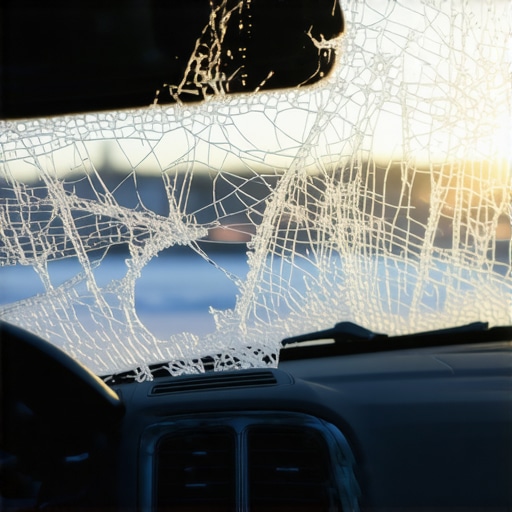
The danger is not just the heat itself, but the delta, the difference between the hot exterior and the cool interior. Imagine your car has been sitting in the sun, and the glass is at 150 degrees. You jump in and blast the air conditioning. The interior surface of the glass (Surface #4 in a dual-pane residential context, but Surface #2 in a single laminate) suddenly starts to contract. This rapid change in temperature creates a shear force within the PVB interlayer. If there is a chip present, the glass lacks the tensile strength to resist this movement. The crack will “run” almost instantly. I have seen cracks move several inches in the time it takes to drive out of a parking garage. This is why I tell my clients that if they have a chip, they should avoid the car wash and avoid the AC blast until they can get a professional to look at it. A chip repair involves cleaning the impact site and filling it with a resin that has a matching refractive index to the glass, but more importantly, it has the structural properties to bind those micro-fractures together.
Why the Installer Matters More than the Glass
In the world of glazing, whether we are talking about a high-rise curtain wall or a truck windshield, the installation is the most common point of failure. I have seen too many “caulk-and-walk” specialists who don’t properly prep the site. If a glass installer does not remove the moisture and air from the chip before injecting the resin, the repair will fail under the first sign of thermal stress. We use specialized pumps to create a vacuum, drawing out the air that would otherwise expand when heated. Then, we cure the resin using specific UV wavelengths to ensure it reaches its maximum hardness. This is precision work. It requires an understanding of how the glass sits in its Rough Opening and how the Glazing Bead or urethane seal maintains the pressure. If the seal is too tight, it adds to the stress; if it is too loose, it allows for vibration that can worsen the damage.
“Installation is just as critical as the window performance itself. A high-performance glazing unit installed poorly or with neglected surface defects will inevitably fail under environmental loading.” – AAMA Installation Masters Guide
Climate Logic: The Southern Burden
If you are living in a climate like Texas, Arizona, or Florida, your glass is under a constant state of attack. In these regions, the Enemy is the Solar Heat Gain. We look for glass with Low-E coatings on Surface #2 to reflect that heat back into the atmosphere. For automotive glass, we rely on the density of the laminate and the quality of the PVB. In these hot zones, a chip is a ticking time bomb. The heat is so intense that the expansion is not a matter of ‘if’ but ‘when.’ I have seen mobile service units busy from dawn until dusk in the summer months specifically because of this thermal reality. The same-day repair isn’t a luxury; it is a necessity for anyone who doesn’t want to lose their Operable view of the road.
The Math of Replacement
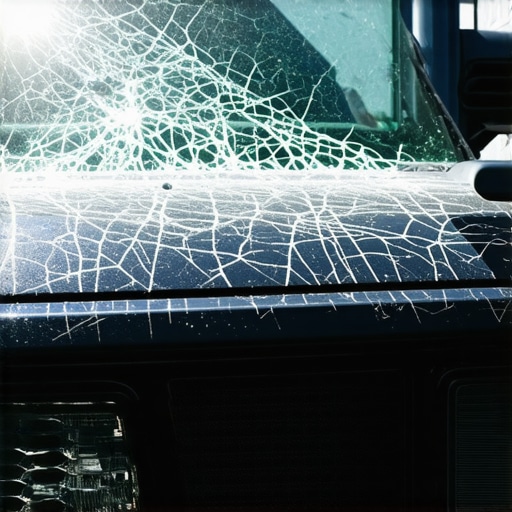
People often ask me about the ROI of a quick repair. It is simple. A chip is a localized structural failure. A replacement is a total system failure. When we replace a windshield, we are breaking the factory seal, removing the trim, and potentially disturbing the Sill Pan or the drainage channels at the base of the glass. While a master glass installer can do this perfectly, it is always better to maintain the original factory bond if possible. The cost of a same-day mobile repair is a fraction of the cost of a full replacement, especially now that many modern vehicles have cameras and sensors mounted to the glass that require recalibration. Don’t let a tiny star-break in the glass become a major financial headache just because you parked in the wrong spot at noon.