The truth about cheap replacement glass and your safety cameras
Beyond the Visible: Why Your Windshield is a Precision Optical Component
For twenty-five years, I have seen the glass industry evolve from simple single-pane float glass to complex, multi-layered structural systems. Most drivers view their windshield as a passive barrier—a transparent shield against bugs and wind. However, in the age of Advanced Driver Assistance Systems (ADAS), that glass has been promoted to a primary optical component. It is no longer just glass; it is a lens. When you opt for a budget glass installer or a cut-rate mobile service, you are not just saving a few dollars; you are potentially compromising the refractive index that your vehicle’s safety cameras rely on for split-second decision-making. Cheap replacement glass often suffers from thickness variations and internal stresses that create a ‘funhouse mirror’ effect. While these distortions might be invisible to the human eye, they are catastrophic for a camera trying to calculate the distance to a braking car at 70 miles per hour.
The Condensation Crisis: A Master Glazier’s Account
I recall a specific instance that perfectly illustrates the danger of prioritizing price over performance. A homeowner called me in a panic because their new luxury SUV’s lane-keeping assist and emergency braking systems were failing every morning. I walked out to the driveway with my hygrometer and a thermal imaging camera. The issue wasn’t a software glitch; it was the physics of the dew point. The previous glass installer had used a budget-tier windshield that lacked the proper solar control coatings. I showed the owner that the humidity inside the camera’s mounting shroud was hitting 75%, causing micro-condensation on the interior surface of the glass. Because the glass failed to manage the thermal transfer between the cold exterior air and the cabin heat, the camera was essentially ‘blinded’ by fog that the defrost vents couldn’t reach. It wasn’t the camera that was broken; it was the glass failing to perform its duty as a thermal regulator. This is the hidden reality of the chip repair and replacement industry: if the glass cannot manage the micro-climate around the sensors, the sensors are useless.
“The optical quality of the glazing is paramount for the correct functioning of Advanced Driver Assistance Systems (ADAS). Even minor distortions or thermal inconsistencies can lead to significant errors in depth perception and object recognition.” – NFRC Optical Performance Manual
The Science of the Refractive Index and Light Transmission
To understand why cheap glass fails, we must look at the ‘Glazing Zooming’ level of detail. Glass is a liquid that has cooled into a solid-like state, and its ability to bend light is measured by its refractive index. High-quality OEM (Original Equipment Manufacturer) glass is produced with a strictly controlled iron content and a specific annealing process to ensure the glass is homogenous. When a budget glass installer uses a secondary-market product, the glass often contains ‘seeds’ (tiny bubbles) or ‘stones’ (unmelted raw material) and variations in the Polyvinyl Butyral (PVB) interlayer. This matters because safety cameras function via parallax. They compare two slightly different views to calculate distance. If the glass has even a 0.5-degree deviation in its flatness—a common occurrence in non-certified glass—the camera’s ‘Rough Opening’ for data collection is warped. The software thinks the car in front of you is 40 feet away when it is actually 35 feet away. In the world of safety, those five feet are the difference between a close call and a collision.
Thermal Management: Why Surface #2 Coatings Matter in Hot Climates
In high-heat environments like the southern United States or Australia, the Solar Heat Gain Coefficient (SHGC) becomes the primary enemy of vehicle electronics. Safety cameras are essentially small computers mounted in a plastic housing directly against the glass. This area is a solar oven. High-performance glass utilizes a Low-E coating on Surface #2—the interior side of the outer pane of glass—to reflect long-wave infrared radiation back into the atmosphere. Cheap replacement glass often omits these coatings to save on manufacturing costs. The result? The temperature inside the camera shroud can exceed 140 degrees Fahrenheit, causing the sensor to throttle its processing speed or shut down entirely. When you call for a same-day mobile service, you must ask if the glass meets the specific IR-rejection requirements of your vehicle’s make and model. If they cannot answer that, they are just a ‘caulk-and-walk’ operation.
“Installation is just as critical as the window performance itself. A high-performance glazing unit installed without regard for its thermal and structural environment will fail to meet its design intent.” – AAMA Installation Masters Guide
The Mechanics of Installation: Shims, Urethane, and the Frit
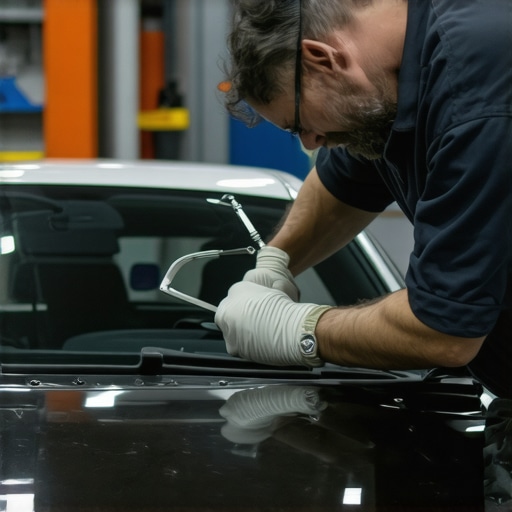
The installation process itself is a delicate balance of mechanical engineering. The ‘Frit’—that black dotted border around your windshield—isn’t just decorative. It provides a rough surface for the urethane adhesive to bond to and protects that bond from UV degradation. A master glass installer knows that the ‘bead’ of urethane must be precise to maintain the glass’s position relative to the camera’s fixed mount. If the glass is set even two millimeters too deep or too shallow, the camera’s focal point is shifted. During a mobile service, environmental factors like wind-blown dust can contaminate the ‘Sill Pan’ area of the dashboard, preventing a proper seal. This leads to air whistles and, eventually, moisture intrusion that destroys the delicate electronics of the ADAS system. Weep holes in the vehicle’s body must be clear, and the flashing—in this case, the weatherstripping—must be perfectly seated to prevent the ‘Shingle Principle’ from being violated, allowing water to track behind the glass and into the camera housing.
Conclusion: The Value of Precision over Speed
The allure of same-day chip repair or a cheap glass installer is understandable, but when you consider that your windshield is a structural member of the car and a primary optical sensor for your safety systems, the math changes. Real ROI isn’t found in the $100 you save today; it is found in the reliability of your emergency braking system when a pedestrian steps into the road. Do not buy the marketing hype; buy the technical specifications. Ensure your glass has the correct U-Factor for your climate, the correct SHGC for your electronics, and the optical clarity that only comes from precision manufacturing. In the world of glazing, you get exactly what you pay for, and your safety cameras deserve better than the cheapest option on the market. Always insist on a calibration check following any glass replacement, as even the best glass requires the camera to be ‘re-taught’ its new view of the world.