The specific temperature that turns a chip into a total loss
The Molecular Fragility of the Edge: Why Glass Fails
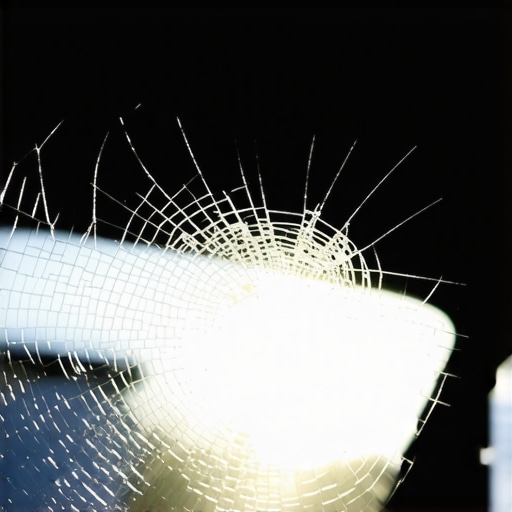
In the world of professional glazing, we do not view a window as a solid, immutable object. We view it as a supercooled liquid that is constantly battling the laws of thermodynamics. When you see a tiny bullseye or a star-shaped chip in your glass, you are looking at a localized structural failure that has already compromised the integrity of the entire pane. As a master glazier with over two decades in the field, I have seen thousands of these minor flaws turn into catastrophic spider-web cracks in a matter of seconds. The question isn’t if the glass will fail, but at what specific thermal threshold the physics of expansion will override the molecular bonds of the silica.
A homeowner called me in a panic because their new windows were ‘sweating’ and one had just cracked with a sound like a pistol shot. I walked in with my hygrometer and a thermal imaging camera. I showed them the humidity was 60%, and the exterior temperature had plummeted to negative ten degrees Fahrenheit. It wasn’t a defect in the glass manufacture; it was a microscopic chip on the edge of the glazing bead that met its breaking point. Their lifestyle—keeping the interior at a balmy seventy-five degrees while a polar vortex hammered the exterior—created a thermal gradient that the compromised glass simply could not bridge.
The Physics of the Snap: Understanding Thermal Gradient
To understand why a chip repair is a race against the clock, we have to talk about the coefficient of linear thermal expansion. Soda-lime glass, the standard for most residential and commercial applications, expands and contracts at a rate of approximately 0.000009 inches per inch per degree Celsius. This sounds negligible until you consider a large architectural pane or a windshield. When one part of the glass is heated (by the sun or an interior heater) and the other remains cold, internal stresses develop. This is known as the Delta T.
“Glazing shall be designed to resist thermal stresses resulting from temperature gradients, especially in high-performance insulated units where absorption rates are elevated.” – ASTM E2112 Standard Practice
In northern climates like Chicago or Minneapolis, the enemy is the heater. If you have a chip and you blast your defroster or turn up the central heat, you are heating the center of the pane while the edges, tucked into the rough opening and surrounded by cold shims, stay freezing. This creates tensile stress at the edges. Since glass is incredibly strong under compression but weak under tension, that tiny chip provides the path of least resistance. At exactly thirty-two degrees Fahrenheit, the moisture trapped inside a chip can freeze, expanding by nine percent and acting as a wedge. However, the real ‘total loss’ threshold usually occurs when the temperature differential between the center and the edge exceeds fifty degrees Fahrenheit.
The North Context: U-Factor and Surface Three
In cold regions, we focus heavily on the U-Factor. This is the measure of heat loss. A lower U-Factor means the window is better at keeping heat inside. To achieve this, we use Low-E coatings on Surface #3—the inward-facing surface of the internal pane of an Insulated Glass Unit (IGU). This coating reflects long-wave infrared radiation back into the room. However, this also means the glass itself gets warmer than traditional clear glass. If that pane has a chip, the increased heat absorption from the Low-E coating actually increases the risk of a crack-out. This is why a professional glass installer will always check the glazing bead and ensure the weep hole is clear to prevent moisture buildup that could lead to edge rot or freeze-thaw damage.
Anatomy of a Chip: Why Same-Day Mobile Service is Mandatory
When a stone hits glass, it creates a percussion cone. If the impact didn’t go all the way through, it’s a candidate for chip repair. But time is your greatest enemy. Contaminants like road salt, car wax, and rain enter the break immediately. Once these impurities are in the chip, a glass installer has a much harder time getting the optically clear resin to bond. This is why mobile service is not just a convenience; it is a technical necessity. By having a technician arrive for same-day service, you are sealing the fracture before the hydroscopic nature of the glass allows moisture to penetrate the PVB interlayer in laminated glass or the spacer system in a residential window.
“Installation is just as critical as the window performance itself. A high-performance window installed poorly will fail under the first sign of thermal stress.” – AAMA Installation Masters Guide
The Glazier’s Process: Beyond the Suction Cup
A true glass professional doesn’t just slap some glue in a hole. We use a vacuum-pressure cycle. First, we pull a vacuum over the chip to remove every microscopic bubble of air. Then, we inject a high-viscosity resin under pressure. We use UV light to cure the resin at a specific wavelength, usually 365nm, which ensures the resin matches the refractive index of the glass. This restores the structural integrity so the pane can once again handle the expansion and contraction of the sash within the rough opening. If you wait until the temperature hits that critical negative ten degrees, the resin won’t flow properly, and the glass will likely migrate from a chip to a long crack that no mobile service can fix, requiring a full, expensive replacement.
Frame Stability: Why Materials Matter
The frame material plays a massive role in how much stress is placed on a chipped window. Vinyl frames have a high rate of expansion, often moving significantly more than the glass itself. If the glass installer didn’t leave proper tolerances in the rough opening or used the wrong type of shim, the frame will squeeze the glass as it expands in the sun. Fiberglass, on the other hand, is much more stable because it is made of glass fibers and resin, meaning it expands at a rate nearly identical to the glass pane. This reduces the mechanical stress on the glazing bead and can actually save a chipped window from cracking out during a sudden temperature shift. Whether you are dealing with an operable sash or a fixed picture window, the sill pan and flashing tape must be installed with the ‘shingle principle’ in mind to ensure that water never sits against the edge of the glass, which is where most thermal failures begin.