The hidden cost of ignoring a cracked back glass
The Deceptive Danger of the Minor Fissure: Why Your Back Glass is Structural
When most drivers spot a small chip or a hairline crack in their rear window, they treat it as an aesthetic nuisance rather than a mechanical failure. As someone who has spent over a quarter century in the glazing industry, from hanging curtain walls on skyscrapers to precision automotive glass installation, I can tell you that this mindset is a dangerous gamble. A window is not just a transparent shield; it is a critical component of a vehicle’s structural envelope. Ignoring a crack in your back glass is effectively ignoring a breach in the integrity of your cabin’s safety cell. We are talking about the management of thermal stress, moisture intrusion, and the complex physics of tempered glass tension.
The Condensation Crisis: A Master Glazier’s Warning
A homeowner recently called me in a panic because their new back glass seemed to be ‘sweating’ on the inside. I walked in with my hygrometer and showed them the humidity in the cabin was hitting 60 percent. It was not a defect in the glass itself; it was their lifestyle combined with a compromised seal. They had ignored a small chip near the ceramic frit for months. That chip had allowed micro-amounts of moisture to seep behind the urethane bead, saturating the interior carpet and creating a permanent tropical environment inside the car. By the time I arrived, the moisture had already begun to corrode the defroster’s electrical connections. What could have been a simple chip repair had evolved into a full-scale cabin restoration. This is the reality of ‘caulk and walk’ logic; if you do not manage the hole in your wall (or car) properly, the environment will manage it for you.
“Installation is just as critical as the window performance itself. A high-performance window installed poorly will fail.” – AAMA Installation Masters Guide
The Physics of the Back Glass: Tempered vs. Laminated
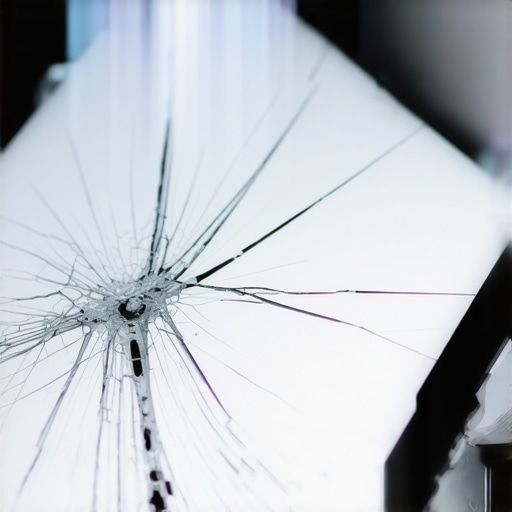
Most rear windows are made of tempered glass, which is created by heating the glass to over 1,100 degrees Fahrenheit and then rapidly cooling it. This process creates a state of high outer compression and internal tension. When a chip occurs, you are not just looking at a surface scratch; you are looking at a localized point of stress that is fighting against thousands of pounds of pressure. In the hot South, where temperatures inside a parked vehicle can reach 170 degrees, the glass undergoes significant thermal expansion. If you have a chip, the Solar Heat Gain (SHGC) is not just a metric on a spec sheet; it is a catalyst for failure. The heat causes the glass to expand, but the compromised area cannot distribute that stress evenly. This is when a tiny pit becomes a spiderweb that shatters into thousands of pebbles. If you are in a high-heat climate like Phoenix or Florida, the Low-E coating typically found on Surface #2 of the glass is working overtime to reflect that infrared radiation. Once that surface is breached, the thermal gradient across the glass becomes unstable.
The Anatomy of the Seal: Beyond the Glass
A professional glass installer knows that the glass is only as good as the pinch weld and the urethane bond. In the industry, we often look at the rear window opening as a Rough Opening. To ensure a water-tight and structural fit, we use high-viscosity urethanes that act as both adhesive and sealant. The black dots you see around the edge of your window? That is the ceramic frit. It provides a rough surface for the urethane to grab onto and protects the adhesive from UV degradation. When you ignore a crack, you allow UV light and water to reach the bond line. This leads to the ‘Shingle Principle’ failure: water should always flow down and out via designated Weep Hole areas or drainage channels. A crack disrupts this flow, allowing water to sit against the metal, leading to rust. By the time you see rust on the exterior, the structural Sill Pan area of your window frame is already gone.
“The integrity of the building envelope depends on the systematic management of water, air, and thermal transfer at every penetration.” – ASTM E2112 Standard Practice
The ROI of Same-Day Mobile Service
Many people delay repair because they believe they do not have time to visit a shop. This is why mobile service is a necessity, not a luxury. A same-day intervention can be the difference between a resin-based chip repair and a total glass replacement. From a technical standpoint, the resin used in modern repairs has a refractive index nearly identical to the glass itself. When injected under vacuum into a fresh chip, it restores the structural tension of the tempered pane. However, if you wait, road grime, car wash wax, and rain fill that void. Once the ‘Rough Opening’ of the crack is contaminated, the repair’s success rate drops from 95 percent to nearly zero. You are then looking at a full tear-out, which involves removing the Glazing Bead and moldings, cleaning the pinch weld, and resetting the glass with fresh primers and adhesives. It is a labor-intensive process that far exceeds the cost of a mobile technician spending thirty minutes on your driveway.
Conclusion: Don’t Buy the Hype, Buy the Science
Whether it is the Sash of a window in a historic home or the back glass of a modern SUV, the principles of glazing remain the same: manage the moisture, account for thermal expansion, and never compromise on the adhesive bond. A small crack is a signal that the tension is out of balance. In a Southern climate, the Solar Heat Gain will eventually win. Do not wait for the glass to fail during a highway drive or a rainstorm. Contact a qualified glass installer who understands Rough Opening tolerances and the chemistry of urethane. Your safety, and your car’s interior, depend on a sealed, stable, and structurally sound piece of glass.