
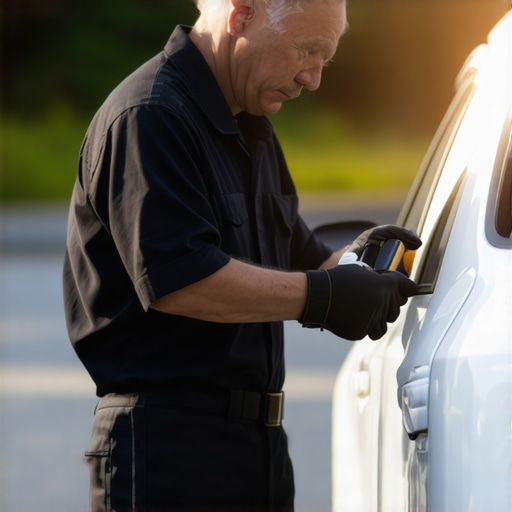
Stop That 2026 Windshield Crack for $50 Using Mobile Service
The Physics of the Rock Strike: Why You Cannot Ignore the Clack
You hear it before you see it. That sharp, sickening clack of a pebble meeting your glass at seventy miles per hour. As a glazier with over two decades of experience, I can tell you that sound is the beginning of a structural failure. A windshield is not just a piece of glass; it is a highly engineered safety component comprising two layers of glass bonded by a polyvinyl butyral (PVB) interlayer. When a rock hits, it creates a microscopic void, a point of concentrated stress where the thermal expansion of the glass will eventually force a full-length crack. In my years of fixing everything from high-rise curtain walls to specialized auto glass, I have seen how a simple fifty-dollar mobile service can save a homeowner or driver from a thousand-dollar replacement. This is not about aesthetics; it is about managing a hole in your vehicle that is under constant pressure from wind, road vibration, and temperature fluctuations.
The Installation Autopsy: A Lesson in Glass Integrity
I once pulled a windshield out of a heavy-duty truck in the middle of a Chicago winter, and the failure was a textbook case of what happens when you ignore the small stuff. I pulled the glass, and the pinchweld, which is the rough opening of the automotive world, was already showing signs of oxidation and early-stage rot. Why? The previous owner had a chip that they tried to fix with a cheap, over-the-counter kit that did not provide a vacuum seal. Moisture had seeped into the crack, reached the PVB layer, and began the process of delamination. By the time I was called, the glass was no longer a structural member of the vehicle. In a rollover, that windshield would have popped out like a loose sash in a rotted window frame. This is why professional mobile service is non-negotiable. A master glass installer knows that the preparation of the site, much like the application of flashing tape in a residential setting, is what determines the longevity of the repair.
“Installation is just as critical as the window performance itself. A high-performance window installed poorly will fail.” AAMA Installation Masters Guide
The Science of the Fifty-Dollar Fix: Vacuum, Pressure, and Resin
When you call a mobile service for a same-day chip repair, you are paying for a sophisticated chemical and physical process. The technician uses a bridge and injector tool that creates a localized vacuum over the strike point. This is critical because air is the enemy. If air remains trapped in the break, the resin cannot bond to the inner surfaces of the glass. Once the vacuum has evacuated the air and any moisture, the technician switches to the pressure cycle. This forces a high-grade acrylic resin into the microscopic fissures. The resin is engineered to have a refractive index nearly identical to the glass itself, which is why the crack seemingly disappears. But more importantly, the resin must have a similar expansion coefficient. If the resin expands faster than the glass when the sun hits it, it will act like a wedge and force the crack to grow. This is why I have no patience for ‘caulk-and-walk’ installers who use low-quality resins that yellow and shrink over time.
Climate Logic: Why Temperature is the Great Decelerator
In cold climates, the enemy is the defroster. Imagine it is ten degrees outside. Your windshield is a frozen sheet of glass. You get in the car and blast the heater. This creates a massive thermal gradient. The inside of the glass wants to expand while the outside remains contracted. If you have an unrepaired chip, that stress will find the weakest point, and ‘zip,’ the crack spreads across the entire width of the glass. In this context, the U-Factor of your glass matters less than the immediate integrity of the laminate. Conversely, in the hot South, the solar heat gain (SHGC) causes the metal frame or the A-pillar to expand, putting lateral pressure on the glass. A mobile service technician must account for these temperatures. If the glass is too hot, the resin will cure too quickly; if it is too cold, the resin will not flow into the points of the star-break. This is why a professional glass installer often uses a heat lamp or a cooling shield to stabilize the rough opening before beginning the injection.
“The repair of laminated automotive glass is a permanent process that can be used to restore the integrity of the windshield.” ASTM E2630 Standard
Beyond the Chip: Understanding the Laminated System
To truly understand why a same-day mobile service is vital, one must look at the glass through the eyes of a glazier. We see the glass as a series of surfaces. Surface #1 is the exterior, Surface #2 is the back of the first pane, Surface #3 is the front of the second pane, and Surface #4 is the interior. A rock chip is a Surface #1 failure. If left untreated, the moisture enters the ‘glazing bead’ area of the repair, leading to foggy glass and eventual structural compromise. While we don’t use a sill pan on a windshield, the urethane bead acts as the primary defense against water intrusion. If a crack reaches the edge of the glass, it breaks the seal of the urethane, potentially leading to leaks that can ruin the vehicle’s interior electronics. Whether it is a fixed sash in a house or a windshield in a car, water management is a science. A fifty-dollar repair is the flashing tape of the automotive world; it is the cheap insurance policy that prevents the rot from ever starting.
The ROI of Mobile Glass Service
Many drivers think they are saving money by waiting. This is a fallacy. The return on investment for a chip repair is immediate. You are spending $50 to save a $500 to $1,500 deductible or out-of-pocket expense for a full replacement, especially on modern vehicles equipped with Advanced Driver Assistance Systems (ADAS). These vehicles require recalibration of the cameras and sensors behind the glass after a replacement, which adds hundreds to the bill. By choosing a same-day mobile service, you maintain the factory seal. No matter how good I am, I can never perfectly replicate the factory-applied urethane bead. Keeping the original glass is always the superior option for the structural integrity of the vehicle. Don’t listen to the high-pressure sales pitches for unnecessary replacements; if the chip is smaller than a half-dollar, fix the glass, save the seal, and keep your money in your pocket.