How to prevent your new windshield from leaking
The Invisible Seal: Why Most Windshield Replacements Fail Behind the Scenes
I have spent over a quarter-century looking at glass not just as a transparent barrier, but as a structural component of a high-performance envelope. Whether it is a triple-glazed curtain wall on a skyscraper or the laminated safety glass of a modern vehicle, the physics remains the same. When a client calls me because they hear a faint whistle at highway speeds or find a damp floor mat after a rainstorm, they are usually victims of a ‘caulk-and-walk’ mentality. A windshield is more than just glass; it is a structural member that contributes to the rigidity of the frame and the deployment path of the passenger-side airbag. If that seal fails, the integrity of the entire system is compromised.
A homeowner called me in a panic because their new windows were ‘sweating’ and water was pooling on the dash of their vehicle parked in the driveway. I walked in with my hygrometer and a thermal imaging camera. It was not a ‘lifestyle’ humidity issue this time; it was a fundamental failure of the glazing bead and the pinchweld prep. Water was bypassing the urethane bond because the installer had failed to address a microscopic patch of surface oxidation on the metal frame. That tiny oversight turned a professional glass installer job into a slow-motion disaster. In the world of high-stakes glazing, there is no room for ‘close enough.’
“Installation is just as critical as the window performance itself. A high-performance window installed poorly will fail.” – AAMA Installation Masters Guide
The Anatomy of a Leak: The Installation Autopsy
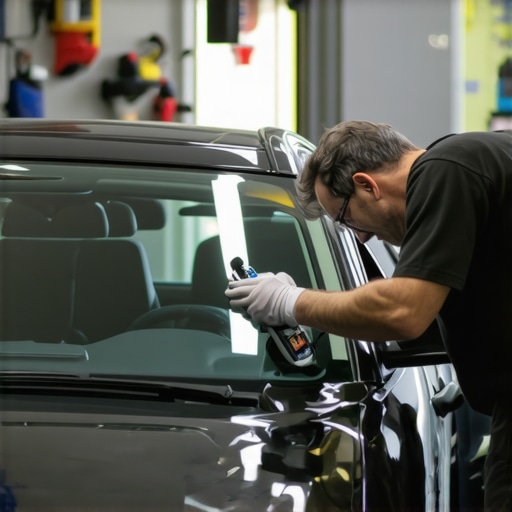
To understand how to prevent a leak, we must perform an autopsy on why they occur. In my 25 years, the number one culprit is the ‘rushed prep.’ When you opt for a same-day mobile service, the environment is your biggest enemy. Unlike a controlled shop environment, a mobile glass installer must contend with wind-blown dust, fluctuating humidity, and temperature extremes that affect the viscosity of the adhesive. If a single grain of pollen lands on the primer before the urethane is applied, you have a cold-joint-in-the-making.
The Pinchweld is the structural ‘Rough Opening’ of your vehicle. If the previous glass installer used a metal scraper and nicked the paint down to the bare steel, a chemical reaction begins. Without a specialized zinc-rich primer, rust will bloom under the new bead of urethane. This is known as ‘rust-jacking.’ The oxidation expands, lifting the adhesive off the metal, creating a microscopic channel for water to enter. By the time you see the leak, the structural integrity of that bond is already gone. This is why a proper chip repair is often preferred over a full replacement if the damage is minor; it preserves the factory seal, which is almost always superior to a field-applied one.
The Science of the Bond: Urethane Chemistry and SDAT
Most people think the black border on their windshield is just for decoration. That is the frit. This ceramic paint is baked into the glass to provide a rough surface for the polyurethane to grip and to protect the adhesive from ultraviolet (UV) degradation. Without that frit, the sun would bake the urethane until it becomes brittle and cracks, leading to an inevitable leak. When we talk about high-performance glazing, we are talking about managing the bond line. A master glass installer ensures that the urethane bead is consistent in height and width, creating a ‘dam’ that redirects water away from the interior.
In hot climates, such as the South or Southwest, we deal with extreme Solar Heat Gain (SHGC). The glass expands at a different rate than the steel frame. If the urethane used does not have high-modulus elasticity, the sheer stress of a hot July day will cause the bond to delaminate. We look for adhesives that can handle the ‘Long-wave infrared’ thermal loading without losing their structural ‘grip’ on the pinchweld. Furthermore, the Safe Drive Away Time (SDAT) is a non-negotiable metric. Chemically, polyurethane requires atmospheric moisture to cure. If you drive the vehicle before the chemical cross-linking is complete, the pressure of the wind can shift the glass by a fraction of a millimeter, creating a ‘pinhole’ leak that won’t show up until the next heavy downpour.
Why Mobile Service Requires Master-Level Precision
There is a myth that mobile service is inherently inferior. It isn’t, provided the technician respects the Sill Pan principle of water management. Even in an automotive context, water must have a path to escape. This is handled by the cowl and the weep holes located at the base of the windshield area. If an installer is sloppy with the urethane and blocks these drainage paths, water backs up into the HVAC intake. Suddenly, you have a ‘leak’ that isn’t coming through the glass bond, but because the glass was installed without regard for the surrounding drainage system.
“The moisture-curing process of high-viscosity adhesives is dependent on environmental variables; failure to account for dew point can result in adhesive failure.” – ASTM E2112 Standard Practice
When I am training a new glass installer, I tell them to treat every windshield like a Sash in a high-rise. You check the Rough Opening for squareness, you Shim the glass to ensure it is centered perfectly, and you never, ever ‘caulk’ over a problem. If the glass is not seated perfectly on the glazing bead of urethane, no amount of secondary sealant will save it. You need a same-day fix that lasts twenty years, not twenty days.
Preventing the Leak: A Checklist for the Sophisticated Owner
If you want to ensure your mobile service results in a leak-free experience, you must look for the technical details. Ask your glass installer about the ‘curing window.’ If they tell you that you can drive immediately in 90% humidity, they are ignoring the physics of moisture-cure urethanes. Ensure they use a dedicated primer on any scratches on the pinchweld to prevent the aforementioned rust-jacking. Finally, avoid high-pressure car washes for at least 48 hours. The mechanical force of the water jets can easily displace a fresh bead of adhesive before it has reached its full Shore A hardness.