How a mobile glass tech handles rain during a windshield swap
The sky turns a bruised shade of charcoal just as the glass installer pulls into your driveway. You have a three inch crack spidering across your laminate, and you need a same-day chip repair or full swap before your commute tomorrow. But then, the first droplets hit the pavement. Most ‘caulk-and-walk’ technicians will tell you it is fine, wipe the metal with a greasy rag, and slap the glass in. As a Master Glazier with over 25 years in the trade, that approach makes my blood boil. I have seen the aftermath of those shortcuts more times than I care to count.
The Anatomy of a Failed Seal: A Cautionary Tale
I remember pulling a windshield out of a late-model sedan in a coastal town after the owner complained of a persistent musty smell. As soon as I pried the molding back, the reality was clear. The previous installer had attempted a mobile service during a light drizzle without proper overhead protection. The header was a disaster zone of oxidized metal and early-stage rot. Why? Because the moisture on the pinchweld prevented the primer from ever biting into the substrate. The urethane bead, which should be a structural component of the vehicle’s safety system, was peeling away like old tape. That technician relied on the weight of the glass rather than a chemical bond. In a collision, that glass would have popped out like a cork, rendering the passenger-side airbag useless. This is why understanding the physics of moisture is not just about a leak-free cabin; it is about life and death.
“Installation is just as critical as the window performance itself. A high-performance window installed poorly will fail.” – AAMA Installation Masters Guide
The Physics of the Bond: Why Water is the Enemy
When we talk about a mobile glass tech handling rain, we are talking about managing surface energy. Auto glass is held in place by high-viscosity polyurethane. This material is often moisture-cured, which sounds like rain would be a good thing. However, there is a massive difference between atmospheric humidity and liquid water sitting on the bond line. Liquid water creates a microscopic barrier between the glass frit and the urethane. If a tech applies a bead over a damp surface, they are essentially ‘floating’ the seal. In the architectural world, we treat every window opening like a high-stakes rough opening. We look for tolerances within an eighth of an inch. In automotive glazing, the tolerances are even tighter because the ‘sash’ (the glass) is a structural member of the frame. If the bond fails because of rain contamination, the structural integrity of the roof is compromised.
The Mobile Service Protocol: How Pros Handle the Pour
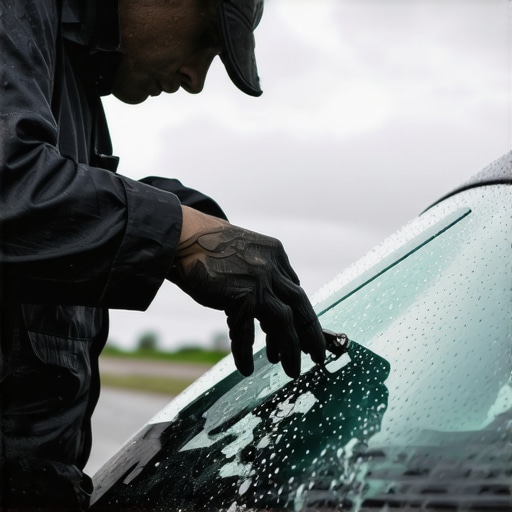
A true expert does not cancel because of a cloud; they adapt. To provide a legitimate same-day service in wet conditions, a mobile glass tech must control the environment. This usually involves a high-grade canopy system or a ‘rain tent’ that encapsulates the front half of the vehicle. We are looking to create a localized micro-climate where the dew point is managed. If the ambient temperature is dropping and the humidity is spiking, condensation will form on the pinchweld faster than you can wipe it away. I always carry a heat gun to ensure the rough opening of the vehicle frame is bone dry and slightly above the ambient temperature to prevent flash-fogging. We then apply a specialized primer that acts as a bridge between the metal and the glazing bead. This is not just ‘glue.’ This is a complex chemical reaction that requires a pristine surface.
Decoding the Standards: Why the Numbers Matter
In my decades of glazing, I have seen standards evolve from simple putty to complex ASTM protocols. Whether you are dealing with a residential window or a mobile windshield swap, the rules of water management are universal. We follow what I call the Shingle Principle: every layer must shed water to the layer below it, eventually exiting the system. In a car, this means ensuring the cowl and the weep hole area are clear of debris before the new glass is set. If those drains are clogged, even the best seal in the world will eventually be undermined by standing water.
“The integrity of the building envelope, or in this case the vehicle cabin, is entirely dependent on the continuity of the air and water barrier at the transition points.” – ASTM E2112 Standard Practice
The ‘Same-Day’ Trap: Don’t Buy the Hype
You see the ads everywhere: ‘Same-day chip repair’ or ‘Windshield replacement in 30 minutes.’ As a specialist, I urge you to look at the Safe Drive Away Time (SDAT). In a rain scenario, the SDAT can double. If the technician uses a standard-grade urethane, you might be looking at six to eight hours before that vehicle is safe to operate. High-end mobile services use ‘Cool Cure’ or advanced chemical primers that allow for a one-hour SDAT even in high humidity. If your tech is not talking about the specific cure time of their adhesive, they are not a professional; they are a tinkerer. A proper glazing bead must be consistent, triangular, and unbroken. Any gap is a failure point for both air and water.
Technical Zooming: The Role of the Frit and the Primer
If you look at the edge of your windshield, you will see a black dotted pattern. That is the frit. It is not just for decoration. That ceramic paint is baked into the glass to provide a rough surface for the urethane to grab onto. It also protects the adhesive from ultraviolet radiation. In a mobile rain-swap, the tech must ensure the frit is chemically cleaned. Any oil from a raindrop or even skin contact will lower the surface tension, leading to a potential adhesive failure. We use a two-step cleaning process: a de-greaser followed by a specialized activator. This ensures that when we set the ‘sash’ into the vehicle, the bond is instantaneous and permanent.
Final Verdict: The Installer is Your Best Warranty
At the end of the day, you can buy the most expensive piece of glass with the lowest U-factor and the best solar coatings, but if the guy in the driveway doesn’t respect the rain, you are wasting your money. Water management is a science, not a suggestion. When you hire a mobile service, ask them about their moisture protocol. Ask them about their canopy. If they pull out a tube of silicone and a roll of blue tape, send them packing. You want a glazier who understands that a windshield is the only thing keeping the roof from crushing you in a rollover. Demand precision, demand a dry environment, and never settle for a ‘caulk-and-walk’ job.