How to remove old adhesive without damaging your car paint
The Forensic Analysis of Adhesive Failure
When you look at a residue-streaked window or a gummy door panel, you are not just looking at a mess. You are looking at a failed chemical bond. As a master glazier with a quarter-century in the field, I have seen every form of ‘caulk-and-walk’ disaster imaginable, from high-rise curtain walls to the delicate glass of a vintage vehicle. Most people treat adhesive removal like a scrub-and-hope project, but it is actually a matter of molecular physics and thermal management. A car’s glass is essentially an operable or fixed sash depending on its location, and the rough opening of the vehicle frame demands the same respect as any architectural structural opening. If you treat the paint like a sacrificial layer, you have already lost the battle. We need to talk about the glazing bead equivalent in automotive trim and why your current approach is likely inviting disaster.
A homeowner called me in a panic because their new windows were ‘sweating’ and the glass installer they hired used a high-tack tape to seal the frames during a storm. I walked in with my hygrometer and showed them the humidity was 60 percent. It wasn’t the windows; it was their lifestyle, but the damage to the finish from the tape was a different story altogether. The adhesive had undergone a process called cross-linking due to the high heat and moisture levels. I spent three hours explaining that you cannot just rip tape off a surface that has reached its dew point without taking the top layer of the finish with it. This is the same crisis car owners face when trying to remove old decals or residue from a chip repair. The sun’s UV radiation acts as a catalyst, turning a temporary bond into a permanent structural nightmare.
“Surface preparation and the removal of previous sealants or adhesives must be performed with mechanical or chemical means that do not compromise the integrity of the substrate.” – ASTM E2112 Standard Practice for Installation of Exterior Windows
The Physics of the Bond: Why Adhesives Stick to Your Paint
To understand removal, you must understand the SHGC (Solar Heat Gain Coefficient) of your glass and how it affects the metal surrounding it. In a hot climate, your car is essentially a thermal oven. When the sun hits the glass, the heat is transferred to the frame. If you have old adhesive on the paint, the polymer chains in that adhesive are constantly expanding and contracting. Over time, the volatile organic compounds (VOCs) evaporate, leaving behind a brittle, resinous matrix that is physically wedged into the microscopic pores of your clear coat. This is why a mobile service professional doesn’t just start scraping. We analyze the surface tension. We look for the weep hole equivalent in the trim to ensure that our solvents aren’t going to pool and eat through the underlying gaskets.
The enemy in a southern or hot climate is Solar Heat Gain. When adhesive is baked on at 140 degrees Fahrenheit, it undergoes a chemical change. If your car has a low SHGC glass, the paint might actually be hotter than the glass itself. This thermal gradient creates a shear force on the adhesive bond. To remove it without damage, you must reverse this process. You are looking for a way to increase the distance between the adhesive molecules and the paint molecules without using mechanical force that exceeds the Shore A hardness of the clear coat. This is where most DIYers fail. They use a metal blade on a surface that requires a plastic shim or a chemical release agent.
The Glazier’s Toolkit: Chemicals Over Clout
When we perform a same-day chip repair or glass replacement, we often find ourselves cleaning up the mess of previous ‘hacks.’ The first rule of the glazier is that like dissolves like. If the adhesive is a petroleum-based product, you need a non-polar solvent. However, you have to be careful with the flashing tape and seals. Using a harsh solvent like acetone on car paint is like using a sledgehammer to drive a finish nail. It will work, but the collateral damage is unacceptable. Instead, we look for citrus-based D-Limonene or high-purity Isopropyl Alcohol (90 percent or higher). These chemicals break the van der Waals forces of the adhesive without softening the catalyzed urethane of your car’s paint.
Step 1: Thermal Modulation. Before applying any chemical, you must stabilize the temperature of the panel. If the metal is too hot, the solvent will evaporate before it can penetrate the adhesive matrix. If it is too cold, the adhesive will be too brittle to release. Aim for a surface temperature of 70 to 80 degrees. This is the ‘sweet spot’ for molecular mobility. Step 2: The Softening Phase. Apply the solvent to a microfiber cloth, not the paint. Lay the cloth over the adhesive and let it dwell. This is not a race. You are waiting for the solvent to migrate through the polymer chains. This is similar to how a sill pan manages water; you are directing the flow of the chemical to exactly where it is needed.
“Installation is just as critical as the window performance itself. A high-performance window installed poorly will fail.” – AAMA Installation Masters Guide
Mechanical Removal and the Plastic Razor Myth
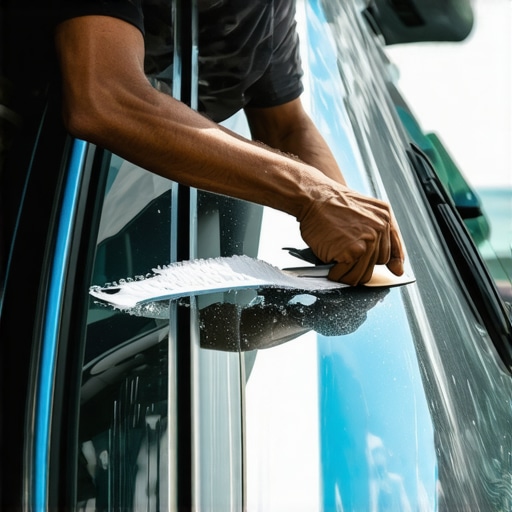
I often see people recommending plastic razors for adhesive removal. While better than steel, a plastic razor can still mar a clear coat if used at the wrong angle. As a glass specialist, I prefer the ‘roll’ method. Once the adhesive is softened, you use the ball of your thumb (protected by a nitrile glove) to apply lateral pressure. This creates a shear force that rolls the adhesive into a cylinder, pulling it out of the paint pores rather than scraping it across the surface. This technique is similar to how we adjust a glazing bead into place. It requires finesse, not force. If you encounter a stubborn spot, do not increase pressure. Increase dwell time with your solvent.
For those in coastal areas, you have the added complication of salt spray. Salt can act as a catalyst for corrosion if it gets trapped under the adhesive residue. This is why a mobile service technician will often wash the area with deionized water before starting the removal process. You don’t want to be grinding salt crystals into your paint while you are trying to remove a sticker. If the adhesive is near the muntin or the edge of the glass, be extremely careful. Capillary action can pull your solvent into the window seal, which can lead to premature seal failure and fogging between the panes of a laminated windshield.
The Aftermath: Polishing and Protection
Once the adhesive is gone, you will likely see a ‘ghost’ of the old residue. This is not adhesive; it is actually a difference in the oxidation level of the paint. The area under the adhesive was protected from UV rays, while the surrounding paint was not. This is a classic case of differential weathering, something we see all the time in operable wood sashes where the flashing tape was applied unevenly. To fix this, you need a light finishing polish. You are not trying to remove paint; you are just leveling the microscopic ridges of the clear coat to ensure that light reflects at a uniform angle. This is the same principle we use when polishing out a scratch during a chip repair. We want the VT (Visible Transmittance) of the surface to be consistent across the entire panel.
Why Professional Help Matters
You might wonder why you should call a professional glass installer for something as simple as adhesive removal. The answer lies in the risk. If you burn through your clear coat, the cost of a respray will be ten times the cost of a professional mobile service visit. A professional has access to industrial-grade release agents that are not available at the local hardware store. We also have the diagnostic tools to ensure that your paint is thick enough to withstand a polish. We treat your vehicle with the same technical precision we use when installing a 500-pound thermal unit in a commercial storefront. We don’t ‘caulk-and-walk.’ We ensure that every sill pan is dry, every shim is level, and every inch of your paint is pristine. When you need it done right, and you need it done same-day, you trust the person who understands the chemistry of the bond, not just the mechanics of the scrape.