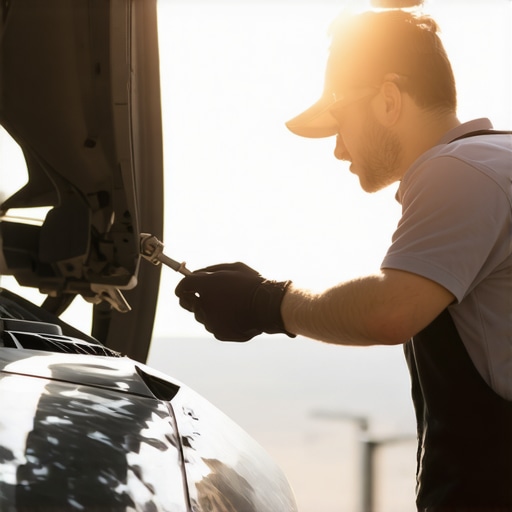
How a mobile tech handles a windshield fix in a parking lot
The Technical Reality of Mobile Glass Restoration
When you see a mobile service vehicle parked in a shopping center with a technician hovering over a late-model sedan, you are witnessing a delicate dance of chemistry and physics. As a glazier with over two decades of experience, I see far more than a simple fix. I see the management of a structural component that must handle wind loads, thermal expansion, and the safety of the occupants. A windshield is not just a piece of glass; it is a laminated safety system comprised of two layers of annealed glass bonded by a Polyvinyl Butyral (PVB) interlayer. When a rock strikes that surface, it creates a fracture that compromises the tension of the entire lite.
The Condensation Crisis: A Narrative of Moisture Management
I recall a specific instance where a driver called me in a total panic. They had just had their windshield ‘serviced’ by a cut-rate mobile service the day before, and now the entire area around the repair looked like a milky white fog. They were convinced the glass was melting. I walked up to the vehicle, pulled out my digital hygrometer, and took a reading of the ambient air versus the micro-climate under the glass. I had to explain that it was not a product failure but a procedural one. The previous installer had ignored the dew point. They trapped moisture inside the fracture before injecting the resin. Because the humidity was over 60 percent and the temperature was dropping, that trapped water vapor condensed inside the repair, creating a permanent cloud. It was a classic example of why environmental control is non-negotiable, even in a parking lot. It wasn’t the glass that failed; it was the installer’s refusal to manage the atmospheric conditions.
“Installation is just as critical as the window performance itself. A high-performance window installed poorly will fail.” – AAMA Installation Masters Guide
The Physics of the ‘Rough Opening’ and the Fracture Pit
In the world of residential glazing, we talk about the Rough Opening as the space where the window sits. In automotive glass repair, the fracture itself is our rough opening. If the impact has created a pit that is too large or too contaminated, the structural integrity cannot be restored without a full replacement. We use a specialized bridge and injector to create a vacuum over this miniature rough opening. This is a critical step because any air left inside the ‘sash’ of the fracture will reflect light differently than the glass, making the repair visible. We aren’t just filling a hole; we are matching the refractive index of the glass. Most windshield glass has a refractive index of approximately 1.52. Our repair resins are engineered to match this exactly so that the light passes through the repair rather than bouncing off it.
Thermal Stress and the Parking Lot Environment
When performing a mobile service, the technician must account for the Solar Heat Gain Coefficient (SHGC). If a car has been sitting in the sun in a southern climate like Texas or Florida, the glass temperature can exceed 150 degrees Fahrenheit. If you apply a cold resin to that hot glass, or if you apply too much pressure with the injector, the thermal stress will cause the crack to ‘run.’ Suddenly, a simple chip repair becomes a full-scale replacement. A professional glass installer knows to shade the glass and bring the temperature down to a stable range before beginning the work. We use a Shim metaphorically here to balance the bridge of the injector, ensuring that the pressure is distributed across the glass surface without creating a localized stress point that would lead to a catastrophic failure of the laminated unit.
The Chemical Bond and UV Curing
The same-day service model relies on the speed of anaerobic and UV-sensitive resins. Once the air is vacuumed out of the fracture and the resin is injected, it must be cured. This is where we move from fluid dynamics to polymer science. We use a specific wavelength of ultraviolet light to trigger the polymerization of the resin. This turns the liquid into a solid that is bonded to the inner walls of the glass fracture. In a residential setting, we might use Glazing Bead to hold a pane in place; in a windshield, the resin acts as both the bead and the glass itself. If the technician does not use the correct UV intensity, the core of the repair will remain soft, leading to a failure of the bond within weeks. We also have to ensure that the Weep Hole—or in this case, the atmospheric vent of our vacuum tool—is clear to allow for a total air-to-resin exchange.
“The NFRC provides energy performance ratings for windows, doors, and skylights to help consumers compare products.” – NFRC Standards Overview
Structural Integrity and the PVB Layer
The primary concern for any glass installer is the safety of the passenger. The windshield provides up to 30 percent of the vehicle’s structural strength in a rollover accident. If a chip is in the ‘acute area’ (the driver’s line of sight) or if it has penetrated the PVB layer, a chip repair is no longer an option. A mobile service tech must be honest about these limits. If the fracture is near the edge of the glass, where the Flashing Tape or urethane seal meets the frame, the stresses are much higher. A repair here is often a temporary fix at best. We look for signs of delamination where the glass is pulling away from the plastic interlayer. If we see that ‘flower’ pattern, the structural bond is gone.
Why Process Trumps Convenience
The same-day convenience of mobile repair is a great benefit to modern drivers, but it must be tempered with technical discipline. Every repair is a battle against the elements. We are fighting dust, which acts like Muntin bars inside our repair, blocking the flow of resin. We are fighting wind, which can cool the glass too quickly. And we are fighting the clock. A master technician treats the parking lot like a clean room. They clean the pit with a carbide scribe to ensure the resin has a mechanical bond. They check the Operable status of the glass—ensuring that the repair doesn’t interfere with the wiper path or any advanced driver assistance systems (ADAS) cameras mounted behind the Sash area of the windshield. In the end, a successful repair is one that you cannot see and one that restores the original strength of the lite. Don’t settle for a ‘caulk-and-walk’ technician who just drops resin into a dirty hole. Demand the science of a true glazier. “