Fixing your cracked screen at the airport parking lot
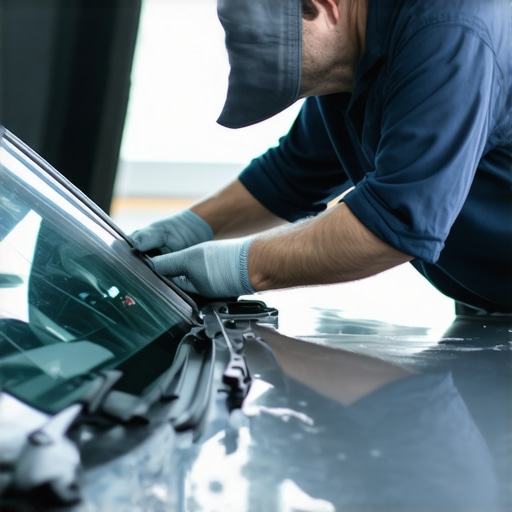
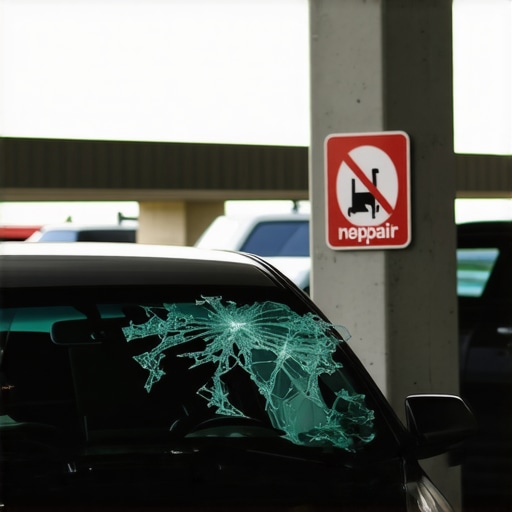
When you return to your vehicle in an airport parking lot and see a radiating starburst on your glass, you are not just looking at a cosmetic defect. You are looking at a structural failure in a laminated system that is currently battling physics. As a glazier with over two decades in the trade, I look at that crack and see the interplay of thermal expansion, the refractive index of light, and the tensile strength of the Polyvinyl Butyral (PVB) interlayer. This is not a job for a ‘caulk-and-walk’ amateur. This is a surgical intervention that requires an understanding of how glass behaves when it is baked on a 140-degree asphalt heat sink.
“Installation is just as critical as the window performance itself. A high-performance window installed poorly will fail.” – AAMA Installation Masters Guide
A homeowner, or in this case, a vehicle owner, called me in a panic because their glass was seemingly ‘growing’ a crack while they watched from the terminal. I arrived with my hygrometer and thermal sensor. I had to show them that the humidity was trapped within the microscopic fissures of the break, and as the sun hit the glass, the moisture expanded. It was not a defective product; it was a failure to manage the environmental variables. This is the reality of glass repair in an airport environment where the vehicle is exposed to extreme UV radiation and fluctuating pressures from departing aircraft.
The Molecular Mechanics of Laminated Glass
To understand why a mobile service is essential for a same-day fix, we have to zoom into the glazing bead and the glass itself. Most modern apertures used in transport or high-performance buildings use a laminated sandwich. This consists of two layers of glass bonded together by a plastic interlayer, usually PVB. When a stone or debris hits the outer layer, it creates a ‘pit.’ This pit is the entry point for air and moisture. The ‘legs’ of the crack are actually separations where the glass has delaminated from the PVB. If you wait to find a glass installer, those legs will travel. This is due to the coefficient of thermal expansion. Glass expands and contracts at a different rate than the frame or the resin used to fix it. In the heat of a South-facing parking lot, the SHGC (Solar Heat Gain Coefficient) becomes your primary enemy. The glass absorbs long-wave infrared radiation, causing the molecules to vibrate and push against the boundaries of the fracture.
Why Surface #2 Matters in Thermal Management
In architectural glazing, we talk about Surface #1 through Surface #4. In a standard lamination, the Low-E coatings or tints are often placed on Surface #2 to reflect heat before it can penetrate the interior. When a chip occurs, it disrupts the continuity of this thermal barrier. A professional chip repair involves more than just filling a hole. It involves vacuuming the air out of the fracture to reach a near-vacuum state—referencing Boyle’s Law—before injecting a high-viscosity resin that matches the refractive index of the glass perfectly. If the refractive index is off by even a fraction, the repair will be visible because the light will bend as it passes through the resin, creating a ‘ghost’ image. We use a bridge and injector to apply precise pressure to the rough opening of the chip, ensuring the resin reaches the very tip of every microscopic leg.
“The integrity of the building envelope depends on the seamless integration of glazing components and their ability to withstand localized pressure differentials.” – ASTM E2112 Standard Practice
The Physics of the Vacuum Injection Process
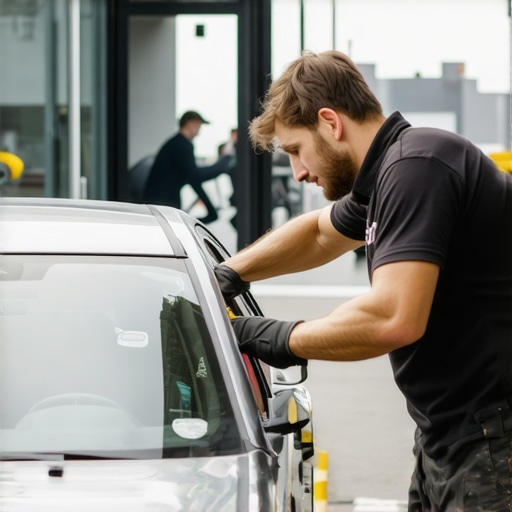
The same-day requirement for chip repair is not just about convenience; it is about contamination. Once road salt, wax, or rain-repellent chemicals enter the crack, the bond strength of the resin drops by 40 percent. As a master glazier, I use a dremel tool to clean the pit, much like a dentist cleans a cavity. We then apply a sill pan approach to the repair site, ensuring that any moisture is diverted away from the bond zone. We look for the ‘weep hole’ of the crack—the point where pressure can be released without further shattering the pane. During the injection, we monitor the temperature of the glass. If the glass is too hot, the resin will become too thin and fail to bridge the gap; if it is too cold, it won’t flow into the extremities of the starburst. This is why a mobile service must be equipped with thermal blankets and cooling fans to stabilize the ‘micro-climate’ of the repair area.
Structural Integrity and the Sash Movement
Whether it is a window in a high-rise or a pane in a vehicle, the glass is an ‘operable’ part of the structure’s safety system. In many designs, the glass provides up to 30 percent of the structural rigidity. A crack is a compromise in that rigidity. When we shim a window into a rough opening, we are accounting for the load-bearing requirements. A chip repair is essentially ‘shimming’ the glass from the inside out. We use UV light at a specific wavelength—typically 365nm—to trigger the polymerization of the resin. This turns the liquid into a solid that mimics the physical properties of the glass. We then scrape the excess resin away with a razor at a 90-degree angle to the glazing bead, ensuring the surface is flush and the aerodynamics (or water-shedding capabilities) are restored.
The Myth of the DIY Kit
I often see ‘Tin Man’ style marketing for DIY glass repair kits. These kits lack the ability to create a true vacuum. Without a vacuum, you are simply trapping air inside the crack. That air will expand when the sun hits it, eventually forcing the crack to spread regardless of the resin ‘plug’ you’ve inserted. A professional glass installer uses a dual-chamber injector that toggles between vacuum and pressure cycles. This ensures that the PVB interlayer is re-wetted by the resin, restoring the optical clarity and the structural bond. Don’t buy the hype of a five-minute fix; a proper repair takes time to stabilize and cure under controlled conditions.