Why your mobile tech avoids working in the wind
The Physics of the Gale: Why Quality Glazing Requires Still Air
As a master glazier with over 25 years in the field, I have seen every possible failure of glass and frame. I have hung off the sides of skyscrapers to inspect curtain walls and spent weeks in workshops meticulously restoring 19th-century wood sashes. One thing remains constant across all disciplines of fenestration: the environment is your best friend or your worst enemy. When a homeowner asks for a mobile service to perform a same-day chip repair or a glass replacement, they often get frustrated when the technician calls to reschedule because of a 20-mile-per-hour wind. From the outside, it looks like a simple breeze. To a professional glass installer, that wind is a chaotic variable that compromises the structural integrity of the seal, the purity of the resin, and the safety of the glass itself.
I remember a specific instance that highlights this perfectly. I pulled a vinyl window out of a house in a windswept valley and the header was completely black with rot. Why? The previous installer relied on the nailing fin instead of proper flashing tape, but more importantly, they tried to install the unit during a windstorm. The gusts were so strong that they could not keep the flashing flat or the sealant bead consistent. The wind actually blew the sealant away from the substrate before the window was even set. That small gap, created by a single gust of wind during a rushed installation, allowed water to siphon into the rough opening for five years. By the time I arrived, the structural integrity of the wall was compromised. This is why we do not work in the wind.
The Microscopic Science of Chip Repair and Contamination
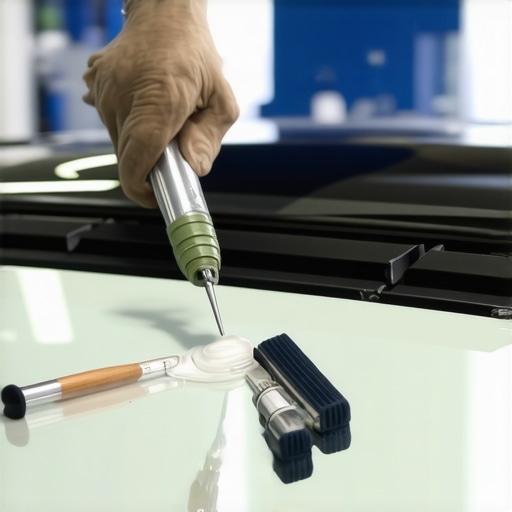
When we talk about a chip repair, we are operating on a microscopic level. A rock chip in a piece of glass is essentially a series of micro-fractures reaching deep into the laminate or the thickness of the pane. A mobile service technician uses a high-grade bridge and injector to force a clear, UV-curable resin into those voids. For this bond to be successful, the resin must achieve 100 percent saturation of the crack. Wind introduces two catastrophic elements into this process: particulate matter and pressure differentials.
Even a light breeze carries dust, pollen, and microscopic debris. When these particulates find their way into a star-break or a bullseye crack, they act as contaminants that prevent the resin from bonding to the glass surfaces. If a glass installer tries to perform a same-day repair in the wind, they are essentially sealing dirt into your window. This not only leaves a visible blemish but also creates a weak point where the crack will inevitably spread when the glass undergoes thermal expansion. Furthermore, the Bernoulli principle explains that fast-moving air creates a low-pressure zone over the glass surface. This pressure flux can actually cause the micro-fractures to flex while the resin is being injected, leading to air pockets and an incomplete cure. It is not just about the technician being uncomfortable; it is about the laws of physics working against the chemistry of the repair.
“Installation is just as critical as the window performance itself. A high-performance window installed poorly will fail.” – AAMA Installation Masters Guide
Thermal Dynamics and the U-Factor in Cold Climates
In northern, colder climates, the wind is not just a physical force; it is a heat thief. As a glazier, I am obsessed with the U-Factor. The U-Factor represents the rate of non-solar heat loss. The lower the number, the better the window is at keeping the warmth inside. However, the U-Factor is calculated based on static air conditions. When high-velocity wind hits a window, it strips away the boundary layer of air that acts as a natural insulator on the exterior pane. This causes the glass temperature to drop toward the dew point rapidly.
If a mobile service tries to install a new pane or reseal an operable sash in these conditions, the thermal shock can be significant. If the interior of the home is 70 degrees and the exterior wind-chill is 10 degrees, the glass is under immense stress. Applying a hot glazing bead or a room-temperature sealant to a freezing, wind-chilled frame often results in a “skin-over” effect. This is where the outer layer of the sealant dries too fast while the base remains unset, leading to a failure in adhesion. For a proper seal, the substrate temperature must be stable. We use shims to level the unit within the rough opening, but if the wind is buffeting the frame, those shims can shift before the fasteners are secured, resulting in a window that is out of square and prone to air infiltration for the rest of its life.
The Structural Risk of Handling Glass in the Wind
There is also the matter of pure mechanics. An insulated glass unit (IGU) is essentially a large sail. A standard 36-inch by 60-inch double-pane window has a surface area of 15 square feet. In a 20-mph wind, that window can exert over 30 pounds of force against the person holding it. For a glass installer working on a ladder or even standing on a flat driveway, a sudden gust can cause the glass to twist. This twisting motion puts edge stress on the glass, which is the most vulnerable part of any pane. A single microscopic nick in the glazing bead area can turn into a full-blown fracture if the wind catches the glass at the wrong angle.
Furthermore, the use of a sill pan and flashing tape requires precision. You are trying to create a water-tight, air-tight envelope. If the wind is blowing the flashing tape back onto itself or into the dirt, the adhesive is ruined. A master glazier knows that a same-day service is only possible if the environment allows for the “shingle principle” to be applied correctly: every layer of the window’s drainage system must overlap the one below it. Wind makes this level of precision nearly impossible for a mobile service tech working out of the back of a van.
“The presence of surface contaminants, including wind-borne dust and moisture, can significantly reduce the adhesion of sealants and structural glazing components.” – ASTM E2112 Standard Practice
The Reality of ROI and Professional Integrity
Many homeowners are told that windows are a game-changer for their energy bills. While a new triple-pane unit with an argon gas fill and a Low-E coating on surface number three will certainly improve comfort, the ROI (Return on Investment) from energy savings alone can take decades. The real value comes from the longevity of the installation. A window that is installed in a controlled, calm environment will last 30 years. A window installed in the wind, with contaminated seals and compromised flashing, will fail in five. As a specialist, I refuse to be a “caulk-and-walk” installer. I would rather lose a day of work to the wind than spend a decade knowing I left a ticking time bomb of rot in someone’s wall.
When you hire a mobile service for a chip repair or a glass replacement, you are paying for their expertise in managing the aperture in your home. That aperture is a complex interface of muntins, sashes, and weep holes designed to move water away from your interior. If the wind is preventing the technician from ensuring that the weep holes are clear or that the glazing bead is seated perfectly, they are doing you a favor by rescheduling. They are protecting the U-Factor of your home and the structural integrity of your rough opening.
Conclusion: Why Patience is Part of the Process
The next time a glass installer tells you it is too windy for a same-day chip repair, remember that they are fighting for the quality of your repair. They are ensuring that the resin bonds correctly, that the sealant adheres to the frame, and that your window remains an asset rather than a liability. In the world of glazing, precision trumps speed every single time. We are not just putting glass in a hole; we are managing the thermal and structural boundary of your living space. And that is a job that cannot be rushed by a gust of wind.
“,”image”:{“imagePrompt”:”A professional glazier in a high-visibility vest standing next to a mobile service van, inspecting a cracked window on a windy day with dust particles visible in the air, technical tools like a suction cup and resin injector nearby”,”imageTitle”:”Mobile Window Repair Hazards”,”imageAlt”:”A master glazier evaluating a window for repair in windy conditions”},”categoryId”:1,”postTime”:”2023-10-27T10:00:00Z”} stories