Why your steering feels off immediately after an auto glass replacement
Why Your Steering Feels Off Immediately After an Auto Glass Replacement
You just picked up your vehicle from the glass shop. The massive crack that was obstructing your view is gone, and the glass is crystal clear. But as you merge onto the highway, something feels fundamentally wrong. The steering wheel feels heavy, perhaps it’s vibrating slightly, or worse – it feels like an invisible hand is tugging the wheel toward the shoulder. You might think you need an alignment near me, but the reality is often found in the technology bonded to your new windshield. In my 20 years as a senior auto glass technician, I have seen this scenario play out hundreds of times. The culprit is almost always a skipped or improper ADAS calibration.
Modern windshields are no longer just a physical barrier against wind and debris. They have evolved into complex structural components that serve as the primary housing for sophisticated sensors. When your steering feels “off” after a glass swap, it’s rarely a mechanical failure of the rack and pinion; it’s a digital disconnect between your car’s eyes and its hands. Understanding windshield replacement steering issues requires looking beyond the glass and into the computer brain of your vehicle.
The “Invisible Hand”: How Your Windshield Controls Your Steering
To understand why your steering feels strange, we have to talk about Advanced Driver Assistance Systems, or ADAS. Most modern vehicles produced after 2016 are equipped with a forward-facing camera mounted directly behind the rearview mirror, pressed against the glass. This camera is the “eye” of your vehicle’s safety suite. It is responsible for identifying lane markings, calculating the distance to the car in front of you, and recognizing traffic signs.
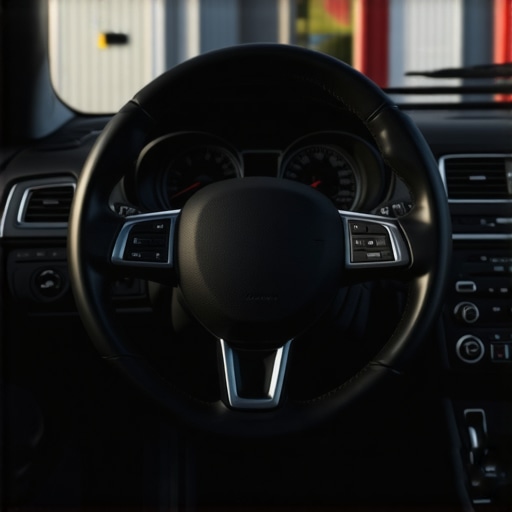
The critical link here is how this camera interacts with your electronic power steering (EPS). Systems like Lane Keep Assist (LKA) and Lane Centering are designed to provide active input to the steering rack. When the camera “sees” that you are drifting toward a line, it sends a digital command to the steering motor to nudge the car back into the center of the lane. If the camera is even slightly misaligned during a windshield replacement, it begins sending incorrect data. According to industry data from USARAG, faulty sensor inputs from an uncalibrated windshield can cause steering wheel vibration and vehicle pull because the car is constantly trying to “correct” a path that isn’t actually crooked.
This is the “invisible hand” sensation. You are trying to drive straight, but your car’s ADAS suite thinks you are veering off-course because its perspective has shifted. It’s a battle between the driver’s physical input and the car’s digital corrections. This is also why your car’s lane departure warning needs glass recalibration immediately after any glass service.
Why New Glass Distorts the “View” of Your ADAS Camera
Many drivers wonder why simply putting a new piece of glass in front of a camera requires a complex ADAS calibration. The answer lies in the physics of light. Every piece of glass has a specific refractive index – the way it bends light as it passes through. Even between two “identical” windshields, there are microscopic variations in glass thickness, curvature, and the clarity of the vinyl interlayer.
If you opt for low-quality aftermarket glass, these variations are magnified. A 1-millimeter offset in the camera bracket or a slight wave in the glass can skew the camera’s field of vision by several feet at a distance of 100 yards. When the camera’s view is distorted, it perceives the lane lines as being in a different position than they actually are. This is why it is vital to know how to tell if your replacement screen is actually high quality. If the glass is “wavy,” your lane departure warning recalibration will likely fail, or worse, the system will operate with a dangerous margin of error.
In my experience, the cheaper the glass, the harder it is to calibrate. OEM (Original Equipment Manufacturer) glass is held to the tightest tolerances, ensuring that the camera “sees” exactly what the engineers intended. When we install a new windshield, we are essentially giving the car a new pair of glasses. If those glasses have the wrong prescription, the car’s “brain” gets confused, leading to that unsettled feeling in the steering wheel.
Symptoms of a Failed or Skipped ADAS Calibration
If you’ve recently had your glass replaced and are wondering if you need to visit an ADAS calibration specialist, look for these specific red flags. These aren’t just annoyances; they are signs that your safety systems are compromised.
- Vehicle Pulling: This is the most common symptom. Unlike a mechanical alignment issue where the car consistently drifts to one side, an ADAS-related pull may feel intermittent. You might feel the car suddenly “jerk” or pull toward a lane line as the camera misinterprets the road markings.
- Steering Wheel Vibration: Many modern cars use haptic feedback (vibration) in the steering wheel to warn you of a lane departure. If your camera is misaligned, you may experience “false positives,” where the wheel vibrates on a perfectly straight, clear road.
- Increased Steering Effort: You might feel like you are “fighting” the car. This happens when the Lane Centering system is actively pushing against your manual steering input because it believes the car is off-center.
- Warning Lights: In many cases, the car’s internal diagnostics will detect a fault and disable the system, illuminating a “Check ADAS” or “Lane Assist Unavailable” light on your dashboard.
If you experience any of these, don’t assume you just need a mechanic near me for a suspension check. The root cause is likely the digital aiming of your forward-facing sensors. It’s a common reason why your local mechanic shop won’t touch a cracked windshield – they know that without the right calibration equipment, the job isn’t truly finished.
Mechanical Alignment vs. Digital Calibration: What’s the Difference?
It is very common for customers to come into an auto repair shop complaining of a steering pull and asking for an alignment near me. While a traditional wheel alignment is necessary if your tires are wearing unevenly or you’ve hit a major pothole, it won’t fix a windshield-related steering issue.
A mechanical alignment involves adjusting the physical angles of your wheels (toe, caster, and camber) so they are parallel to each other and perpendicular to the ground. In contrast, ADAS calibration is a digital and optical “zero-point” reset. We are telling the car’s computer exactly where the camera is positioned relative to the vehicle’s “thrust line” (the direction the rear wheels are pointing).
Think of it this way: Mechanical alignment ensures the “legs” of the car are straight. Digital calibration ensures the “eyes” of the car are looking straight. If the eyes are looking left, the brain will tell the legs to turn right to compensate. No amount of mechanical adjustment will fix a car that is being told to steer incorrectly by its own software. If you’ve had a windshield replaced, you need a specialist mechanic near me who understands the marriage between physical suspension and digital sensors.
Before you spend money on a four-wheel alignment, check your glass. Did you recently have a chip repaired? Understanding the difference between a crack and a pit in your auto glass can help you determine if a full replacement – and subsequent calibration – was even necessary in the first place.
Static vs. Dynamic Calibration: The Technical Process
When you take your vehicle in for ADAS calibration, the technician will perform one of two processes (or sometimes both), depending on the manufacturer’s requirements.
Static Calibration
This takes place inside a specialized auto repair shop. We use highly precise physical targets mounted on stands. The vehicle is positioned in a bay with perfectly level flooring and specific lighting conditions. Using a diagnostic tool plugged into the OBD-II port, we “aim” the camera at these targets. The car’s computer then calculates the offset and saves the new “zero point.”
Dynamic Calibration
This requires the technician to drive the vehicle on the road. The car is put into a “learning mode,” and we must drive at a specific speed (usually between 35 and 60 mph) on a road with clear, visible lane markings. The car uses this real-world data to map its surroundings and align its internal sensors. Some brands, like Honda and Subaru, often require a complex “dual” process involving both static and dynamic steps.
It is important to note that certain vehicle modifications can make this process much harder. For example, suspension modifications like small lifts or leveling kits are often cited in owner’s manuals (Source: Ridgeline Owners Club) as factors that can interfere with ADAS aiming. If your car is lifted and you just got new glass, your technician needs to account for that change in height during the calibration process, or your steering will never feel quite right.
The Safety Risk of Ignoring “Off” Steering
Ignoring a steering wheel that pulls or vibrates after a windshield replacement isn’t just an inconvenience – it’s a significant safety hazard. These systems are designed to save lives by preventing head-on collisions and run-off-road accidents. When the calibration is off, the system doesn’t just “fail” or turn off; it can actively steer the vehicle in the wrong direction (Source: Famous Auto Glass).
Imagine driving in a heavy rainstorm. You are relying on your Automatic Emergency Braking (AEB) and Lane Keep Assist to provide an extra layer of protection. If your camera is “blinded” or misaligned due to improper installation, the car might fail to brake when a pedestrian steps into the road, or it might steer you into oncoming traffic because it misidentified a wet patch on the road as a lane marker. This is why your car’s safety features depend on your glass quality and the precision of the technician who installs it.
Furthermore, if you are on a long road trip, you might notice the specific sound of a windshield seal failing while you are on the highway. A whistling or hissing sound often indicates that the glass isn’t seated perfectly. If the glass is moving or vibrating even slightly due to a poor seal, the ADAS camera will never be able to maintain a stable “view,” leading to erratic steering behavior and constant system errors.
Conclusion: What to Do If Your Car Feels Different
If you’ve just had a windshield replacement and your steering feels “off,” don’t ignore it, and don’t assume you just need to “get used to” the new glass. Steering issues following a glass replacement are rarely mechanical and almost always digital. The sophisticated sensors that keep you safe are incredibly sensitive to the glass they look through.
Your first step should be to return to your auto repair shop or glass provider immediately. Ask them for a copy of the calibration report. A professional shop will use a diagnostic tool that generates a digital certificate proving the ADAS calibration was completed successfully and that all sensors are within OEM tolerances. If the shop tells you that “the car will calibrate itself as you drive,” be wary – many vehicles require a static setup that cannot be bypassed.
In the world of modern automotive repair, the line between a “glass guy” and a “computer tech” has blurred. Your windshield is a high-tech component, and your steering is its primary output. Treat them with the technical respect they deserve to ensure your vehicle remains safe, stable, and true on the road.