Why your car glass is whistling on the highway
You are cruising at sixty-five miles per hour when it starts: a high-pitched, tea-kettle shrill that seems to emanate from the very edges of your vision. To the average driver, it is an annoyance. To a professional glass installer with two decades in the trenches, that whistle is a technical siren. It is the sound of a failed pressure seal, a symptomatic cry of a compromised adhesive bead, or a turbulent wake caused by a poorly seated glazing bead. When you hear that sound, you are not just hearing wind; you are hearing the physics of a pressure differential seeking equilibrium through a microscopic breach in your vehicle’s structural integrity.
The Anatomy of the High-Speed Whistle
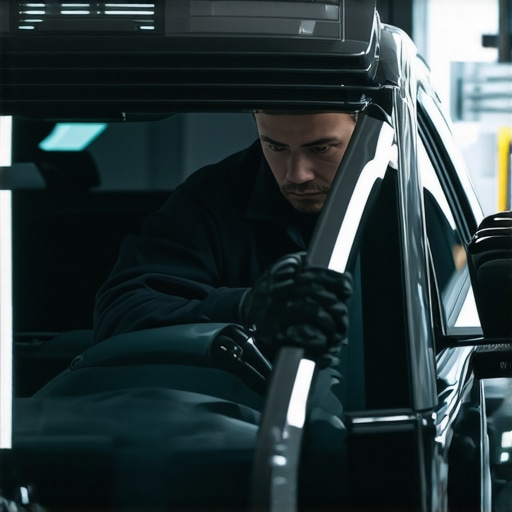
I remember a case in a bitter Chicago winter where a homeowner brought me their sedan, complaining of a whistle so loud it drowned out the radio. I did not even need to drive it. I took a look at the top edge of the windshield and saw the tell-tale sign of a ‘caulk-and-walk’ job. The previous technician had failed to account for the dew point during a mobile service appointment. The moisture on the pinchweld had prevented the urethane from cross-linking with the glass primer. I pressed my thumb against the glass near the roofline and the entire unit shifted. That ‘whistle’ was the sound of a four-pound piece of glass vibrating against the frame because it was essentially unattached.
“Installation is just as critical as the window performance itself. A high-performance window installed poorly will fail.” – AAMA Installation Masters Guide
This principle applies equally to your vehicle as it does to a triple-pane architectural unit. In the world of glazing, we talk about the Rough Opening of a building, but in your car, the pinchweld is your rough opening. If that opening is not prepped with the surgical precision of a master glazier, the result is air infiltration.
The Bernoulli Effect and Your Windshield
Why does it only whistle at high speeds? This is governed by Bernoulli’s principle. As your car moves, the air velocity over the curved surface of the glass increases, which causes a drop in air pressure on the exterior. Meanwhile, the air inside the cabin remains at a higher, static pressure. This creates a pressure vacuum. If there is even a pinhole-sized gap in the urethane bead, the internal air is sucked out at high velocity to fill that vacuum. The ‘whistle’ is actually a Helmholtz resonance. If your glass installer did not use a Shim to perfectly center the glass, or if they left a void in the sealant, you have essentially created a flute out of your windshield.
Chip Repair and Aerodynamic Disruption
Sometimes the whistle is not the seal but the surface itself. A chip repair is often seen as a purely aesthetic fix, but it is actually a structural and aerodynamic necessity. A deep pit in the glass disrupts the laminar flow of air. As the air hits that crater, it transitions from a smooth stream to a turbulent wake. At highway speeds, this turbulence can vibrate the trim or the Glazing Bead, producing a persistent hum or whistle. Using a mobile service for a same-day resin injection is the only way to restore that surface tension before the crack propagates and the wind noise becomes the least of your worries.
“The structural integrity of the vehicle is dependent on the proper bonding of the glass to the pinchweld, which accounts for up to 60 percent of roof crush resistance.” – AGRSS Standard
The Mobile Service Reality Check
Everyone wants same-day convenience, but as a master glazier, I have to be the bearer of bad news regarding the mobile service model in cold climates. If it is ten degrees outside and your glass installer is working in your driveway, the polyurethane adhesive is not going to flow correctly. It becomes too viscous, leading to ‘skinning’ before the glass is even set. In my shop, we treat every car like a high-rise Sash. We control the temperature and the humidity. If you are in a northern climate like Minneapolis or Chicago, the cold is your enemy. Heat loss through the glass is one thing, but the physical shrinking of the rubber gaskets in the winter can open up gaps that did not exist in July. We use warm-edge technology in buildings, and in cars, we rely on high-modulus urethanes that can withstand the extreme thermal expansion and contraction of the metal frame versus the glass.
The Installation Autopsy: Why They Leak
When I perform a tear-out on a whistling window, I am looking for the ‘Shingle Principle’ failure. In building glazing, we use Flashing Tape and a Sill Pan to ensure water and air move down and out. In a car, the Weep Hole in the cowl area serves this purpose. However, if the installer was lazy and did not use a Muntin-style alignment or failed to clean the Operable side-glass tracks, the air will find a way in. Most whistles come from the ‘A-pillar’ where the glass meets the vertical frame. If the urethane bead was not ‘V-notched’ correctly, you get a flat bead that doesn’t reach the glass surface uniformly, leaving a tunnel for the wind.
Don’t Buy the Hype, Buy the Craftsmanship
Don’t be fooled by high-pressure sales tactics. A whistle is a technical failure, not a quirk of the car. Whether it is a chip repair to fix a surface pit or a full replacement to address a failed seal, the expertise of the person holding the caulking gun is what determines the ROI of your comfort. If your windows are ‘sweating’ on the inside or whistling on the outside, the physics are telling you that the barrier has failed. Demand a glazier who knows the difference between a ‘caulk’ job and a technical installation. In the end, water management and air management are sciences, not hobbies.