How to check if your glass installer used oem parts
How to Verify OEM Glass Quality: A Master Glazier’s Guide to Mobile Service
The glass industry is currently flooded with cheap, substandard imitations that look identical to a novice eye but fail under the physical stresses of thermal expansion and structural load. When you hire a glass installer for a same-day chip repair or a mobile service unit, you are not just paying for the glass itself, you are paying for the safety and thermal integrity of your building envelope or vehicle. I have seen far too many ‘caulk-and-walk’ installers swap out a high-performance sash with generic float glass that lacks the necessary coatings. Understanding how to check if your glass installer used OEM parts is the only way to ensure you are not being overcharged for an inferior product that will fail within three years.
The Condensation Crisis: A Reality Check
I recall a specific incident where a homeowner called me in a panic because their brand-new mobile-installed windows were ‘sweating’ only two weeks after the job was finished. I walked in with my hygrometer and showed them the humidity was 60 percent. It wasn’t just the lifestyle, it was the glass. The installer had promised OEM-equivalent glass, but they had actually installed a single-pane unit with a fake spacer. The internal glass temperature was dropping below the dew point, causing massive condensation. It was not the windows failing, it was a failure of the material quality masquerading as a premium part. This is why you must be vigilant about what arrives in the back of that mobile service truck.
“Installation is just as critical as the window performance itself. A high-performance window installed poorly will fail.” – AAMA Installation Masters Guide
The Anatomy of the Glass ‘Bug’ or Monogram
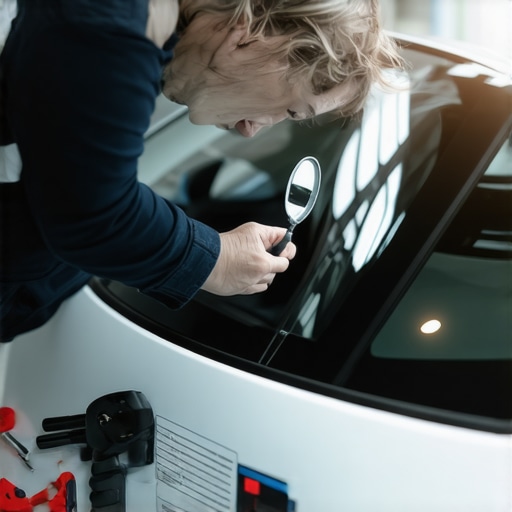
Every piece of OEM glass, whether it is for a residential sash or a specialized vehicle, carries a permanent signature. In the trade, we call this the ‘bug’ or the monogram. This is usually a sandblasted or laser-etched mark found in one of the corners. If you are checking for OEM parts, this is your first line of defense. A legitimate glass installer will point this out to you. Look for the manufacturer name like Pilkington, PPG, or Guardian. Next to the brand, you will see a series of codes. These codes identify the manufacturing plant, the date of production, and the glass type. If your installer claims they are using OEM parts but the glass is completely blank, you are likely looking at a ‘generic’ or ‘aftermarket’ piece that was cut in a local shop. While cut-to-size glass has its place, it is not an OEM part and should not be priced as one. For mobile service and same-day chip repair, ensure the technician isn’t using a generic resin or a generic glass blank that lacks the proper curvature or tempering marks.
Climate Logic: Why SHGC and Surface Coatings Matter
In hot southern climates, the enemy is Solar Heat Gain. If your installer replaces a pane of glass in a south-facing room, that glass must have the Low-E coating on Surface #2. This is the inner face of the outer pane. This coating is designed to reflect long-wave infrared radiation back toward the sun before it ever enters the building. If a mobile glass installer uses a non-OEM part, they often omit these specialized coatings to save on costs. You can test this with a simple Low-E detector or by looking at the reflection of a flame; if the color of the reflected light doesn’t change across the layers, you probably don’t have the coating you paid for. Without the correct SHGC (Solar Heat Gain Coefficient) rating, your cooling bills will skyrocket, and your furniture will begin to fade within months. OEM glass is tested to meet specific NFRC standards that generics often ignore.
“The NFRC label is the only way to reliably compare the energy performance of different window and glass products.” – NFRC Performance Standards
The Technical Autopsy: Examining the Installation
A true master glazier knows that the glass is only one part of the system. To verify if your glass installer is using the right parts, you must look at the peripheral components. When they perform a same-day mobile service, watch the ‘Glazing Bead’ and the ‘Sash’ handling. Are they using the correct ‘Shim’ materials to center the glass within the ‘Rough Opening’? If they are just squirted in some silicone and calling it a day, they are practicing ‘caulk-and-walk’ techniques that lead to premature seal failure. An OEM-quality repair will include proper ‘Flashing Tape’ or a ‘Sill Pan’ if they are doing a full-frame replacement. For chip repair, the resin must match the refractive index of the original glass. If the repair remains highly visible or looks yellow after it cures, they used a cheap, non-OEM resin that will not hold up to UV exposure. Check the ‘Weep Hole’ in the frame as well; if the installer blocked it with sealant, water will back up and rot your subfloor. This attention to detail is what separates a professional glass installer from a temporary fix.
The Math of Quality: ROI vs. Cheap Glass
Many homeowners are lured by the promise of same-day service and low prices, but the math does not favor the cheap option. A non-OEM glass unit often lacks a ‘warm-edge’ spacer. Older spacers were made of aluminum, which is a massive thermal conductor. OEM units typically use a stainless steel or composite spacer that reduces heat transfer at the edge of the glass. If you see a metal spacer in your ‘new’ glass, you’ve been given technology from thirty years ago. In a hot climate, a poor-quality glass replacement can increase the radiant heat in a room by as much as 15 degrees. The ‘Energy Savings’ myth is often used to sell these products, but the real ROI is in comfort and the longevity of the ‘Operable’ parts of the window. A heavy, non-OEM glass pane that is not balanced for the existing ‘Sash’ will wear out the balances and hinges, leading to a window that won’t stay open or close properly.
Final Inspection Checklist for Mobile Service
Before the glass installer leaves your property, perform a final walkthrough. First, check the clarity. OEM glass is manufactured with high-quality silica sand with low iron content. If the glass has a heavy green tint when looking through the face, it is high-iron glass, which is cheaper and less clear. Second, check the edges. In a quality mobile service replacement, the ‘Glazing Bead’ should be snapped back into place without gaps or tool marks. Third, ask for the NFRC label. If they cannot provide the documentation for the glass performance, they did not use an OEM part. Finally, inspect the ‘Muntin’ bars if your windows have them. OEM grids are precisely aligned, whereas cheap replacements often have crooked or rattling internal grids. Do not accept a job that looks ‘mostly right.’ Glass is a precision science, and your installer should treat it as such.