The fastest way to fix a rock chip at your office
The Physics of Structural Compromise: Why That Tiny Chip is a Ticking Clock
When you are sitting at your desk and notice a glint of light reflecting off a small star-break in your glass, you are looking at more than just an aesthetic blemish. You are looking at a localized failure of the structural integrity of the pane. In my twenty-five years as a master glazier, I have seen thousands of these minor impacts evolve into catastrophic failures because the homeowner or property manager did not understand the science of thermal stress. A window is not a static object; it is a dynamic barrier that undergoes constant expansion and contraction. The moment a rock or projectile breaches the surface tension of the glass, it creates a point of concentrated stress that acts as a lever for every temperature change and pressure differential your building faces.
I remember a call in Minneapolis during a particularly brutal February. A property manager had a small bullseye on a storefront pane near the glazing bead. He ignored it for three days. As soon as the building’s HVAC system cycled on and blasted 75-degree air against that 5-degree glass, the thermal gradient—the massive difference in temperature between the inner and outer surfaces—caused a stress fracture that shot across the entire six-foot span. It was no longer a simple repair; it was a full-frame replacement costing thousands. He tried to save fifty bucks on a mobile service and ended up with a boarded-up window in the middle of a blizzard. This is why a same-day response from a professional glass installer is not just a convenience; it is an essential maintenance protocol for any commercial or residential property.
The Science of the Repair: More Than Just Glue
To understand why a professional mobile service is the fastest way to fix a rock chip at your office, we have to look at the chemistry of the repair. We do not just ‘glue’ the glass back together. We perform a microscopic structural restoration. Most architectural glass in modern offices is either tempered or laminated. When we deal with laminated glass, we are working with a sandwich of two layers of soda-lime glass with a Polyvinyl Butyral (PVB) interlayer. A rock chip typically penetrates the outer layer and creates a void between the glass and the PVB.
“Installation is just as critical as the window performance itself. A high-performance window installed poorly will fail.” – AAMA Installation Masters Guide
The repair process involves a specialized bridge assembly that creates a vacuum over the impact site. This is a critical step that many amateur kits skip. You must remove the trapped air and moisture from the ‘legs’ of the crack. If air remains, the resin will not bond to the silica on a molecular level, leaving a visible scar and a weak point. Once the vacuum is established, we inject a low-viscosity, UV-curable anaerobic resin. This resin is engineered to have a refractive index nearly identical to the glass itself (approximately 1.52), which is why the chip seems to disappear. We are literally replacing the missing glass with a liquid polymer that, once cured, restores the tensile strength of the pane.
The North/Cold Climate Context: Thermal Shock and U-Factor
In colder regions like Chicago or Minneapolis, the chip repair process is dictated by the laws of thermodynamics. The U-Factor of your window—the rate at which it conducts non-solar heat flow—is compromised at the site of a chip. In these climates, the ‘Enemy’ is heat loss and the subsequent condensation. If moisture enters a rock chip and the temperature drops below freezing, the water expands by approximately 9% as it turns to ice. This expansion exerts an incredible amount of internal pressure on the ‘rough opening’ of the chip, forcing the cracks to propagate. This is why a mobile service must be deployed immediately. We use warm-edge technology in our resin curing to ensure that the repair site does not become a point of thermal bridging. By sealing the chip, we maintain the integrity of the Low-E coating, which is often found on Surface #3 in cold climates to reflect heat back into your office space.
Blueprint for the Perfect Office Repair: The Mobile Advantage
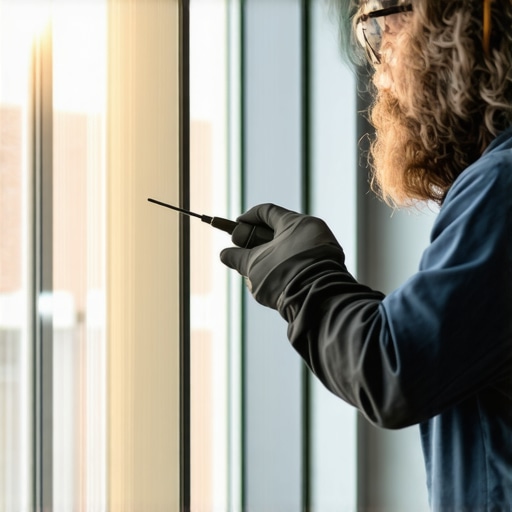
When you hire a mobile glass installer to come to your office, you are getting more than a technician; you are getting a controlled laboratory environment brought to your parking lot. The process begins with an assessment of the sash and the glazing bead to ensure the impact hasn’t shifted the pane within the frame. We then clean the pit of the chip, removing any crushed glass or ‘glass flour’ that could interfere with the resin bond.
“Standard Practice for Installation of Exterior Windows, Doors and Skylights” – ASTM E2112
Following the standards set by ASTM E2112, we ensure that the perimeter of the repair is stabilized. The technician uses a specialized injector to cycle through pressure and vacuum stages. This ensures the resin penetrates the furthest reaches of the micro-fractures. Once the resin has filled the void, a high-intensity UV lamp is placed over the site. This triggers the photo-initiators in the resin, causing it to polymerize in seconds. Finally, a pit filler resin is applied to the surface, cured, and scraped flush with a razor, leaving the operable window as smooth as the day it was manufactured.
Why Same-Day Service is Non-Negotiable
The ‘Tin Man’ salesmen might tell you that you can wait until your next scheduled maintenance, but they aren’t the ones who have to deal with a shattered pane at 5:00 PM on a Friday. The fastest way to fix a rock chip is to treat it like a medical emergency for your building. A mobile service eliminates the logistical nightmare of transporting a large pane or leaving a vehicle at a shop. We come to your office, perform the chip repair in under thirty minutes, and you never even have to leave your desk. This prevents the chip from being contaminated by road oils, car wash waxes, or rain—all of which contain surfactants that can prevent the resin from bonding. If you wait, you are not just risking a crack; you are guaranteeing a more expensive, less effective repair later.
Conclusion: Precision Over Procrastination
Do not be fooled by ‘caulk-and-walk’ installers who claim a dab of superglue will fix the problem. Real glass restoration is a science involving refractive indices, molecular bonding, and thermal management. By choosing a professional same-day mobile service, you are protecting your investment and ensuring that your office remains a safe, energy-efficient environment. Remember, the glass is under tension; don’t let a small rock chip be the reason that tension is released. Check your windows today, look for the ‘bullseyes’ and ‘half-moons,’ and get them filled before the next temperature swing turns a fifty-dollar fix into a two-thousand-dollar headache. Professionalism in glazing means understanding that every ‘rough opening’ and ‘sash’ is part of a larger system that keeps the elements out and the comfort in. Stay vigilant, and keep your glass clear.