How to keep your car cool to prevent stress cracks
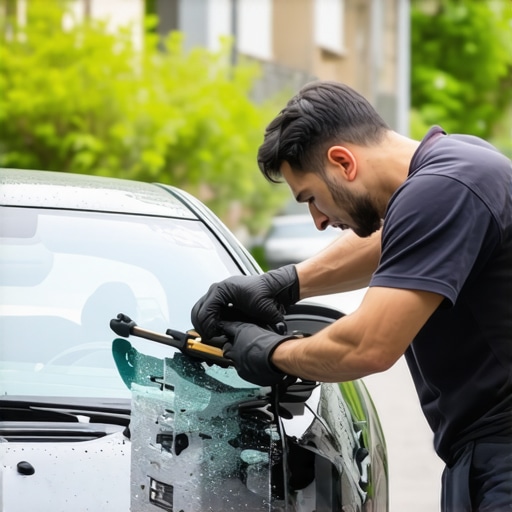
In my twenty five years as a master glazier, I have learned one immutable truth: glass is a liquid that thinks it is a solid, and it is constantly at war with temperature. While most of my career has been spent hanging curtain walls on skyscrapers or restoring nineteenth century wood sashes, the physics of a windshield are no different than a high performance storefront. You have a transparent substrate subjected to extreme thermal loading, held in place by a rigid frame. When you leave your vehicle in the July sun, you are essentially running a laboratory experiment in thermal expansion. If you do not manage the heat, the glass will eventually fail. I recall a specific instance where a client called me in a full blown panic because their windshield had spontaneously cracked while the car was parked in their driveway. I walked out with my infrared thermometer and showed them that while the ambient air was ninety degrees, their black dashboard was radiating one hundred and ninety five degrees directly into the laminate. It was not a ghost or a vandal; it was a physics problem. The glass was experiencing a massive thermal gradient between the shaded edges and the center of the lite, leading to a classic stress fracture. To understand how to prevent this, we have to look at the glass not as a static shield, but as a dynamic thermal barrier. Most people do not realize that automotive glass is a sophisticated glazing system. Your windshield is a sandwich of two sheets of soda-lime glass with a Polyvinyl Butyral (PVB) interlayer. This interlayer is designed for safety, keeping the glass shards together during an impact, but it also reacts to heat differently than the glass itself. When the sun beats down, the glass expands. If that expansion is uneven, or if there is a minor defect in the edge of the glass, the internal tension exceeds the modulus of rupture, and you get a crack. This is why a mobile service for chip repair is so vital. A tiny stone chip is not just a cosmetic blemish; it is a stress concentrator. It creates a weak point where thermal tension can focus and eventually ‘run’ across the entire surface. We see this constantly in regions with high Solar Heat Gain.
“Installation is just as critical as the window performance itself. A high-performance window installed poorly will fail.” – AAMA Installation Masters Guide
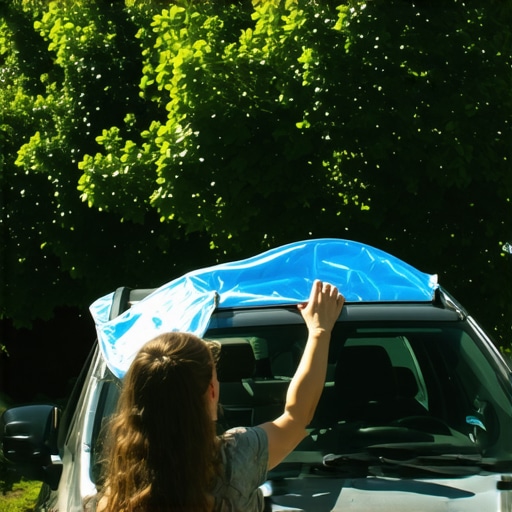
This principle applies to your vehicle just as much as your home. If the glass is not seated correctly in the pinch weld or if the adhesive bed is inconsistent, it creates pressure points. When you add the variable of extreme heat, those pressure points become the origin of a fracture. To keep your car cool and protect your glass, you must address the Solar Heat Gain Coefficient (SHGC). In the glazing world, SHGC is the fraction of incident solar radiation that actually enters the space. In a car, your glass is Surface #1 on the outside and Surface #2 on the inside. When solar energy hits Surface #1, some is reflected, but a significant portion is absorbed and then re-radiated from Surface #2 into the cabin. This is why your steering wheel gets hot enough to cause second degree burns. The most effective way to prevent thermal stress is to block that radiation before it reaches the interior surfaces. A high quality, reflective sunshade is essentially a temporary Low-E coating. It reflects that long-wave infrared radiation back out through the glass before it can be absorbed by the dashboard and seats. Furthermore, you should consider the ‘Rough Opening’ of your car. By leaving the side windows cracked by just a quarter of an inch, you allow for convective cooling. This reduces the delta between the interior and exterior temperatures, which in turn reduces the thermal stress on the windshield. If you do find a chip, you cannot afford to wait. You need a glass installer who offers same-day service.
“The primary purpose of glass in any building or vehicle envelope is to provide a barrier while managing light and energy. Understanding the thermal limits of the glazing material is paramount to longevity.” – NFRC Performance Standards
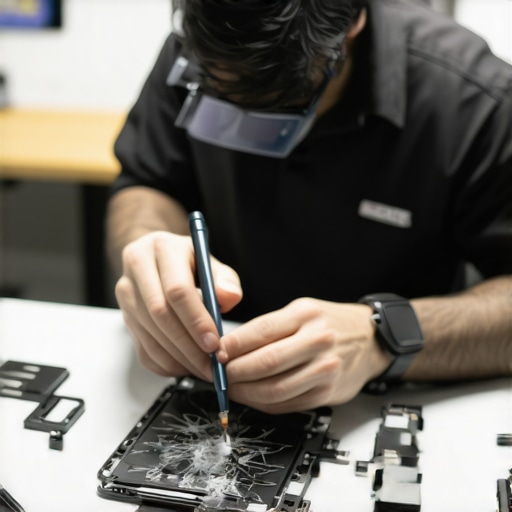
When a professional performs a chip repair, they are injecting a specialized resin that has a similar refractive index and expansion coefficient as the glass. This stabilizes the ‘Glazing Bead’ area and prevents the crack from propagating. A mobile service is especially useful here because driving a car with a compromised windshield through temperature fluctuations can cause the chip to spread before you even reach the shop. I tell my clients to treat their car glass with the same respect they would a custom fiberglass window frame. Fiberglass is used in high end residential windows because it is thermally stable; it expands and contracts at nearly the same rate as the glass. Your car frame, usually steel or aluminum, does not. This differential movement puts constant pressure on the glass. If you add the localized heating of a sun-drenched dashboard, you are asking the glass to perform a feat of structural gymnastics it was never designed for. Always look for a technician who understands the importance of the ‘Sill Pan’ equivalent in a car, which is the cowl and drainage system. If water builds up around the base of the windshield because of clogged weep holes, it can lead to edge corrosion or ‘delamination’ of the PVB, which further weakens the glass against thermal shocks. In summary, managing the heat in your vehicle is a three pronged approach: utilize reflective barriers to lower the SHGC, maintain air circulation to keep the interior temperature below the dew point where condensation and rapid heat spikes occur, and address any structural defects like chips immediately with a same-day repair professional. Do not wait for the glass to tell you it is stressed; by then, it is usually too late for a simple fix.