Why your windshield seal fails after a quick car wash
Why Your Windshield Seal Fails After a Quick Car Wash: A Glazier’s Autopsy
You pull into the bay, the high-pressure sprayers kick on, and suddenly, you see a trickle of water running down the interior of your glass. It is a moment of pure frustration. As a master glazier with a quarter-century of experience, I can tell you that a windshield is not just a piece of glass; it is a structural component of your vehicle, much like a high-performance window in a skyscraper. When that seal fails, it is rarely the fault of the water. It is a failure of the mechanical bond. I once had a homeowner call me in a panic because their new windows were ‘sweating’ and leaking after they hosed down their siding. I walked in with my hygrometer and showed them the humidity was 60 percent. It was not the windows; it was the fact that they had ignored the structural drainage. In the automotive world, the story is similar. I have seen countless vehicles where a quick car wash revealed a disaster caused by a mobile service that rushed the job or a chip repair that was ignored until the structural tension of the laminate finally snapped under the pressure of a 1500 PSI water jet.
The Anatomy of the Seal: Why Urethane is King
In the field of glazing, we talk about the Rough Opening and the Glazing Bead. In your car, the rough opening is the metal pinch weld of the frame. The glass is bonded to this frame using high-viscosity polyurethane. This is not the silicone you buy at a hardware store. We are talking about a material with a tensile strength that must support the roof of the car in a rollover accident.
“Installation is just as critical as the window performance itself. A high-performance window installed poorly will fail.” – AAMA Installation Masters Guide
This standard applies whether you are talking about a triple-pane architectural unit or a laminated windshield. When a glass installer applies the urethane, they must ensure the bond is chemical, not just physical. If the primer is skipped or if the mobile service technician touches the glass with oily fingers, you get a ‘dry bond.’ It looks sealed, but the first time you hit it with the thermal shock of a hot car wash in a North/Cold climate, the seal shears right off the metal.
Thermal Shock and the North/Cold Climate Logic
In regions like Minneapolis or Chicago, the U-Factor of the glass becomes a critical safety metric. During a winter car wash, your windshield might be at 10 degrees Fahrenheit. The car wash water is often heated to 120 degrees. This creates a massive thermal gradient. The glass wants to expand, but the metal frame has a different coefficient of expansion. If the seal is compromised by an unaddressed chip repair, that chip becomes a stress concentrator. The pressure from the car wash nozzles acts like a wedge, forcing water into the microscopic gaps of the laminate. In these cold climates, we focus on heat retention, but we also must account for the Warm-edge spacers equivalent in automotive glass: the bond gap. If that gap is too thin because the technician did not shim the glass correctly or used too little urethane, the glass can actually touch the metal, leading to a stress crack and an immediate seal failure.
The Same-Day Trap: Physics of the Cure
Everyone wants same-day service. However, physics does not care about your schedule. Polyurethane cures by reacting with atmospheric moisture. If a glass installer tells you the car is ready to wash thirty minutes after installation, they are risking your life. A true professional understands the ‘Safe Drive-Away Time.’ When you take a freshly installed windshield into a high-pressure wash, the water pressure can actually deform the bead of urethane before it has achieved its shore hardness. This creates Weep Hole issues where there should be none. In a house, we want water to escape; in a car, if water finds its way behind the urethane, it sits on the pinch weld and starts the slow process of corrosion.
“The primary defense against water penetration is the integrity of the sealant joint. Any discontinuity in the bead is a potential point of failure.” – ASTM E2112 Standard Practice
The Role of the Sill Pan and Water Management
In architectural glazing, we use a Sill Pan to catch water that gets past the first line of defense. In your car, the cowl area acts as this drainage system. If your car wash is flooding your interior, it might not be the glass seal itself, but a clogged Weep Hole in the cowl. However, most often, it is a failure of the Flashing Tape equivalent: the butyl or urethane barrier. If the Sash (the moving parts of the glass system) is not aligned, the pressure of the car wash brushes can shift the glass just enough to break a weak bond. This is why choosing a qualified mobile service is vital. They need to ensure the environment is controlled, the temperature is within the chemical operating range of the adhesive, and the surface is free of contaminants that could inhibit the cross-linking of the polymer chains.
Why Chip Repair is Not Optional
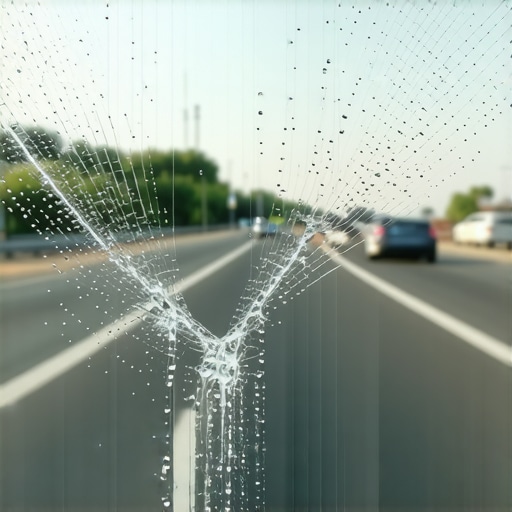
A small stone chip is essentially a fracture in the top layer of the laminated glass. Under the heat and pressure of a car wash, the air trapped inside that chip expands. If a glass installer has not performed a vacuum-pressure resin injection, that chip will spread. It is the same principle we see in Double-pane windows where a seal failure leads to permanent fogging. In a windshield, that failure leads to a spiderweb crack that ruins the structural integrity of the Glazing Bead area. Don’t wait for the leak to tell you that your seal is gone. Address the chips early to maintain the factory seal, which is almost always superior to a field-installed replacement.