Why your windshield camera needs recalibration after a swap
I have spent over a quarter of a century looking at the world through glass. From massive curtain walls in downtown skyscrapers to the delicate historic wood sash of a Victorian restoration, I have learned one fundamental truth: a window is never just a piece of glass. It is a precision engineered component of a larger system. When we talk about modern automotive glass, that system is no longer just about keeping the wind out of your face; it is about the Advanced Driver Assistance Systems (ADAS) that keep you alive. If you think a glass installer can simply slap a new windshield into your vehicle and call it a day, you are living in 1995. Today, your windshield is a primary optical lens for your car’s computer brain.
The Moisture Crisis: A Cautionary Tale
A homeowner recently called me in a panic, but not about their house. They knew my reputation for precision and asked why their brand new SUV was suddenly braking for no reason on the highway. I walked out to their driveway with my hygrometer and a digital level. I found that the mobile service installer they hired had performed a same-day swap during a humid, 90 percent saturation morning. The previous installer relied on a standard urethane bead without accounting for the dew point or the thermal expansion of the camera bracket. I showed them that the humidity had caused a microscopic layer of condensation to be trapped within the camera’s aperture during the seal. It wasn’t the glass that was failing; it was the installer’s ignorance of the environmental variables. The camera was ‘sweating’ internally because the seal was compromised during the cure, leading to a refractive error that the car’s computer interpreted as an obstacle. This is what happens when you treat a high-tech optical swap like a simple chip repair.
“Installation is just as critical as the window performance itself. A high-performance window installed poorly will fail.” – AAMA Installation Masters Guide
The Physics of the Frit and the Focal Point
To understand why recalibration is mandatory, we have to look at the ‘Glass Class’ of physics. Every windshield has a ‘Frit’—that black ceramic border that protects the urethane from UV degradation. In a modern ADAS-equipped vehicle, that frit includes a specific opening for the camera. When a glass installer replaces the windshield, the new glass, even if it is OEM (Original Equipment Manufacturer), will have slight variations in the refractive index. Laminated glass consists of two layers of glass with a PVB (Polyvinyl Butyral) interlayer. If the thickness of that interlayer or the curvature of the glass varies by even a fraction of a millimeter, it alters the way light hits the camera sensor. This is known as Snell’s Law in action. The camera is programmed to expect light to travel through a specific medium at a specific angle. When the glass changes, the ‘Rough Opening’ of the camera’s vision shifts. A one-degree deviation at the windshield can translate to a twenty-foot error on the road ahead. This is why recalibration is not a suggestion; it is a mathematical necessity.
Static vs. Dynamic Recalibration: The Glazier’s Perspective
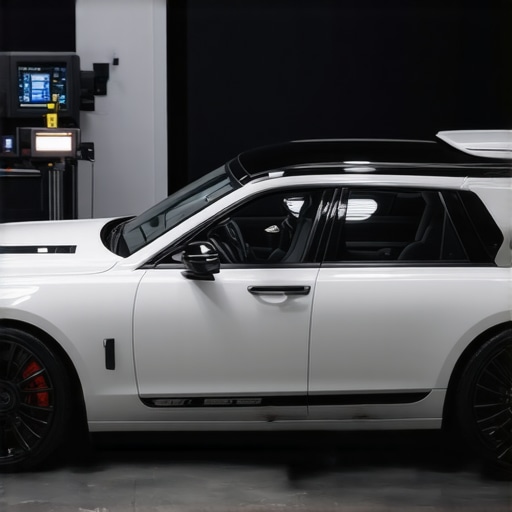
In the trade, we don’t just ‘fit’ things; we align them. Recalibration comes in two forms. Static recalibration occurs in a controlled shop environment using specialized targets. We set up the vehicle at a precise distance from these targets, ensuring the floor is perfectly level—within a tolerance that would make a standard ‘caulk-and-walk’ installer quit. We then use diagnostic tools to tell the car’s computer to ‘re-learn’ its focal point through the new glass. Dynamic recalibration, on the other hand, requires driving the vehicle at a set speed on well-marked roads. The car’s sensors use the lines on the road to orient themselves. In hot climates like Texas or Phoenix, the Solar Heat Gain Coefficient (SHGC) becomes a factor. High heat can cause the metal camera bracket to expand. If the installer did not use a high-modulus urethane, the camera might shift during the first few hours of the curing process. This is why a mobile service must be performed with extreme care regarding the ‘Minimum Drive-Away Time’ (MDAT). If you drive too soon, the vibrations of the road will shift the glass in the pinchweld, throwing the camera’s pitch, roll, and yaw out of alignment before the glue has even set.
“Standard Practice for Installation of Exterior Windows emphasizes that the perimeter seal must be maintained to prevent air and water infiltration, which in the automotive world, translates to protecting the sensitive electronics of the ADAS bracket.” – ASTM E2112
The Trap of the Same-Day Mobile Service
We all love the convenience of a mobile service, but we have to be realistic about the chemistry. Urethane is a moisture-cure product. If you are in a cold, northern climate like Chicago, the cure time is significantly longer. If an installer performs a swap and then attempts a dynamic recalibration while the glass is still ‘floating’ on a wet bead, the calibration will be junk by the time the customer gets home. A true professional understands that the windshield acts as a structural member of the car. In the event of a rollover, that glass provides up to 60 percent of the roof’s structural integrity. If the camera isn’t calibrated, your lane-keep assist or emergency braking might fail, but if the glass isn’t bonded correctly because the installer rushed the job, the structural safety is also gone. When you are looking for a glass installer, you aren’t just looking for someone to fix a crack. You are looking for a technician who understands the intersection of structural glazing and optical physics. Don’t be fooled by the low-cost ‘Tin Man’ tactics. If they don’t mention the words ‘Pinchweld,’ ‘Urethane Bond,’ or ‘ADAS,’ keep your keys in your pocket.
Final Technical Audit
When you undergo a windshield replacement, you are essentially resetting the optical baseline of your vehicle’s safety system. The chip repair you got last year was a simple structural fix to prevent a crack from spreading across the sash of your car. A full swap is a different beast entirely. You must ensure that the installer uses a recalibration tool that plugs into the OBD-II port to verify the camera’s alignment. They should provide you with a certificate of calibration showing that the camera’s Field of View (FOV) is within the manufacturer’s specifications. In the world of glazing, precision is the only thing that separates a master from a hack. Whether it is managing the dew point during a house window install or recalibrating a CMOS sensor after a windshield swap, the principle remains the same: the glass is only as good as the technician who sets it.