Why your car’s windshield is not clear
The Illusion of Transparency: Why Your View is Compromised
When a driver tells me their glass is blurry, they expect me to hand them a bottle of surfactant and a microfiber cloth. They do not expect a lecture on the molecular degradation of polyvinyl butyral or the refractive index of glass repair resins. But after 25 years in the glazing trade, I know that clear is a technical state, not a cleaning goal. A homeowner once called me in a panic because their new windows were sweating. I walked in with my hygrometer and showed them the humidity was 60%. It was not the windows; it was their lifestyle. The same principle applies to your vehicle. That haze is not always on the surface; often, it is the result of a system failure between the plies of glass. To understand why your windshield is not clear, we have to look past the surface and into the structural and chemical composition of the glazing unit itself.
“Installation is just as critical as the window performance itself. A high-performance window installed poorly will fail.” – AAMA Installation Masters Guide
The Pitting Phenomenon: The Sandblasted Surface
One of the primary reasons for reduced clarity is a process we call micro-pitting. Think of your glass as a vertical sash in a high-wind environment. As you drive, your windshield is bombarded by microscopic debris, sand, and industrial fallout. Over 50,000 miles, these impacts create thousands of tiny conchoidal fractures. These are too small to be seen individually, but collectively they scatter light. This is why you see a blinding glare when driving into the sun. The light is no longer passing through the glass in a straight line; it is being refracted in a thousand different directions by the damaged surface. A professional glass installer knows that once the surface reaches this level of degradation, no amount of cleaning will restore the optical path. This is a matter of the glass integrity being compromised by mechanical wear.
The Lamination Autopsy: PVB Delamination and Haze
Modern windshields are not a single piece of glass. They are a composite of two layers of float glass bonded by a Polyvinyl Butyral (PVB) interlayer. This interlayer is what makes the glass safety glass. However, PVB is hygroscopic, meaning it can absorb moisture if the edges are not properly sealed. If the urethane bead, which acts as the glazing bead and sealant, fails to provide a hermetic seal against the pinch weld (the vehicle’s rough opening), moisture can migrate into the interlayer. This causes a milky appearance at the edges, known as delamination. Furthermore, the plasticizers in your vehicle’s dashboard off-gas under UV radiation. These chemicals condense on the interior surface, creating a stubborn, oily film that resists standard cleaners. This is the interior version of the condensation crisis, where the environment inside the cabin dictates the clarity of the glass.
The Physics of Chip Repair and Light Transmission
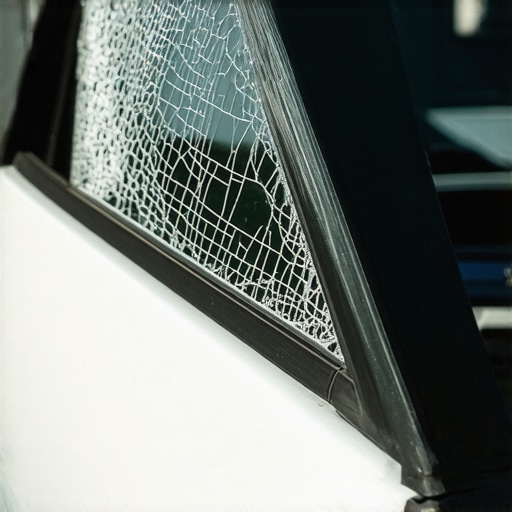
When a stone hits your glass, it creates an air-filled void. Because air has a different refractive index than glass, the light bends, making the crack visible. A mobile service specializing in chip repair does not just fill the hole with glue. We inject a specialized resin with a refractive index that mirrors the glass itself. By evacuating the air with a vacuum tool and replacing it with resin, we restore the optical continuity. This is a technical process that requires precise temperature control. If the glass is too hot, the resin’s viscosity drops, and it will not cure with the necessary density. If the installer does not account for the thermal expansion of the rough opening, the repair will fail as soon as the heater is turned on in January. Same-day service is often requested, but a master glazier knows the glass must be stabilized to ambient temperature before the injection begins.
“Safety glazing materials shall be of such quality as to minimize the possibility of injury.” – ANSI Z26.1 Standard for Safety Glazing
The Role of Water Management: From Sill Pans to Cowl Drains
In architectural glazing, we rely on a sill pan and weep holes to manage water. In a vehicle, the cowl area serves this function. If the cowl drains are clogged with organic debris, water backs up against the base of the windshield. This constant hydrostatic pressure can find its way under the flashing tape and primer of the installation, leading to rust on the pinch weld. Once rust starts, it expands, lifting the glass and creating stress points that can cause a crack to form spontaneously. A professional glass installer looks for these signs of water mismanagement during a replacement. We ensure the urethane is applied in a continuous, high-aspect-ratio bead to maintain the structural integrity of the roof line. Unlike an operable window that can be adjusted, the windshield is a fixed structural member that must be shimmed perfectly to avoid stress concentrations.
Refractive Errors and Optical Distortion
Not all glass is created equal. Cheap aftermarket glass often suffers from varying thickness across the sheet, leading to optical distortion. When you look through the glass at an angle, the world appears wavy. This is a failure of the float glass process. When we install a high-quality unit, we are looking for a Visible Transmittance (VT) rating that meets OEM standards. The glass must be free of seeds (bubbles) and stones (solid inclusions). A mobile service technician must be able to identify these defects before the glass is set into the urethane. Because once that glass is bonded, the cost of correction increases exponentially. Clarity is the result of proper material science, expert installation, and consistent maintenance of the glass surfaces.