Why your car’s VIN plate must be perfectly visible through new glass
The Invisible Barrier: Why Precision Matters in Automotive Glazing
When you sit behind the wheel, you likely view your windshield as a passive barrier against the wind and occasional rain. As a master glazier with over 25 years in the trade, from setting 500-pound lites in high-rise curtain walls to meticulous historic restorations, I see something different. I see a complex structural component that manages thermal energy, provides a critical safety bond, and serves as a legal portal. The visibility of your Vehicle Identification Number (VIN) plate through that glass is not a suggestion; it is a technical and legal requirement that speaks to the quality of the glass installer and the integrity of the product. If that VIN is obscured, even slightly, by the ceramic frit or a poor alignment within the rough opening of the pinch weld, you are looking at a failure of professional standards.
The Condensation Crisis: A Lesson in Environmental Control
I recall a specific instance where a homeowner called me in a panic because their new glass was ‘sweating’ so profusely they couldn’t see out of it. I walked in with my hygrometer and showed them the humidity was 60 percent. It wasn’t the glass that was failing; it was their internal environment and the lack of understanding of how dew point interacts with surface temperature. This same logic applies to your vehicle. When you opt for a mobile service for a same-day glass installer, you aren’t just buying a piece of clear material; you are buying a thermal system. If the installer doesn’t understand how the glass manages Solar Heat Gain Coefficient (SHGC), your car becomes a greenhouse, and that heat directly impacts the dashboard where the VIN plate resides. High heat can cause inferior dashboard materials to off-gas, creating a film on the interior of the glass that obscures the VIN, leading to legal headaches during inspections or resale.
“Installation is just as critical as the window performance itself. A high-performance window installed poorly will fail.” – AAMA Installation Masters Guide
The Physics of the VIN Window
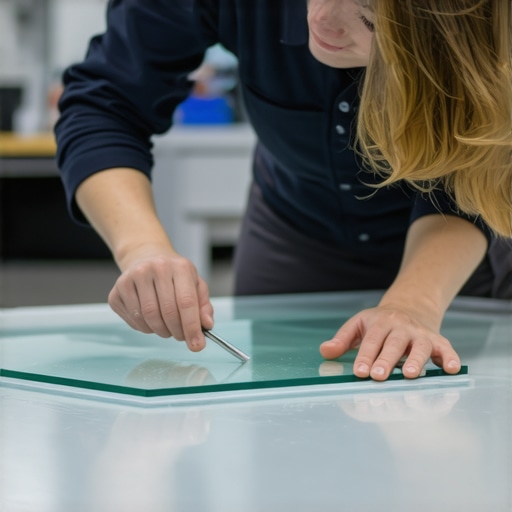
The black speckled pattern you see around the edges of your windshield is known as the frit. This is not decorative. It is a ceramic paint baked into the glass that protects the urethane adhesive from ultraviolet (UV) degradation. In the world of glazing, we treat this bond with the same reverence a structural engineer treats a load-bearing beam. Within this frit, there is a specific cutout designed to align perfectly with the VIN plate on your dashboard. This is the ‘VIN Window.’ If a glass installer uses a generic, ‘one-size-fits-all’ windshield, that cutout may not align. This indicates a low-quality casting. In my shop, we measure the rough opening and the alignment of the sash components with a tolerance of less than one-sixteenth of an inch. A windshield that obscures the VIN is a sign that the glass was not manufactured to OEM specifications, potentially lacking the correct curvature or refractive index. This is why a chip repair is often preferable to a total replacement if the damage is outside the critical vision area; it preserves the factory-set alignment of the VIN window.
Climate Logic: The Battle Against Solar Heat Gain
In hot climates like Texas or Florida, the enemy is the sun. We focus heavily on SHGC. You want a glass that blocks the sun’s radiant heat before it can penetrate the cabin. This is achieved through Low-E coatings, typically placed on Surface #2 (the inner face of the outer lite in a laminated sandwich). This coating reflects long-wave infrared radiation. If your glass installer uses a cheap substitute without these coatings, the temperature of your dashboard can reach 200 degrees Fahrenheit. This extreme heat doesn’t just make the car uncomfortable; it puts immense thermal stress on the glass and the VIN plate itself. The VIN plate is often made of metal or high-stability plastic, but the adhesives holding it can fail under extreme SHGC, causing it to slip or warp. A professional glazier understands that the glass is the first line of defense for the vehicle’s interior electronics and identification markers.
“The NFRC label is the only way to truly verify the thermal performance of a glazing unit in its intended environment.” – NFRC Performance Standards
Anatomy of a Professional Installation
When you call for a mobile service for a same-day replacement, you must watch the process. A master glazier will first inspect the pinch weld, which is effectively the ‘rough opening’ of the car. Any rust or old urethane must be removed. We don’t just ‘caulk and walk.’ We use specific primers that act like flashing tape in a building, creating a moisture-proof barrier. If water gets behind the glass because the installer skipped the primer, it will pool in the cowl area, which is designed with a sill pan effect to drain water through weep holes. However, if that water sits against the VIN plate, it leads to corrosion. You might think a small gap in the sealant is fine, but as any glazier knows, water will find its way in. We use shims to ensure the glass sits perfectly centered so the VIN is framed exactly as the manufacturer intended. If the glass is not operable, like a windshield, the bond must be absolute. The glass provides up to 30 percent of the vehicle’s structural integrity in a rollover. If the VIN window is misaligned, it’s a red flag that the structural bond might also be compromised.
The Technical Reality of Chip Repair
Sometimes, a full replacement is an overkill. A chip repair is a surgical procedure where we inject a clear resin with the same refractive index as the glass. The goal is to restore the structural integrity of the lite. If you have a chip near the VIN window, it must be addressed immediately. Small cracks can act as a prism, catching the light and making the VIN unreadable from certain angles. As a specialist, I use a vacuum-pressure tool to ensure no air remains in the break. It is about maintaining the ‘Visible Transmittance’ (VT) of the glass. The law requires the VIN to be readable by law enforcement and service technicians without obstruction. If your glass installer can’t explain the VT rating of the resin they are using, find another one.
The Math of Quality Over Hype
Many ‘Tin Man’ salesmen in the glass industry will try to sell you on the newest ‘Diamond Coating’ or ‘Self-Healing’ glass. I tell my clients: don’t buy the hype, buy the numbers. Look at the U-factor and the SHGC. In a hot climate, a lower SHGC is the king of metrics. It’s the difference between a dashboard that stays intact for 20 years and one that cracks in five. When that dashboard cracks, the VIN plate often goes with it. The investment in high-quality, OEM-spec glass pays for itself by protecting the vehicle’s resale value and legal standing. A visible, clear VIN through a perfectly installed windshield is the hallmark of a master glazier’s work. It shows that the installer respected the tolerances of the rough opening and understood the chemistry of the bond. Water management, heat rejection, and legal compliance are all tied to that small window of glass at the bottom of your windshield. Don’t let a ‘caulk-and-walk’ installer compromise your safety or your vehicle’s identity.