The specific reason your car electrical system repair impacts your windshield safety features
The Specific Reason Your Car Electrical System Repair Impacts Your Windshield Safety Features
Imagine this: you’ve just picked up your vehicle from a local shop after a necessary alternator replacement. The engine purrs, the lights are bright, and the battery is charging perfectly. However, as you merge onto the highway, a warning light flashes on your dashboard: “ADAS System Unavailable.” Suddenly, your Lane Keep Assist isn’t nudging you back into your lane, and your Adaptive Cruise Control refuses to engage. You might wonder how a mechanical fix under the hood could possibly break the high-tech sensors mounted behind your rearview mirror.
My name is Matt Antrobius. As a Diagnostic Calibration Technical Specialist for ADAS (Advanced Driver Assistance Systems) and an engineer with a deep-rooted passion for automotive performance, I spend my days bridge-building between traditional mechanical repair and the complex world of digital safety systems. I’ve seen countless drivers confused by this very scenario. The reality is that modern vehicles are no longer just collections of mechanical parts; they are sophisticated, interconnected computer networks on wheels. In this environment, your windshield has evolved from a simple piece of safety glass into a critical sensor platform, and that platform is entirely dependent on the health of your vehicle’s electrical nervous system.
The connection between a car electrical system repair and your windshield safety features isn’t just a coincidence – it is a matter of physics, voltage stability, and digital communication protocols. To understand why your safety features might fail after an electrical repair, we have to look deep into the “brain” of your car.
The Windshield as a High-Tech Sensor Hub
For decades, the windshield was designed for two things: visibility and structural integrity. While those remain vital, the modern windshield now serves as the primary mounting point for the “eyes” of your vehicle. Behind that darkened area around your rearview mirror (known as the frit), you will find a suite of sensors including forward-facing cameras, LiDAR units, and rain sensors. These components are the foundation of your Advanced Driver Assistance Systems (ADAS).
When you seek out professional auto service and repair, it is crucial to recognize that these sensors are incredibly sensitive to their environment. They don’t just “see” the road; they process massive amounts of visual data in milliseconds to determine if you are about to hit an object or drift out of your lane. Because these sensors are mounted to the glass, there is a literal physical dependency: “Why your car’s safety features depend on your glass quality” is a question of optical clarity and structural rigidity. If the glass vibrates too much or has minor distortions, the camera’s “vision” is compromised.
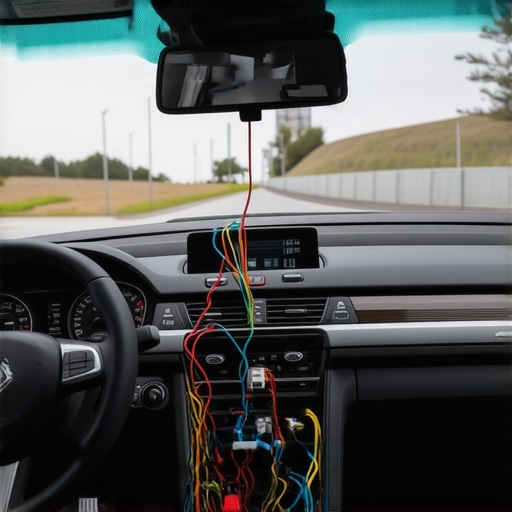
However, the physical mounting is only half the story. These sensors are high-speed digital devices that require an incredibly clean and stable power supply to function. When we talk about the windshield as a sensor hub, we are talking about a component that is electrically tethered to the battery and alternator. Any disruption in that tether can lead to a system-wide “blindness.”
The “Specific Reason”: Voltage Stability and ECU Communication
The core reason a car electrical system repair impacts your windshield safety features comes down to voltage stability. Most drivers assume a car battery is either “good” or “dead,” but ADAS sensors operate in a much narrower window of tolerance. These systems typically require a steady voltage between 12.6V and 14.4V. If the voltage fluctuates even slightly outside of this range, the sensors may produce “noisy” data or shut down entirely to prevent a false positive (like your car slamming on the brakes for a shadow).
The ECU Handshake
When an auto repair center performs a major electrical repair, such as replacing a starter or battery, they often disconnect the power supply. In modern vehicles, this can trigger a “loss of communication” error across the Controller Area Network (CAN bus). The Engine Control Unit (ECU) must maintain a constant “handshake” with the camera module on the windshield. If the power is interrupted or if the voltage drops during a botched jump-start, the ECU may lose the “learned” calibration values for the camera.
General Motors ADAS guides and other manufacturer technical documents explicitly state that a camera’s failure to calibrate or maintain its function is often attributed to improper power delivery or hardware that isn’t correctly positioned. When the battery is reconnected, the system performs a self-diagnostic. If it detects that the voltage was unstable during the boot-up sequence, it may disable ADAS features as a safety precaution. This is why you might see a “Service Front Camera” message immediately after a battery replacement.
Micro-Surges and Digital “Blindness”
Even a micro-surge can be devastating. Think of it like this: “Why your phone battery percentage jumps after a screen repair” – it’s often due to the power management chip needing to recalibrate to the new hardware’s draw. Similarly, a car’s safety camera is calibrated to work with a specific electrical load. If an alternator is failing and sending “AC ripple” (unrectified current) through the DC system, it can “blind” the camera by creating digital interference in the video feed, much like static on an old television.
Why Alternator and Battery Health Matters
The alternator is the heart of your car’s electrical health. Its job is to provide consistent power while the engine is running and to keep the battery topped off. When an alternator begins to fail, it doesn’t always just stop working. Often, it begins to struggle to maintain a steady voltage under load – such as when you have the headlights, wipers, and AC running simultaneously.
If you are in need of a car electrical system repair, the instability caused by a dying alternator can lead to intermittent safety system failures. The windshield camera is often the first to “complain” because it requires high-speed data transmission. Electrical “noise” from a failing alternator can corrupt the data packets being sent from the camera to the ADAS control module. This is a common reason for “ghost” warnings, where the car thinks there is an obstacle in the road that isn’t there.
Furthermore, the battery acts as a giant capacitor, smoothing out voltage spikes. If your battery is weak, it can’t absorb these spikes effectively. You might notice “The reason your battery drains faster after a hard impact” is sometimes due to internal plate damage that increases resistance. This increased resistance makes the entire electrical system work harder, creating a “dirty” power environment that ADAS sensors loathe. A high-quality auto repair center will always test the battery’s “state of health,” not just its voltage, to ensure the safety systems have a solid foundation.
The Necessity of Recalibration After Electrical Work
Most consumers are now aware that they need a camera calibration after a windshield replacement. However, the automotive industry is beginning to realize that significant electrical disruptions also necessitate a “system reset” or, in some cases, a full recalibration. This is especially true for vehicles that utilize “Dynamic Calibration.”
There are two primary types of calibration:
- Static Calibration: Performed in a controlled shop environment using specialized targets and laser levels.
- Dynamic Calibration: Performed by driving the vehicle at specific speeds on well-marked roads so the camera can “learn” its environment.
When a major electrical overhaul occurs, the “learned” parameters in the camera’s volatile memory can be wiped. The car essentially “forgets” where the lane markings are supposed to be in relation to its current pitch and yaw. This is “Why your car’s lane departure warning needs glass recalibration” even if the glass itself wasn’t touched – the software’s baseline was lost during the power outage. Research from Work Truck Online and various OE (Original Equipment) manufacturers notes that recalibration is often required after significant electrical disruptions or suspension changes to ensure the “zero point” of the safety system remains accurate.
Common Symptoms of Electrical-Related Safety Failures
How do you know if your electrical system is sabotaging your windshield safety features? Keep an eye out for these specific symptoms:
- “ADAS Unavailable” or “Front Camera Blocked”: These messages often appear when the camera isn’t receiving enough voltage to process images, even if the glass is perfectly clean.
- Erratic Steering Wheel Vibrations: If your Lane Departure Warning is acting twitchy, it may be receiving corrupted signal data.
- Phantom Braking: This is a serious safety concern where the car applies the brakes for no reason. This can be caused by voltage drops that make the ECU misinterpret sensor data.
- Inaccurate Adaptive Cruise Control: If the car is following too closely or losing track of the vehicle in front, the sensor’s refresh rate might be lagging due to electrical issues.
Interestingly, even systems you wouldn’t associate with the windshield can play a role. If you have recently searched for auto ac repair near me because your cooling is failing, be aware that a seizing AC compressor clutch can create a massive momentary voltage draw every time it tries to engage. This sudden “dip” in power can be enough to trip a fault code in the sensitive ADAS camera module, leading to a temporary loss of safety features.
You might also notice “Why your steering feels off immediately after an auto glass replacement” – this is often because the electronic power steering (EPS) and the windshield camera work in tandem for Lane Keep Assist. If the electrical handshake between them is interrupted, the steering weight and response can feel “artificial” or inconsistent.
Choosing the Right Technician: Beyond “Parts Changing”
The era of the “parts changer” is over. To properly maintain a modern vehicle, you need a technician who understands the intersection of mechanics and electronics. When your car needs a car electrical system repair, you shouldn’t just take it to any auto repair shop. You need a facility that possesses the diagnostic tools to perform a “Post-Repair Scan.”
A post-repair scan is a comprehensive check of all the vehicle’s computer modules. It ensures that after the alternator or battery was replaced, all the “eyes” of the car – the cameras and sensors – are communicating correctly with the “brain.” If a shop simply swaps a battery and sends you on your way, they may be leaving you with a vehicle that is physically functional but digitally “blind.”
When interviewing car repair shops, ask them specifically about their ADAS capabilities. Do they have the equipment to perform a steering angle sensor reset? Can they verify the calibration of the forward-facing camera? A shop that understands these requirements is a shop that prioritizes your safety.
Conclusion: Safety is a System, Not a Part
As we have explored, the health of your vehicle’s electrical system is inextricably linked to the performance of your windshield safety features. The “specific reason” for this connection is the requirement for ultra-stable voltage and uninterrupted communication between the camera modules and the ECU. From the optical clarity of the glass – which explains “Why some windshield chips look silver or black from the inside” (it’s an air pocket reflecting light!) – to the steady flow of electrons from your alternator, every component must work in harmony.
If you notice any glitches in your safety systems following a battery swap, alternator fix, or even an AC repair, don’t ignore them. Your car is telling you that its digital “eyes” are out of sync with its electrical “heart.” Always seek out a professional auto repair center that understands the complexities of ADAS and the necessity of post-repair diagnostics.
Modern driving is safer than ever thanks to these windshield-mounted technologies, but they are only as good as the power that fuels them. Keep your electrical system healthy, and your windshield will keep you safe. Safe driving starts with a healthy charge!