The simple way to tell if your windshield chip is too deep for resin
The Master Glazier’s Perspective on Laminated Failures
As a veteran with over 25 years in the glazing industry, I have seen every manner of glass failure imaginable, from the spontaneous shattering of tempered panels in high-rise curtain walls to the slow, agonizing delamination of residential IGUs. But nothing frustrates me more than the common misconception surrounding the repairability of automotive glazing. A windshield is not merely a piece of glass; it is a structural component of the vehicle, a high-performance laminated unit consisting of two lites of annealed glass bonded by a polyvinyl butyral (PVB) interlayer. When a projectile strikes this surface, it initiates a complex release of kinetic energy that results in what we in the trade call a break. To understand if a chip is too deep for resin, you must look past the surface and analyze the internal tension of the glass stack.
I once inspected a vehicle where a previous mobile service had performed a ‘caulk-and-walk’ style repair on what they claimed was a simple bullseye. Three weeks later, the entire windshield had catastrophically cracked across the driver’s line of sight during a cold snap. When I removed the unit, I saw the problem: the previous installer had ignored the fact that the impact had reached the PVB interlayer. They hadn’t cleaned the pinchweld or addressed the underlying structural deficit. The resin had only filled the surface pit, leaving the internal fractures to expand under thermal stress. This is why proper diagnosis is the difference between a safe vehicle and a rolling liability.
“Installation is just as critical as the window performance itself. A high-performance window installed poorly will fail.” AAMA Installation Masters Guide
The Anatomy of the Impact: Analyzing the Hertzian Cone
When we talk about the depth of a chip, we are technically discussing the penetration of the fracture through the outer lite of the laminated assembly. Most automotive glass is 2.1mm to 2.5mm thick per lite. A repairable chip is one that is confined strictly to the outer layer. If the impact has sufficient force to compromise the PVB interlayer or, heaven forbid, the inner lite of glass, the unit is structurally compromised and must be replaced by a qualified glass installer. You can identify this by looking for a ‘milky’ or ‘cloudy’ appearance around the center of the impact. This indicates that the glass has separated from the plastic interlayer, a condition known as delamination. No amount of resin can restore that bond.
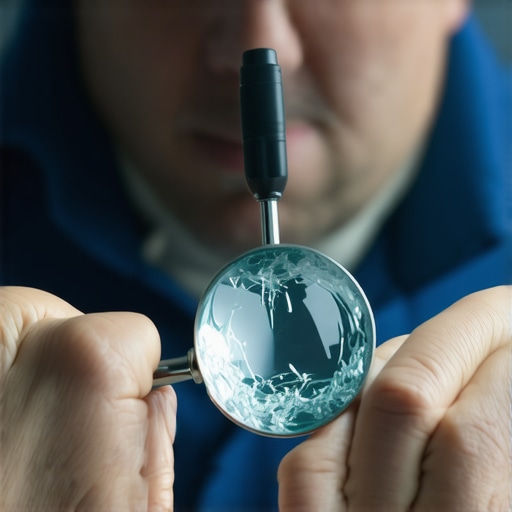
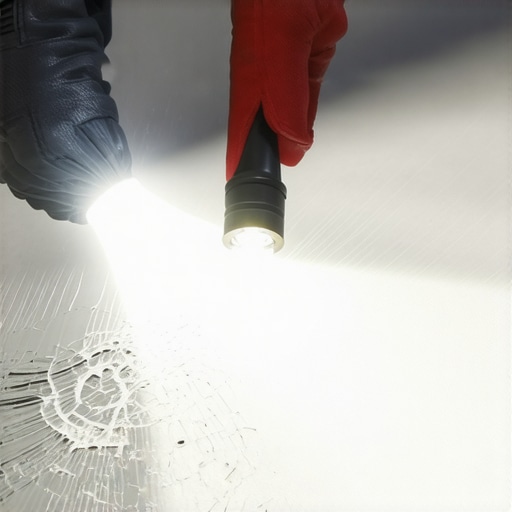
The simplest way to gauge this is the ‘Scribe Test.’ A professional tool, much like the shims we use to level a heavy sash in a rough opening, allows us to feel the ‘bottom’ of the pit. If your scribe or a fine needle drops into a void that feels soft or ‘spongy,’ you have reached the plastic. At that point, the chip is too deep for resin. Resin requires a solid, non-porous ‘floor’ of glass to bond effectively. If it touches the PVB, it can actually cause the plastic to swell over time, leading to further optical distortion and eventual failure. This is especially true in Southern climates where Solar Heat Gain (SHGC) is a constant factor.
The Southern Climate Factor: SHGC and Thermal Expansion
In hot regions like Texas or Arizona, the sun is the enemy of the glass installer. The Solar Heat Gain Coefficient (SHGC) of your windshield determines how much radiant heat is absorbed. Windshields are designed with Low-E properties, usually with the coating on Surface #2, to reflect heat outward. However, when a chip occurs, it creates a ‘hot spot.’ The dark resin and the disrupted glass surface absorb more heat than the surrounding clear glass. This creates a massive thermal gradient. If the chip is deep, the heat cannot dissipate through the interlayer efficiently. The outer lite expands while the inner lite remains cooler, creating a shearing force that will ‘pop’ the crack in seconds. This is why same-day chip repair is non-negotiable in the South. You are racing against the sun.
“The integrity of the building envelope, or in this case the vehicular envelope, is dependent on the management of thermal and mechanical stresses at the glazing interface.” ASTM E2112 Standard Practice
The Science of Resin Refraction and Curing
Many homeowners think resin is just glue. It isn’t. High-quality repair resin is an anaerobic methacrylate designed to match the refractive index of silicate glass. When we perform a mobile service, we use a vacuum-pressure cycle to evacuate the air from the fracture. Think of it like a weep hole in a window frame; if the air and moisture can’t escape, the system fails. We pull a vacuum to 28 inches of mercury, then switch to positive pressure to force the resin into the microscopic ‘legs’ of the break. If the chip is too deep, the vacuum cannot be maintained because air is being pulled through the compromised PVB from the cabin side. This is a clear indicator that the structural integrity is gone.
A professional glass installer will also look for ‘muntin-style’ fractures, which are straight-line cracks radiating from a central point. If these cracks exceed the diameter of a quarter, or if they are deep enough to feel with a fingernail on the inside of the glass, the repair is a waste of time. The ROI on a bad repair is zero. You are better off investing in a full replacement where the flashing tape, or in this case the high-modulus urethane, can be applied to a clean, fresh surface. Don’t let a salesman tell you that a deep pit can be ‘filled and forgotten.’ If you can’t clear the air, you can’t clear the view.
Final Checklist for Repairability
Before you commit to a repair, perform your own autopsy of the damage. Is the pit deeper than 1.5mm? Is there a halo of silver or black around the impact point? Does the damage sit within the ‘acute’ area (the driver’s direct field of vision)? If the answer to any of these is yes, the chip is likely too deep. A quality mobile service will be honest about this. They won’t try to shim a broken sash; they will tell you when it’s time for a new unit. Remember, in the world of glazing, whether it’s a window in a rough opening or glass in a pinchweld, water and heat management are the only things that matter. Buy the numbers, trust the physics, and never settle for a ‘caulk-and-walk’ technician.