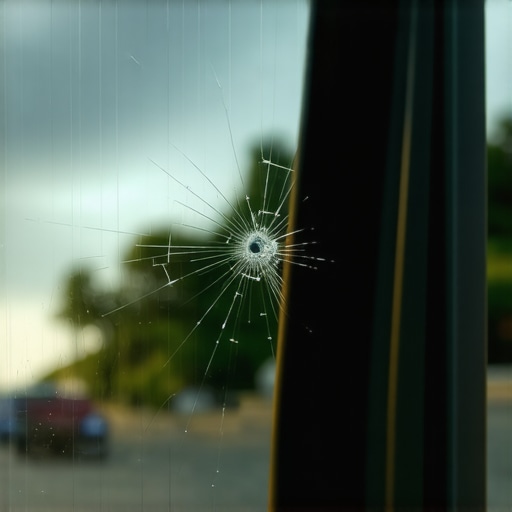
Is that rock chip small enough to fix without a replacement?
The Anatomy of a Fracture: More Than Just a Cosmetic Flaw
As a master glazier with over a quarter-century of hands-on experience, I have seen every imaginable type of glass failure. I have stood on scaffolds fifty stories up looking at micro-cracks in curtain walls, and I have spent just as much time in driveways assessing whether a windshield can survive another winter. When you hear that sharp ‘clink’ of a stone hitting your glass, your first instinct is usually to check the size. But to a professional glass installer, the size is only the beginning of the story. A rock chip is not just a blemish: it is a structural compromise of a complex laminated system.
A homeowner recently called me in a panic because their glass seemed to be ‘growing’ a crack right before their eyes. I walked onto the site with my hygrometer and thermal camera, and the diagnosis was immediate: the condensation crisis. They had a small, neglected chip near the edge of the glass. Over the weekend, the humidity inside the house reached 65 percent while the temperature outside dropped to near freezing. That tiny void in the glass acted as a collection point for moisture. When that moisture froze, the expansion force was enough to overcome the surface tension of the tempered lite, sending a crack clear across the pane. It was not a failure of the glass itself, but a failure to address a breach in the sacrificial layer of the assembly. This is why mobile service and immediate chip repair are not just conveniences: they are technical necessities.
The Physics of Laminated Glass and the Stress Riser
To understand if a chip is fixable, you must understand what you are looking at. Most modern high-performance glass, especially in automotive and premium residential applications, uses a laminated construction. This involves two ‘lites’ of glass bonded together by a Polyvinyl Butyral (PVB) interlayer. When a rock hits the glass, it usually only damages the outer lite. This creates what we call a ‘stress riser.’ In the world of structural mechanics, a stress riser is a location where stress is concentrated. A perfectly smooth piece of glass distributes load evenly. A chipped piece of glass focuses all the atmospheric and thermal pressure onto a single, microscopic point at the bottom of the pit.
“Installation is just as critical as the window performance itself. A high-performance window installed poorly will fail.” – AAMA Installation Masters Guide
The AAMA guide reminds us that the environment around the glass is constantly trying to destroy it. In a mobile service context, a glass installer must evaluate the refractive index of the repair resin. If the resin does not match the glass (which usually sits around 1.52), you will see a ‘ghost’ of the repair. But more importantly, if the resin does not chemically bond to the PVB interlayer, the structural integrity remains compromised. This is where the ‘caulk-and-walk’ amateurs fail: they fill the hole, but they do not bridge the structural gap.
The Critical Dimensions: When to Repair vs. Replace
In the trade, we use specific metrics to determine if a chip is a candidate for same-day repair or if it requires a full replacement. We look at the ‘Bullseye,’ the ‘Star Break,’ and the ‘Cloverleaf.’ Generally, if the central void of the chip is smaller than a quarter and is not located directly in the driver’s line of sight or within the critical ‘D-zone’ near the glazing bead, it can be saved. However, if the pit has penetrated the PVB interlayer, or if the ‘legs’ of a star break exceed two inches, the glass is technically dead. At that point, the mechanical bond between the glass and the interlayer is peeling away, a process known as delamination.
You must also consider the depth. A shallow pit that only affects the top few microns of the glass can often be polished out. But a deep impact that creates a ‘cone’ of missing glass requires a vacuum-pressure cycle. This is a process where the glass installer uses a specialized bridge tool to evacuate the air from the break before injecting high-viscosity resin. Without the vacuum, air bubbles remain trapped, creating a weak point that will eventually fail under thermal shock.
The Climate Logic: Thermal Stress and the North-South Divide
Your geographic location dictates the urgency of your chip repair. In cold northern climates like Chicago or Minneapolis, the primary enemy is heat loss and the resulting thermal gradient. When you have a rock chip and you turn on your defroster or interior heater, you are creating a massive temperature differential between the inner lite and the outer lite. The inner glass expands while the outer glass remains contracted. This ‘differential expansion’ puts the chip under immense tension. In these regions, a U-Factor is king, and a chip is a thermal bridge that invites a total crack-out within hours of the first frost.
In southern climates like Phoenix or Miami, the enemy is the Solar Heat Gain Coefficient (SHGC). The sun’s radiant energy hits the glass, and the Low-E coatings (typically on Surface #2 for hot climates) reflect that heat. However, a chip disrupts the continuity of these metallic oxide coatings. The localized heat buildup around the chip can exceed 150 degrees Fahrenheit. If you hit a pothole or even just close your door too hard, the pressure spike combined with the weakened, hot glass will cause the chip to ‘run.’ This is why same-day mobile service is critical in the South: you are racing against the sun.
The Technical Superiority of Professional Resin Injection
Why not use a store-bought kit? Because those kits lack the ‘Muntin’ of professional repair: the high-pressure injector. A master glazier uses an injector that can exert upwards of 20 PSI to force resin into the microscopic fissures of a star break. These fissures are often thinner than a human hair and are invisible to the naked eye. A DIY kit relies on gravity and a prayer. If the resin does not reach the very tip of each crack leg, the crack will continue to grow underneath the repair.
“The performance of the fenestration system is dependent upon the maintenance of the glass integrity and the sealants used to protect the interior environment.” – ASTM E2112 Standard Practice
The ASTM E2112 standard is the bible for installers. It emphasizes that the glass is part of the building’s (or vehicle’s) envelope. A chip is a hole in that envelope. When we perform a professional chip repair, we are essentially performing a microscopic glazing job. We clean the site with denatured alcohol, remove any loose glass shards with a carbide scribe, and then create a seal that is airtight. This is the only way to ensure that the weep holes and drainage systems of the frame are not overwhelmed by water ingress through the glass itself.
Final Verdict: Don’t Wait for the Run
In my 25 years, I have never seen a chip get better with age. They are like cavities: they only get deeper, more expensive, and more dangerous. Whether you are dealing with an operable sash in a historic home or a laminated windshield, the physics remain the same. The moment the surface of the glass is breached, the clock starts ticking. A professional glass installer can provide a same-day mobile service that preserves the factory seal, which is always superior to a replacement seal. Remember, the glass is not just there to let you see the world: it is there to manage the violence of the atmosphere. Treat it with the technical respect it deserves.
{“@context”:”https://schema.org”,”@type”:”HowTo”,”name”:”How to Assess and Repair a Rock Chip”,”description”:”A guide by a Master Glazier on determining if glass can be repaired or needs replacement.”,”step”:[{“@type”:”HowToStep”,”name”:”Initial Inspection”,”text”:”Clean the area and use a magnifying glass to check if the chip is smaller than a quarter.”},{“@type”:”HowToStep”,”name”:”Depth Analysis”,”text”:”Use a carbide scribe to determine if the pit has reached the PVB interlayer.”},{“@type”:”HowToStep”,”name”:”Thermal Stabilization”,”text”:”Ensure the glass is at a stable temperature before injecting resin to avoid crack expansion.”},{“@type”:”HowToStep”,”name”:”Vacuum Injection”,”text”:”Use a professional bridge tool to remove air and inject UV-curable resin under pressure.”}]}