The reason your car’s glass is making a whistling noise at high speeds
The High Speed Whistle: Why Your Car Glass is Screaming at You
There is a specific kind of madness that sets in when you are cruising down the interstate at 70 miles per hour and a high pitched whistle starts piercing through the cabin. To the average driver, it sounds like a flute played by a ghost. To a master glass installer with 25 years in the trenches, it sounds like a failure of technical precision. I once had a homeowner call me in a panic because their new windows were ‘sweating’ and their car was ‘whistling.’ I walked in with my hygrometer and showed them the humidity was 60 percent. It wasn’t the windows; it was their lifestyle. But when that whistle happens in a car, it is almost always the glass, and it is almost always the result of a ‘caulk and walk’ technician who didn’t respect the physics of the aperture.
The Physics of the High-Speed Whistle
When your vehicle moves at high speeds, it creates a massive pressure differential. The air moving over the curved surface of the glass is traveling faster than the air inside the cabin, creating a low-pressure zone. This is basic Bernoulli’s principle. If there is even a microscopic void in the urethane bead, the high-pressure air from inside the cabin tries to escape toward that low-pressure zone. This air movement through a tiny gap creates a reed effect, exactly like a woodwind instrument. A professional glass installer knows that the seal is not just about keeping water out; it is about managing the structural integrity of the rough opening of the vehicle frame. If the urethane bead is not continuous, or if the installer skipped the primer, that gap becomes a vocal cord for your car.
“Installation is just as critical as the window performance itself. A high-performance window installed poorly will fail.” AAMA Installation Masters Guide
The Problem with Same-Day Mobile Service
In our rush-and-go culture, everyone wants same-day mobile service. While mobile service is a triumph of convenience, it often ignores the environmental variables that dictate a successful cure. If you are in a hot, southern climate like Texas or Arizona, the Solar Heat Gain Coefficient (SHGC) of your glass is not just a number on a sticker; it is a measure of how much energy is beating down on the urethane seal. In high-heat environments, we place the Low-E coating on Surface #2 to reflect heat outside, but the extreme heat can also cause the metal frame of the vehicle to expand at a different rate than the glass. A mobile glass installer working in the sun might set the glass, but the rapid expansion and contraction can create those tiny voids before the urethane has reached its full shore hardness. This is where the whistle begins.
The Anatomy of the Seal: Beyond the Chip Repair
Many drivers think a whistle is related to a small stone chip. While a chip repair is vital for structural integrity, the whistle is almost always a perimeter issue. When we look at the rough opening where the glass meets the pinch weld, we have to consider the glazing bead and the moldings. If the molding is loose, it vibrates. If the urethane has a ‘thin spot,’ it breathes. This is why I insist on a full-frame autopsy when a client complains of noise. We aren’t just looking for a hole; we are looking for evidence of poor adhesion. If the previous installer didn’t use shims to center the glass properly, the glass might be sitting too close to one side of the sash, leaving the other side with a stretched, thin seal that eventually fails under the pressure of high-speed travel.
“The window assembly must be treated as a system, where the interaction between the glass, the frame, and the sealant determines the ultimate success of the installation.” ASTM E2112 Standard Practice
The Role of the Sill Pan and Drainage in Automotive Glass
While we talk about sill pans mostly in residential glazing to manage water, the same logic applies to the bottom of your car’s windshield and door glass. Every operable window in your car has a system of weep holes at the bottom of the door. If these are clogged, or if the glass installer didn’t seat the glass properly in the track, the air can be forced up through the drainage system and out through the top seal, creating a phantom whistle that is notoriously difficult to track down. It requires a technician who understands that a window is a hole in the wall (or the car) that needs to be managed for heat, light, and water. We are not just sticking glass to metal; we are engineering a pressure-tight environment.
How to Diagnose the Whistle
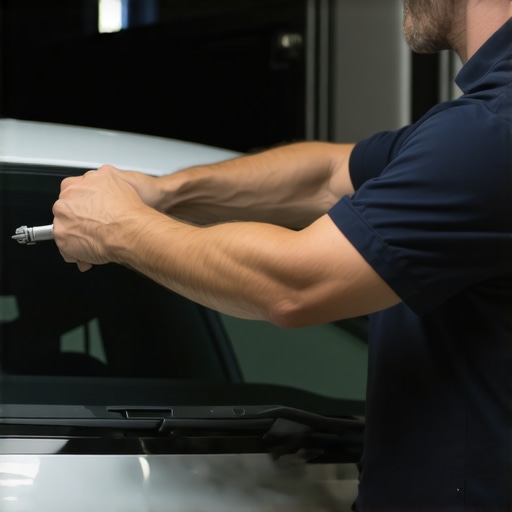
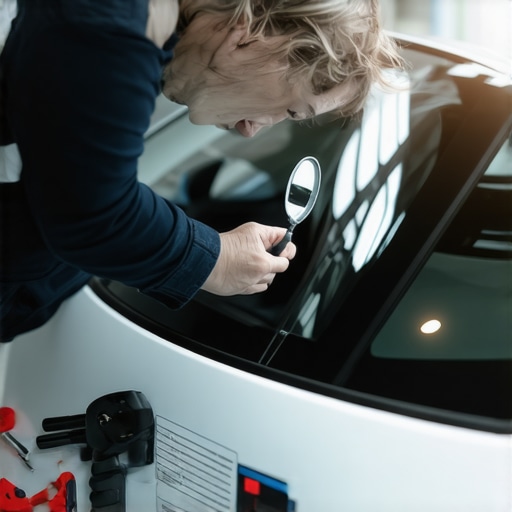
If you suspect your glass is the culprit, try the ‘Soap Test.’ While the car is stationary, turn the blower motor to high on the ‘fresh air’ setting. This creates positive pressure inside the cabin. Take a spray bottle of soapy water and spray it around the exterior perimeter of the glass. If you see bubbles forming, you have found your leak. That leak is where the air is escaping at high speeds, creating that maddening noise. This is not a job for a DIY fix or more flashing tape. This requires a professional to pull the glass, prep the rough opening, and lay a consistent, high-viscosity bead of urethane that respects the aerodynamics of the vehicle. Don’t settle for a same-day fix that leaves you with a permanent headache. Demand a glass installer who knows the difference between a window that fits and a window that performs.”, “image”: {“imagePrompt”: “A professional glass installer wearing a branded uniform, using a technical tool to inspect the seal of a car windshield on a modern luxury sedan in a clean workshop setting.”, “imageTitle”: “Master Glazier Inspecting Car Glass Seal”, “imageAlt”: “A professional glazier inspecting a windshield for air leaks and seal integrity.”}, “categoryId”: 0, “postTime”: “”}