The danger of localized heat on a small windshield crack
The Morning the Glass Screamed: A Narrative of Thermal Stress
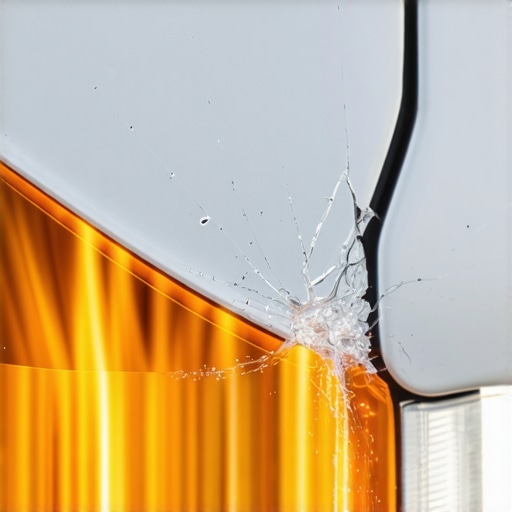
I once took a call from a client in Phoenix who was convinced someone had vandalized his car in his driveway. I arrived as his glass installer and found a single, clean crack bifurcating the entire windshield from the bottom edge. He told me it was just a tiny, insignificant stone chip the night before. I pulled out my thermal imaging camera and showed him the dashboard temperature: 165 degrees Fahrenheit. The black dash had been absorbing solar radiation all morning, radiating that heat directly into the lower edge of the glass. Meanwhile, he had started the car and blasted the A/C at 60 degrees. It was not a vandal; it was physics. The localized heat on that small chip had turned a five-minute chip repair into a full replacement. This is the reality of glass. It is a brittle solid that behaves according to strict thermodynamic laws, and ignoring a chip in a high-heat environment is an expensive gamble.
“Installation and repair procedures must account for the thermal stresses inherent in laminated glazing units to prevent catastrophic failure of the structural integrity.” – ASTM E2211 Standard Practice
The Anatomy of Laminated Glass and the PVB Buffer
To understand why localized heat is so dangerous, you have to understand what a windshield actually is. It is not a single pane of glass. It is a sandwich consisting of two layers of annealed glass bonded together by a PVB (Polyvinyl Butyral) interlayer. This construction is designed for safety, ensuring that upon impact, the glass shards adhere to the plastic rather than flying into the cabin. However, this sandwich construction creates a complex thermal environment. When sun hits the glass, the exterior pane heats up faster than the interior pane. In a healthy windshield, the PVB layer can absorb some of this differential expansion. But when you introduce a chip, you have created what we call a stress riser. You have broken the continuous surface tension of the glass. At that specific point, the glass can no longer distribute the load of thermal expansion. The chip acts as a wedge, and as the glass expands from the heat, that wedge is driven deeper into the material.
The Frit Factor: Why the Edges are the Danger Zone
Look at the edge of your windshield. You will see a black painted border known as the frit. This is not just for aesthetics or to hide the adhesive. This ceramic paint provides a rough surface for the urethane sealant to bond the glass to the rough opening of the vehicle frame. However, the frit is also a heat magnet. In the South, where the Solar Heat Gain is extreme, the black frit absorbs energy much faster than the clear glass. This creates a massive thermal gradient over a distance of just a few millimeters. If a stone chip is located near this frit line, the localized expansion of the black-painted glass against the cooler clear glass creates a shearing force. A mobile service technician knows that a chip near the edge is a ticking time bomb. This is why same-day service is not just a marketing slogan; it is a technical necessity to save the glass before the afternoon sun peaks.
The Mechanics of Professional Chip Repair
When you call for a professional chip repair, we aren’t just “filling a hole.” We are performing a structural restoration. First, we use a bridge and injector to create a vacuum over the impact point. This is critical. We must evacuate all air and moisture from the micro-fissures within the glazing. If air remains, it will expand when heated, continuing the cracking process. Once the vacuum is achieved, we inject a specialized anaerobic resin. This resin is engineered to have a refractive index nearly identical to the glass, but more importantly, it has a similar coefficient of thermal expansion. We then cure the resin using a specific UV wavelength, which cross-links the polymers and bonds the broken edges together. This restores the structural continuity of the pane, allowing it to once again withstand the localized heat of the sun without the crack spreading.
“The performance of a glazing system is only as reliable as its weakest point, which in the case of automotive glass, is often a neglected stone bruise or chip.” – NFRC Performance Guidelines
The SHGC Reality in Modern Vehicles
In high-heat climates like Texas or Arizona, the Solar Heat Gain Coefficient (SHGC) of your glass is your primary defense against cabin overheating. Modern windshields often include Low-E coatings on Surface #2 (the inner side of the outer pane) to reflect infrared radiation. However, localized heat can still build up if the car is parked at an angle where the sun hits only one corner of the glass. This uneven heating causes the glass to expand at different rates. If you have a chip, even a microscopic one, the expansion of the hot section against the stationary cool section will find that point of weakness. Our mobile service teams often see “long-cracks” that happen while a car is sitting perfectly still in a parking lot. The owner returns to find a foot-long fracture that started from a tiny pit they hadn’t even noticed. This is why we advocate for a proactive inspection of the sash and glass surfaces during every maintenance interval.
Why Mobile Service is the Superior Solution
Some people think they should drive to a shop for glass work, but in the case of a chip, the drive itself can be the catalyst for failure. The vibration of the road, combined with the wind pressure on the glass and the internal stress of the A/C, can cause the chip to spread before you even arrive. A same-day mobile service eliminates this risk. We come to your location, where the glass can be treated in a stable thermal state. By stabilizing the chip where the car sits, we prevent the mechanical and thermal stresses of transit from ruining the windshield. We check the weep holes in the cowl and ensure the flashing tape or gaskets are not compromised, providing a holistic check of the window’s health. Do not trust your safety to a “caulk-and-walk” amateur who doesn’t understand the Dew Point or the molecular behavior of resin. Physics does not forgive shortcuts.