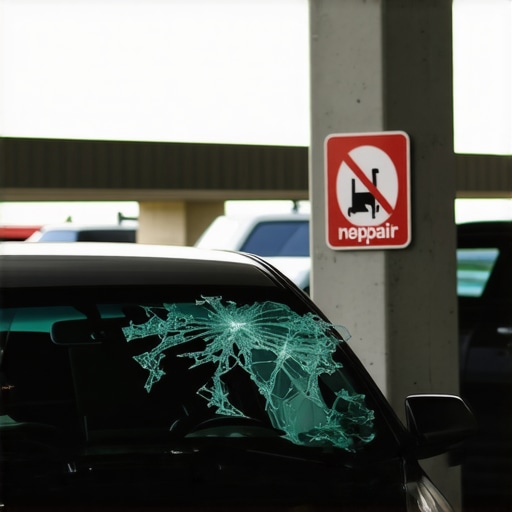
Why we won’t fix your windshield in a parking garage
The Dangerous Myth of the ‘Anywhere’ Mobile Service
As a master glazier with over two decades of experience, I have seen it all. From 40-story curtain walls to the intricate sash work on Victorian restorations, the principles of glass remain constant. One of the biggest fallacies in the modern glass installer industry is the idea that a professional, structural installation can happen anywhere, at any time. When a customer calls for a same-day chip repair or a full replacement and insists we do it in a subterranean parking garage, my answer is a firm no. It is not because we are difficult; it is because we understand the physics of mobile service better than the ‘caulk-and-walk’ crews who will take your money and leave you with a leaking, dangerous vehicle. I remember a specific case that illustrates this perfectly. A client called me in a panic because their new windshield was ‘sweating’ and whistling on the highway. I met them with my hygrometer and found the relative humidity in their office parking garage was hovering at a stagnant 72%. The previous installer had applied a high-viscosity urethane in those conditions, and the moisture-cured adhesive had ‘skinned’ too quickly, trapping air pockets. It wasn’t the glass that failed; it was the installer’s ignorance of the ambient environment. You cannot fight the Dew Point and win.
“Installation is just as critical as the window performance itself. A high-performance window installed poorly will fail.” – AAMA Installation Masters Guide
The Micro-Climate of the Parking Deck
To understand why a parking garage is the enemy of a quality glass installer, you have to look at the chemistry of the bond. Most modern windshields are structural components of the vehicle, providing up to 60% of the roof strength in a rollover. This is not a simple glazing bead application; it is a structural fusion. In a parking garage, you have three primary enemies: lighting, airborne contaminants, and temperature stagnation. When we perform a chip repair, we are injecting a clear, UV-curable resin into the damaged area. These resins are designed to bridge the refractive index of the glass. However, they require a specific intensity of ultraviolet light to achieve a full cross-link of the polymers. In the dim, fluorescent-lit bowels of a concrete garage, that resin stays soft. It looks fine for an hour, but as soon as you hit a pothole or experience a temperature swing, that soft resin fails, and the crack propagates across your entire field of vision. Furthermore, garages are magnets for concrete dust. This microscopic silt settles on the rough opening of the vehicle frame. If even a trace amount of this dust mixes with the primer or the urethane bead, you’ve lost your molecular adhesion. You might as well be using flashing tape and prayer to hold your glass in place.
Thermal Stress and Surface Tension
In the southern climates, we are constantly fighting Solar Heat Gain (SHGC). When a car is parked in a hot, stagnant garage, the glass surface temperature can reach levels that make the application of primers impossible. A professional glass installer knows that the glass surface must be at least five degrees above the dew point to prevent microscopic condensation. If I apply a structural adhesive to a surface with latent moisture, the bond is compromised before the car even leaves the deck. This is why a mobile service must be performed in a controlled environment. We look at the glass as a managed barrier. Just as a sill pan manages water in a residential window, the pinch weld of a vehicle handles significant water runoff. If the weep hole equivalent in a vehicle’s cowl is blocked by excess urethane—often a result of working in poor lighting where you cannot see your bead height—you will end up with water in your floorboards and mold in your dash. We aren’t just ‘swapping glass’; we are managing the structural integrity of a pressurized cabin. The sash of your vehicle—the glass unit itself—must be perfectly centered with shim-like precision to ensure that the operable parts of the car, like the wipers and sensors, function correctly.
“The integrity of the structural sealant is dependent upon the cleanliness of the substrate and the ambient conditions during application.” – ASTM E2112-Standard Practice
The Same-Day Trap
The marketing for same-day service has convinced the public that glass repair is like getting a car wash. It is a chemical process. We have to account for the Static Drive-Away Time (SDAT). In a parking garage, without proper airflow, the solvents in the cleaners and primers cannot flash off. If we apply the adhesive over ‘wet’ primer, the chemical bond is void. You might think you’re getting a deal with a mobile service that meets you in your office garage, but you are actually paying for a high-probability failure. Think of the muntin on a window; it provides aesthetic structure. The ceramic ‘frit’ (the black edge) of your windshield provides the ‘tooth’ for the glue. If that frit is contaminated by the greasy, exhaust-heavy air of a garage, the glue won’t bite. When we insist on a shop install or a clear, outdoor, temperature-stable environment, we are ensuring that the glass stays in the car during an accident. I’ve seen what happens when a windshield pops out because the installer didn’t want to tell the customer that the garage was too damp. It’s not a pretty sight. Don’t buy the hype of convenience; buy the expertise of a glazier who respects the science of the bond.