Why your mobile glass tech asks you to roll down a window
You have seen it a hundred times: the glass installer finishes the job, wipes down the new surface, and then gives you that one specific instruction as they hand back the keys: Leave your window cracked about an inch for the next twenty-four hours. To the average driver, this sounds like a minor inconvenience or perhaps a quaint industry superstition. To a Master Glazier with twenty-five years in the trenches, it is a non-negotiable directive rooted in the cold, hard physics of atmospheric pressure and chemical curing. I have spent decades dealing with everything from high-rise curtain walls to intricate chip repair, and I can tell you that ignoring this advice is the fastest way to turn a high-quality same-day mobile service into a structural failure. I remember a client in Houston who called me in a panic because their new glass was ‘whistling’ at highway speeds. I walked up to the vehicle with my hygrometer and a pressure gauge, but I did not even need them. I could see the urethane bead had been blown outward. They had slammed the door with the windows up in 100-degree heat, and the resulting internal pressure spike literally punched a hole through the fresh seal. It was not a product defect; it was a failure to respect the laws of thermodynamics.
The Piston Effect: Why Your Cabin is a Pressure Vessel
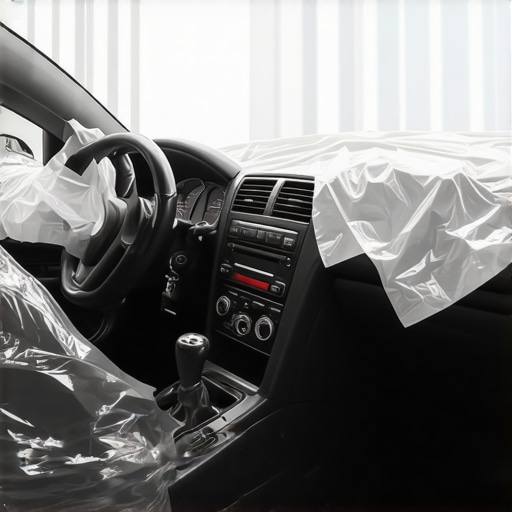
Modern vehicles are designed to be incredibly airtight to reduce road noise and improve HVAC efficiency. When you slam a car door, the interior cabin acts like a cylinder and the door acts like a piston. This creates a sudden, massive spike in air pressure. If the vehicle is sealed, that air has nowhere to go but against the glass. In a standard set-up, your weather stripping and cabin vents handle this. However, when a glass installer has just set a new windshield or side window, that glass is floating on a bed of wet, viscous urethane.
“Installation is just as critical as the window performance itself. A high-performance window installed poorly will fail.” – AAMA Installation Masters Guide
This urethane is the only thing holding the glass to the pinch weld. When that pressure spike hits, it can displace the bead, creating a microscopic channel in the adhesive. This is what we call a ‘blowout.’ You might not see it immediately, but the first time it rains, you will find water on your floorboards because that pressure gap has become a permanent leak path.
Thermal Expansion and Solar Heat Gain
In the South, where the radiant heat can turn a car into a furnace in minutes, the role of Solar Heat Gain Coefficient (SHGC) is paramount. When your car sits in the sun, the air inside expands. If your mobile service tech is performing a same-day chip repair or replacement, they are working with materials that are sensitive to these temperature fluctuations. We often talk about the Rough Opening in architectural glazing, but in a mobile context, the pinch weld is our rough opening. It must be perfectly prepared. When the sun hits the glass, the Low-E coatings (typically on Surface #2 for automotive glass) reflect some heat, but the air inside still builds pressure. By rolling down the window, you allow for continuous pressure equalization. This ensures the glass stays seated perfectly against the shims and the adhesive retains its structural profile as it transitions from a liquid to a solid state.
The Chemistry of the Cure
Whether we are talking about a full replacement or a chip repair, we are dealing with complex polymers. The resins used in chip repair are designed to have a specific refractive index to match the glass, but they also require a stable environment to bond with the Polyvinyl Butyral (PVB) interlayer. If the glass is under mechanical stress from internal air pressure, the resin cannot wick into the microscopic fissures of the break effectively.
“Environmental conditions during the curing phase are critical to the final structural performance of the sealant.” – AAMA 800 Sealant Standards
In a replacement scenario, the urethane requires moisture from the air to cure. Closing the car up tight can actually slow down this process in some climates, whereas leaving a window cracked ensures a steady supply of ambient humidity to trigger the chemical cross-linking. We also have to consider the ‘green strength’ of the adhesive. This is the initial holding power of the glue before it fully hardens. During this phase, the glass is vulnerable. Even a slight shift can cause the glazing bead to lose its aesthetic line or, worse, cause the glass to contact the metal frame, leading to a stress crack later on.
Anatomy of a Mobile Service
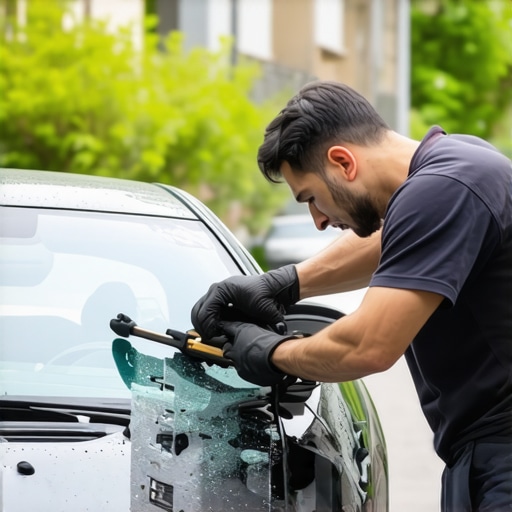
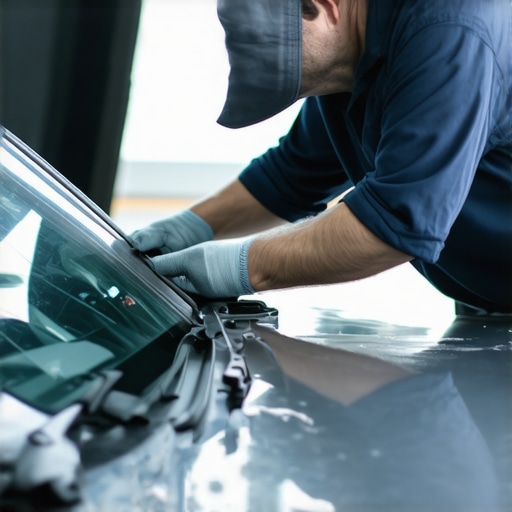
A professional glass installer does not just ‘swap’ glass. They manage a system. First, the old glass is removed, and the pinch weld is cleaned down to a thin layer of specialized OEM urethane. Any rust is treated because a sash is only as strong as the frame it sits in. We apply primers that act as molecular bridges between the glass frit and the metal. If we are doing a mobile service, we have to account for the slope of the ground where the car is parked. We use specialized shims to ensure the glass does not slide down before the urethane tacks up. We check the weep hole areas to ensure that any future moisture has an exit path, much like a sill pan in a residential window installation. Then, we apply the flashing tape—or in this case, retention tape—to hold the top edge. But all of these technical steps are negated if the owner creates a pressure vacuum or spike by sealing the cabin too early. It is the difference between a professional installation and a ‘caulk-and-walk’ job that will fail in six months.
The Critical Role of the Frit and the Sill Pan Logic
The black dotted band around the edge of your window is called the frit. It is not just decorative; it is a ceramic flux that protects the urethane from UV degradation and provides a rough surface for the adhesive to grab onto. In the world of high-end glazing, we treat this interface with the same respect as a structural silicone joint in a skyscraper. We ensure the glass is operable only after the initial set time has passed. This is why the ‘roll down’ rule is so vital. It protects the integrity of the frit-to-urethane bond. If you think of the bottom of the window frame like a sill pan, you realize that any displacement of the glass creates a gap where water can pool. Once water gets behind that urethane, the freeze-thaw cycles in Northern climates or the salt-air corrosion in Coastal areas will begin to eat away at the metal. A Master Glazier knows that water is a patient enemy. It will find the one millimeter where the pressure spike pushed the glue aside.
Final Verdict from the Glazing Bench
When you are looking for a glass installer, you are looking for someone who understands that they are not just fixing a chip; they are restoring the structural integrity of a safety component. A windshield is a structural member of the vehicle that supports the roof during a rollover and provides the backstop for the passenger-side airbag. Using a mobile service for same-day repair is efficient, but it requires the consumer to be a partner in the process. Respect the technician’s request to vent the cabin. It is the only way to ensure that the complex dance of chemical bonding, pressure equalization, and thermal management results in a window that is as clear and strong as the day it left the factory. Do not settle for installers who ignore these physics. Look for the ones who talk about humidity, cure times, and the Piston Effect. Those are the masters of the craft.