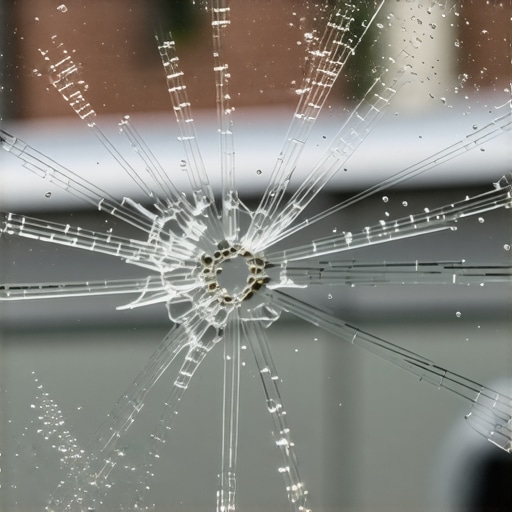
Why you should never ignore a chip in your line of sight
The Optical Deception and the Reality of Glass Tension
When you look through a window or a windshield and see a tiny pit, your brain likely classifies it as an annoyance. You see a disruption in your field of vision, a minor distortion of light. But as a master glazier with a quarter-century in the field, I see a ticking time bomb. A chip is not a static defect; it is a localized failure of a material that exists in a constant state of internal tension. Glass is an amorphous solid, a rigid structure that lacks the long-range order of a crystal, and when you introduce a point of impact, you are not just removing a flake of material. You are creating a stress concentrator that can, and will, compromise the entire lite. In my twenty-five years of experience, I have seen ‘insignificant’ chips transform into catastrophic spiderweb cracks in the span of a single afternoon, simply because the owner didn’t understand the physics at play.
“Installation is just as critical as the window performance itself. A high-performance window installed poorly will fail.” AAMA Installation Masters Guide
A homeowner once called me in a panic because their large picture windows were ‘sweating’ on the inside of the glass. I walked in with my hygrometer and showed them the humidity was 60 percent. It was not just their lifestyle, though; the root cause was a small, neglected chip near the glazing bead. That chip had created a micro-fracture that breached the secondary seal of the Insulated Glass Unit (IGU). Once that seal was compromised, the desiccant inside the spacer became saturated. What began as a visual distraction in their line of sight ended as a full-frame replacement because the structural integrity of the seal was gone. This is why a mobile service for same-day repair is not a luxury; it is a necessity for maintaining the envelope of your home.
The Anatomy of a Fracture: Why Chips Grow
To understand why you should never ignore a chip, we must look at the Glazing Zooming level of the material. Glass is incredibly strong under compression but surprisingly weak under tension. When a pebble or a piece of debris hits the glass, it creates a ‘cone’ fracture. This fracture radiates outward from the point of impact. Even if the chip appears stable, it is subject to the relentless laws of thermal expansion. In a NORTH/COLD climate, the internal surface of the glass is trying to stay warm while the exterior surface is subjected to sub-zero temperatures. This creates a massive thermal gradient. The molecules on the outside want to contract, while the molecules on the inside want to stay expanded. This tug-of-war happens right at the site of your chip. If the U-Factor of your window is high, the heat loss is greater, and the stress on that chip is amplified every time the furnace kicks on.
If you have an operable window, every time you open or close the sash, you are introducing mechanical vibration and torque. If that window was not perfectly leveled with the correct shim placement in the rough opening, the frame might be slightly out of square, putting constant pressure on the glass. A chip provides the path of least resistance for that pressure to release. A professional glass installer knows that a chip is a fracture waiting for a reason to travel. By utilizing a chip repair specialist immediately, you are injecting a clear, high-index resin that bonds the glass back together, effectively neutralizing the stress concentrator and restoring the structural continuity of the surface.
The NFRC Label and Your Line of Sight
We often talk about the NFRC (National Fenestration Rating Council) ratings in terms of energy, but they also reflect the quality of the glass being used. The Visible Transmittance (VT) of your window is a measure of how much light comes through. A chip doesn’t just block light; it refracts it, creating a glare that can be dangerous in certain lighting conditions. In high-performance glazing, we use Low-E coatings. If your chip is deep enough to reach the coating layer (usually Surface #2 or #3), it can lead to oxidation of the silver layer, resulting in a permanent, ugly bloom around the chip that no amount of cleaning can fix.
“Standard Practice for Installation of Exterior Windows, Doors and Skylights requires that the fenestration product be free of defects that compromise performance or safety.” ASTM E2112
The weep hole in your frame is designed to let moisture out, but if a chip is located near the bottom of the glass, it can actually draw moisture in through capillary action. This is particularly dangerous in freezing climates where that trapped water will expand as it turns to ice, instantly shattering the pane. This is the ‘shingle principle’ applied to glass: water must always be directed away from the structural core. A chip is a hole in that defense. When you hire a glass installer for same-day service, they aren’t just fixing a cosmetic issue; they are sealing a breach in your home’s thermal and moisture barrier.
The Science of Professional Chip Repair
Modern chip repair is a feat of chemical engineering. A mobile service technician will first clean the site to remove any microscopic debris or moisture. They then use a vacuum tool to pull the air out of the fracture. This is critical. If you leave air in the crack, the resin won’t bond properly, and the repair will be visible. Once the vacuum is established, they inject a specialized resin with a refractive index nearly identical to the glass itself. This resin is then cured using specific ultraviolet wavelengths. This process doesn’t just hide the chip; it reinforces the sash and prevents the crack from migrating. If you wait, dust and oils from the atmosphere will migrate into the crack, making a clean repair impossible and forcing a full replacement of the glass lite. Don’t let a twenty-dollar repair turn into a thousand-dollar glazing bead and glass replacement project. Respect the physics of your home and address the chip before the next temperature swing dictates the terms of your repair.