Why your mobile tech needs exactly one hour of dry weather
The Hidden Science of the One-Hour Dry Window
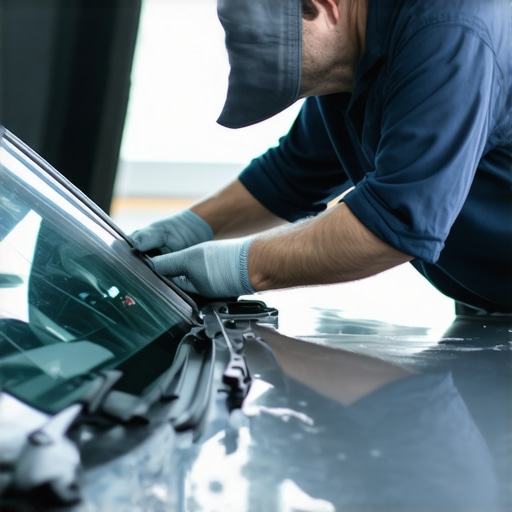
When you call for a mobile service to handle a chip repair, the first thing the dispatcher usually asks is about the weather. It is not because the glass installer is afraid of getting a little wet. It is because the physics of glass bonding are ruthlessly unforgiving. After twenty-five years in this trade, I have seen every shortcut in the book, and I can tell you that moisture is the absolute enemy of structural integrity. I once walked onto a job site where a homeowner was frantic because their same-day repair on a high-performance laminated pane had turned into a milky, opaque mess. I pulled out my digital hygrometer and showed them that the relative humidity near the glass surface was nearly 85 percent. They had tried to ‘pre-wash’ the glass with a garden hose minutes before I arrived. I had to explain that by trying to be helpful, they had essentially created a microscopic lake inside the break that no amount of industrial suction could fully clear. We had to wait for the dew point to shift because a glass installer who ignores moisture is just a person making a mess.
“Installation and repair materials must be applied to clean, dry surfaces. The presence of moisture can inhibit the chemical bond of the resin to the glass substrate, leading to premature failure of the repair.” – ASTM E2112 Standard Practice
The Molecular Battle: Resin vs. Water
To understand why we need that sixty-minute dry window, we have to look at the Glazing Bead and the microscopic landscape of the glass itself. Glass may look smooth, but at a molecular level, it is a jagged terrain of silica. When a stone hits your window, it creates a ‘bullseye’ or a ‘star break’—a series of microscopic fissures. If it is raining, or even if there is heavy fog, capillary action pulls H2O molecules deep into those cracks. Water has a lower refractive index (1.33) than glass (1.52). The chip repair resin we use is specifically engineered with a refractive index of approximately 1.51 to 1.53 to make the damage disappear. If even a trace of water remains, the resin cannot ‘wet’ the surface of the silica. Instead of a structural bond, you get a ‘ghost’ image where the light bends incorrectly, and more importantly, the water prevents the resin from reaching the very tip of the crack. This is where the Rough Opening of the crack remains vulnerable. During the next freeze-thaw cycle in our cold northern climate, that trapped moisture expands with a force of several thousand pounds per square inch, and your simple chip becomes a full-pane replacement.
The Role of UV Curing and Vapor Pressure
A professional mobile service uses anaerobic or UV-cured resins. These polymers require a pristine environment to transition from a liquid to a solid. If the tech arrives and the glass is damp, the curing process is compromised. The UV light used to harden the resin will not properly penetrate a water-resin emulsion. We talk about ‘Surface #2’ and ‘Surface #3’ in the glazing world when discussing Low-E coatings, but in repair, we are worried about the ‘wetting’ ability of the resin on the primary surface. In a cold climate like ours, U-Factor is king. We need to maintain the thermal envelope. A failed repair allows air infiltration, which ruins the insulating value of the window. When we ask for an hour of dry weather, we are allowing the vapor pressure to equalize so that any residual moisture can evaporate out of the break. I have seen the ‘Bucket-and-Squeegee Hack’ where amateurs try to blow-dry a chip with a heat gun. All that does is stress the glass and potentially cause a thermal crack. Patience is the only tool that works.
“A high-performance window or repair installed poorly will fail to meet its rated specifications, regardless of the quality of the glass components themselves.” – AAMA Installation Masters Guide
The Physics of Humidity in Cold Climates
In regions where the mercury drops below freezing, the ‘One Hour Rule’ is even more critical. Cold air is dry, but the moment it hits a warmer glass surface, you get condensation. If I am performing a same-day chip repair in the winter, I have to manage the temperature of the glass carefully. If the glass is too cold, the resin viscosity increases, and it won’t flow into the tightest Sash fissures. If it’s too damp, the resin will ‘bloom,’ turning a white color that is impossible to fix later. We use Flashing Tape and temporary shelters sometimes, but nothing beats natural dry air. The Rough Opening for the repair must be bone dry so the Sill Pan effect of the break doesn’t trap contaminants. When we talk about Weep Hole technology in frames, it is about moving water away; in glass repair, we don’t have that luxury. We have to ensure the water was never there to begin with.
Why Same-Day Service Depends on the Sky
Consumers love the idea of same-day service, and as a glass installer, I want to provide it. But I won’t sacrifice my reputation for a ‘caulk-and-walk’ fix. If the sky is gray and the humidity is climbing, that hour of dry weather is your only guarantee that the chip repair will last for the life of the window. We are looking for a window of time where the substrate temperature is at least five degrees above the dew point. This ensures that the resin can achieve a covalent bond with the silica. Anything less is just a temporary patch that will fail the moment the wind pressure hits it. Don’t buy the hype of the ‘all-weather’ repair kit; buy the expertise of a tech who knows when to wait. Success in glazing is 10 percent technique and 90 percent environmental management. When the sun finally breaks through and the glass dries, that is when the real magic happens, and your window’s structural integrity is restored.