
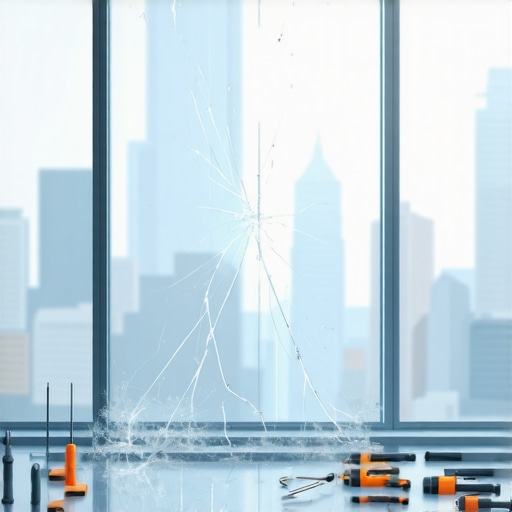
3 Reasons 2026 Smart Glass Fails Without Pro Chip Repair Services
The High-Tech Mirage: Why Your 2026 Smart Glass is at Risk
By 2026, the standard for high-end residential glazing has shifted from passive Low-E coatings to active electrochromic systems. We are talking about windows that change their Solar Heat Gain Coefficient (SHGC) with the flick of a digital switch. But here is the cold, hard truth from someone who has spent twenty-five years staring through a rough opening: the more complex the glass, the more catastrophic a simple chip becomes. I have seen homeowners spend a fortune on switchable glazing only to watch the entire system fail because they ignored a microscopic rock chip. They think it is just a cosmetic blemish, but in the world of smart glass, a chip is a system-wide hardware failure.
I remember walking into a luxury build in the high desert where the owner had installed floor-to-ceiling smart panes. They called me in a panic because their master bedroom window was ‘stuck’ in a permanent dark tint while the rest of the house was clear. I walked in with my hygrometer and a thermal camera. I did not even need the sensors to see the problem. A tiny, star-shaped chip near the glazing bead had allowed a microscopic amount of atmospheric moisture to enter. The humidity inside the house was 55 percent, but inside that glass unit, it was a disaster zone. The moisture had shorted out the conductive Indium Tin Oxide (ITO) layer. It was not a manufacturing defect; it was a maintenance failure. The owner waited three weeks to call a glass installer, and by then, the Indium Tin Oxide had oxidized. The ‘smart’ part of the glass was effectively dead.
“Installation and long-term maintenance of the building envelope are the primary determinants of fenestration longevity. Even the most advanced glazing systems are subject to the laws of thermodynamics and moisture migration.” – ASTM E2112 Standard Practice
1. The Breakdown of the Electrochromic Circuit
When we talk about smart glass in 2026, we are talking about a sandwich of thin-film ceramic materials. To get that glass to tint, we run a low-voltage current through a transparent conductive layer. When a pebble hits your window and creates a chip, it does more than just displace glass; it severs that conductive path. Think of it like a trace on a circuit board. If that circuit is broken, the ions cannot migrate across the electrochromic stack. In a hot climate like Phoenix or Miami, where you rely on a low SHGC to keep your cooling bills under five hundred dollars a month, a failed smart window becomes a massive thermal liability.
A mobile service specialist using vacuum-injection resin is the only way to save this tech. If you do not get a same-day chip repair, the electrical potential across the glass will start to degrade at the edges of the fracture. This creates ‘hot spots’ where the resistance is higher. I have seen these spots reach temperatures that can actually cause the glass to undergo spontaneous thermal breakage. You are not just repairing a chip; you are restoring a circuit. If the glass installer does not understand the impedance of the glass they are working on, they might as well be smearing toothpaste on the crack.
2. The Argon Escape and the Death of the U-Factor
Most 2026 smart glass units are dual-pane or triple-pane systems filled with Argon or Krypton gas to keep the U-Factor low. The U-Factor measures how well a window prevents non-solar heat flow. In the South, we care more about SHGC, but the U-Factor still matters when the sun goes down. A chip often penetrates the first lite of glass, compromising the primary seal. Once that seal is breached, the heavy inert gas escapes, replaced by moisture-laden ambient air. This is why same-day service is not a luxury; it is a technical necessity.
Once the gas is gone, your high-tech window reverts to the performance of a 1980s builder-grade unit. You start seeing condensation on the sash, and eventually, the weep holes cannot keep up with the internal drainage. This leads to sill pan corrosion and eventual rot in the rough opening. As a master glazier, I can tell you that moisture is a patient killer. It starts at the chip and ends at your structural headers. A professional chip repair uses a specific refractive-index resin that not only hides the damage but recreates the structural integrity of the lite, effectively resealing the vacuum environment before the Argon is lost to the atmosphere.
“The performance of a fenestration product is only as good as its weakest point. A breach in the glass surface or seal can result in a 40 percent loss in thermal efficiency within forty-eight hours.” – NFRC Performance Guidelines
3. Thermal Stress and the ‘Spider-Web’ Effect
Smart glass absorbs a significant amount of energy when it is in its tinted state. This is by design. It converts solar radiation into heat which is then re-radiated back outside. However, this creates an immense amount of thermal stress across the pane. A chip acts as a stress concentrator. In a mobile service context, we see this all the time: a small chip that looks stable at 7:00 AM becomes a foot-long crack by 2:00 PM when the sun hits that face of the building. The glass expands, but the area around the chip cannot distribute the stress evenly.
If you are not using a glass installer who understands the physics of ‘Surface #2’ coatings, you are asking for trouble. In southern climates, the Low-E or smart coating is almost always on the second surface (the inner side of the outer pane) to reflect heat before it even enters the air gap. A chip disrupts the uniformity of this heat absorption. Without chip repair, the localized expansion will overwhelm the shimming tolerances in the frame. I have seen operable windows become fused shut because the glass expanded so much it warped the sash, all because of a single untreated chip. A same-day repair stabilizes the tension, allowing the glass to expand and contract as it was engineered to do.
The Glazier’s Verdict on 2026 Technology
We are entering an era where windows are gadgets, not just building materials. But these gadgets are installed in a harsh, unforgiving environment. You have wind loads, UV degradation, and the constant threat of debris. Choosing a glass installer who offers specialized mobile service for smart glass is the only way to protect your investment. Do not trust a general handyman with a chip repair on a switchable lite. They do not understand the glazing bead pressure or how to avoid damaging the bus bars that power your tint. When your glass is smart, your repair strategy has to be smarter. Keep the moisture out, keep the gas in, and for the sake of your home’s structure, never ignore a chip until it becomes a replacement.