
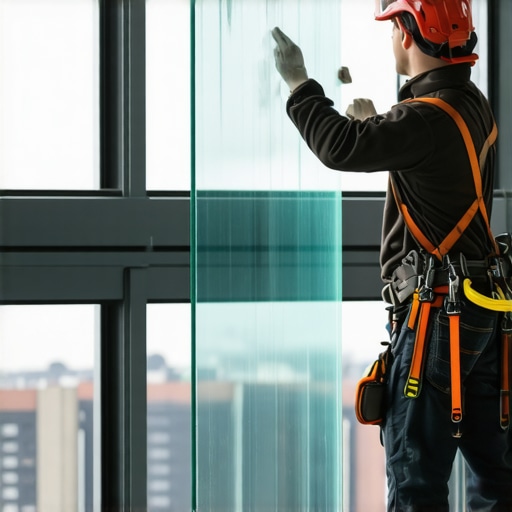
3 Things Your 2026 Glass Installer Needs to Check for Safety
Precision in Glazing: The 2026 Standard for Glass Safety
I have spent over a quarter-century in this trade, from hauling 300-pound lites of laminated glass up scaffolds to the meticulous work of historic restoration. In my 25 years as a master glazier, I have seen every shortcut in the book. There is a specific kind of frustration that builds when you see a ‘caulk-and-walk’ installer slap a high-performance unit into a Rough Opening without a second thought for the physics involved. By 2026, the complexity of residential and commercial glass has reached a point where a simple visual check is no longer enough. Whether you are calling for a mobile service for a chip repair or a full-scale replacement, the safety of your building envelope depends on technical precision, not just aesthetic finish.
The Condensation Crisis: A Narrative of Misdiagnosis
I remember a call I took last November in a high-end subdivision. The homeowner was frantic because their brand-new, expensive windows were ‘sweating’ profusely on the exterior. They were convinced the glass installer had sold them defective units. I arrived with my hygrometer and a thermal imaging camera. Within five minutes, I showed them that the humidity in the house was sitting at 65% while the outside air was dropping through the Dew Point. The windows weren’t failing; they were actually performing so well that the exterior pane was staying cold enough to condense atmospheric moisture. This wasn’t a product failure; it was a failure of the HVAC system to manage indoor air quality in a ‘tight’ house. It is a prime example of why understanding the science of the Sash and its environment is more important than the brand name on the sticker.
1. Structural Integrity and the Rough Opening Tolerance
The first thing any qualified installer must check in 2026 is the structural squareness and load-bearing capacity of the Rough Opening. As we move toward larger glass spans and triple-pane units, the weight of the glass has increased significantly. A standard double-pane unit might weigh 3 to 4 pounds per square foot, but modern high-performance glass can easily double that. If your installer does not use high-density plastic shims at the quarter-points to transfer that weight directly to the structural framing, you are looking at a future of operational failure.
“Installation is just as critical as the window performance itself. A high-performance window installed poorly will fail.” – AAMA Installation Masters Guide
We look for more than just ‘level.’ We look for the Sill Pan integrity. In 2026, a glass installer must ensure that the sill is not just flat, but sloped toward the exterior with a back-dam. If water gets past the primary Glazing Bead—and eventually, it will—it must have a clear path to the Weep Holes and out of the building. Without a properly integrated Flashing Tape system that follows the ‘shingle principle’ (where the top layer always overlaps the bottom), that water will find its way into your wall cavity, rotting the king studs and trimmers long before you ever see a leak on the drywall.
2. Thermal Stress and Low-E Positioning Science
In our northern, colder climates, the enemy is heat loss. Every glass installer must be an expert in the U-Factor, which measures the rate of non-solar heat flow. However, the safety check often missed is the risk of thermal stress fractures. When we apply a Low-E (Low-Emissivity) coating to Surface #3 (the indoor-facing side of the inner pane), we are reflecting long-wave infrared radiation back into the room. This is great for comfort, but it creates a massive temperature differential between the center of the glass and the edges Shimmed into the cold frame.
If the installer hasn’t accounted for the expansion and contraction rates of the frame material—whether it’s vinyl, fiberglass, or thermally broken aluminum—the glass can spontaneously crack. This isn’t a chip repair situation; it’s a total unit failure. In 2026, we use digital sensors to check the ‘edge-of-glass’ temperature. We ensure that the Glazing Bead allows for at least 1/8 inch of lateral movement. If the glass is ‘tight’ in the frame, the first cold snap of January will snap the glass as the frame shrinks around it.
3. The Secondary Seal and Gas Retention Check
For same-day service calls involving mobile service, the most critical safety check is the integrity of the Insulated Glass Unit (IGU) seal. Most modern windows use a dual-seal system: a primary seal of polyisobutylene (PIB) and a secondary structural seal of silicone or polysulfide. This system holds in the Argon or Krypton gas that provides your insulation. If that seal is compromised, even by a microscopic amount, the gas escapes and is replaced by moisture-laden air.
“The field technician shall verify that the perimeter seal is continuous and that no voids exist in the sealant bedding that could allow for air or water infiltration.” – ASTM E2112 Standard Practice
In 2026, we don’t just look for fog. We use an Argon gas analyzer to verify the concentration levels. If the concentration drops below 80%, the U-Factor of the window is shot. This creates a safety issue regarding the Dew Point on the interior surface, which can lead to mold growth on the Muntins and Sash. A professional glass installer must verify that the Weep Holes are clear and that the Sill Pan is not holding standing water, which would eventually degrade the secondary seal through hydrostatic pressure.
Conclusion: The Science of the Opening
Ultimately, a window is not just a piece of glass; it is a complex mechanical assembly. Whether it is an operable casement or a fixed picture window, it must manage wind loads, thermal transfer, and moisture redirection. Don’t be fooled by high-pressure sales tactics focusing on ‘energy savings’ that take a century to recoup. Focus on the installation. Demand to see the Flashing Tape integration and the Sill Pan before the trim goes on. In 2026, safety isn’t just about glass that doesn’t break; it’s about a window system that doesn’t destroy your home from the inside out. Your glass installer should be a technician of the building envelope, not just a salesman with a level.
This article really highlights the importance of detailed attention during window installation, especially with the evolving complexity of modern glass units. I totally agree that the structural integrity of the rough opening and proper flashing are critical; I’ve seen too many cases where overlooking these details causes costly leaks and failures down the line. One thing I’ve noticed is that many newer installers still rely heavily on visual cues and overlook the value of digital tools like sensors for temperature and gas concentration testing. Have others here integrated these tech solutions into their workflow? I think it’s a game-changer for ensuring the long-term performance and safety of high-performance glazing.
This post certainly underscores the growing complexity in glass installation standards for 2026. From my experience, paying meticulous attention to details like proper shimming and flashing tape isn’t just an option anymore, it’s a necessity. I’ve found that on-site digital tools, like infrared sensors for checking thermal profiles and gas analyzers, dramatically improve our ability to verify seal integrity and prevent future failures. It’s interesting how technology can serve as both a safeguard and a teaching aid for new installers still mastering the nuances of proper installation techniques. Regarding the secondary seal integrity, I’ve wondered if others have employed regular gas concentration monitoring as a standard practice? It seems like a proactive approach that could greatly reduce call-backs due to seal failures. What are some of the biggest challenges you’ve encountered when integrating these sensors into the workflow, and how have you overcome them? Overall, the emphasis on precision aligns with my belief that proper installation today saves countless headaches in the future.
Reading this post really highlights how crucial attention to detail becomes as we move into the 2026 standards. I’ve personally experienced situations where neglecting proper shimming or failing to verify the integrity of the secondary seal led to long-term issues like gas loss or moisture ingress. Using digital sensors to check the edge-of-glass temperature and gas concentration has become a game changer in my workflow; it gives confidence that the seals will perform as intended over the years. One challenge I faced was integrating these sensors into a tight on-site schedule, but training my team on quick, accurate testing methods helped us keep up without sacrificing quality. Has anyone else found that these tech tools require special handling or calibration to stay reliable over time? Also, how do you educate clients on these high-tech checks versus just showing them the finished product? I believe such practices elevate the profession and truly align with the goal of creating safer, more durable windows.