
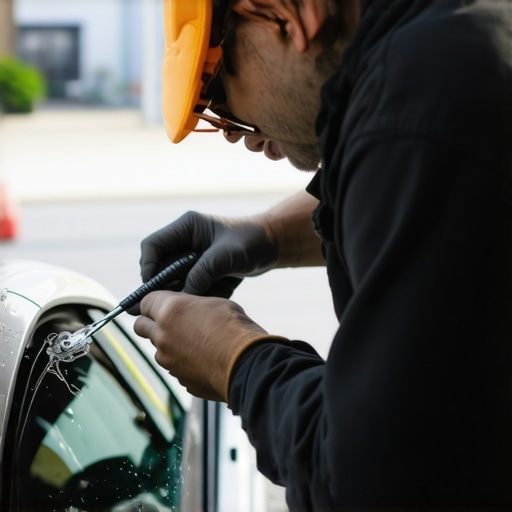
Fix That $50 Rock Chip Fast With 2026 Mobile Service
The Anatomy of a Fracture: Why That Tiny Star-Break is a Structural Time Bomb
I’ve spent over two decades looking at glass through a critical lens, from the massive curtain walls of city skyscrapers to the delicate sash of a 19th-century Victorian. One thing I have learned is that glass is never truly static. It is a material under constant tension and compression. When a rock hits your glass at 60 miles per hour, it creates more than a cosmetic blemish; it initiates a localized structural failure. In my years as a glazier, I have seen homeowners ignore a small chip only to have it spider-web across the entire surface the moment they turn on their defroster on a frosty morning. I recall one specific instance where a client in a high-wind region called me in a panic. They had a minor ‘bullseye’ chip that they ignored for a month. While I was on-site checking their Rough Opening tolerances for a different project, a sudden temperature drop caused the glass to contract. Right before our eyes, that $50 repair turned into a $1,200 full-replacement job because the thermal stress exceeded the shear strength of the compromised laminate.
“Installation and maintenance of glazing materials must account for thermal expansion and contraction cycles to prevent premature failure of the glass assembly.” – ASTM E2112 Standard Practice for Installation of Exterior Windows
The Physics of Laminated Glass and Resin Injection
To understand why our 2026 mobile service is so effective, you have to understand the ‘Sandwich’ of modern safety glass. This isn’t your standard single-pane float glass. We are dealing with two layers of glass bonded together by a Polyvinyl Butyral (PVB) interlayer. When a rock hits, it usually only damages the outer layer. The goal of a professional chip repair is to evacuate the air trapped within the fracture and replace it with a clear, UV-curable resin that matches the refractive index of the glass. Our mobile service technicians don’t just ‘fill’ a hole; they use a specialized bridge and injector system to create a vacuum. This pulls the moisture and air out of the break—critical because trapped moisture will freeze, expand, and shatter the glass from the inside out. Once the vacuum is achieved, we inject a high-viscosity resin that bonds at a molecular level to the glass and the PVB. This isn’t a ‘caulk-and-walk’ operation. If the resin viscosity is wrong for the ambient temperature, the repair will be visible and structurally weak. This is why we monitor the ‘Dew Point’ and glass temperature before we even open our toolkits.
Mobile Service Logistics: Precision on the Go
You might wonder if a same-day mobile service can match the quality of an in-shop repair. The answer lies in the equipment and the environment. While we don’t need a Sill Pan or Flashing Tape for a windshield chip, we apply the same level of precision as we would when setting a 400-pound Sash into a luxury home. Our 2026 mobile units are equipped with climate-controlled resin storage. If the resin is too warm, it becomes too thin and won’t hold the tension; if it’s too cold, it won’t penetrate the micro-cracks at the edges of the chip. We ensure the glass surface is stabilized, often using Shims for our bridge equipment to ensure a perfectly level injection site. This level of detail is what separates a professional glass installer from a DIY kit you’d find at a hardware store. We aren’t just hiding the mark; we are restoring the structural integrity of the laminated assembly.
“The performance of a glazing system is only as reliable as the smallest point of its compromise. Prompt repair of surface defects is essential to maintaining the design pressure ratings of the unit.” – AAMA Installation Masters Guide
Thermal Stress: The Enemy of the Compromised Chip
In a cold climate, the ‘U-Factor’ of your glass matters, even in your vehicle. When you blast the heater on a freezing morning, the inner layer of glass expands rapidly while the outer layer remains cold. This differential expansion creates massive stress at the point of any existing chip. Conversely, in a hot climate, the ‘Solar Heat Gain’ (SHGC) can cause the glass to reach temperatures well over 140 degrees Fahrenheit. If you have a chip and then hit it with a blast of cold air from the AC, the glass can ‘self-destruct.’ By utilizing our 2026 chip repair technology, we use resins with thermal expansion coefficients that mimic the glass itself. This means that when the glass expands in the sun, the resin expands with it, preventing the ‘starring’ effect that ruins most amateur repairs. We don’t just look at the Glazing Bead or the Muntin layout; we look at the molecular bond. This is how we provide a same-day solution that lasts for the life of the glass. Don’t wait for the crack to reach the edge of the frame—by then, the Weep Hole drainage and the Operable parts of your window system won’t matter, because the glass itself will be a total loss.