
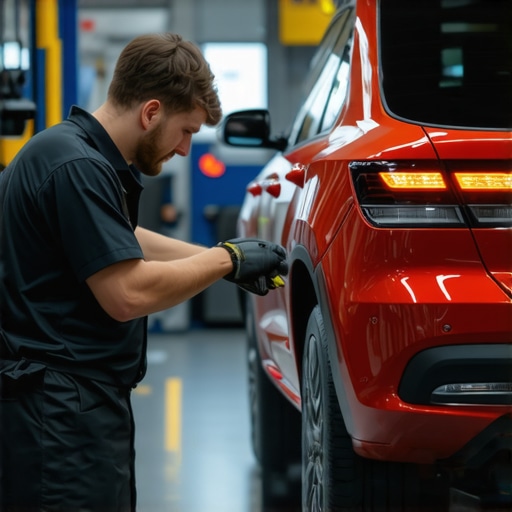
Fix It Fast: 15-Minute Chip Repair Services for 2026 Drivers
That distinctive, sharp ‘ping’ against the glass is a sound every driver dreads. It is the sound of a rock or piece of road debris impacting your laminated safety glass at high velocity, initiating a microscopic fracture that, left unaddressed, will inevitably compromise the structural integrity of your entire viewport. In my twenty-five years as a master glazier, I have seen thousands of these ‘minor’ chips transform into catastrophic failures. A window is not merely a piece of transparent material; it is a complex engineered system designed to manage thermal stress, wind load, and structural safety. When you are driving a 2026 model vehicle, that glass is likely an integral part of your Advanced Driver Assistance Systems (ADAS), housing cameras and sensors that require absolute optical clarity. A 15-minute chip repair isn’t just a convenience; it is a high-tech surgical intervention designed to restore the refractive index and structural bond of the glazing unit before the environment tears it apart.
The Miami Incident: A Case Study in Thermal Shock
A homeowner, who also happened to be a daily commuter in a high-humidity coastal region, once called me in a panic because their windshield had ‘spontaneously’ cracked across its entire width while parked in their driveway. I arrived with my hygrometer and thermal imaging camera to perform an autopsy on the failure. The culprit wasn’t a manufacturing defect; it was a tiny, neglected bullseye chip. I showed them how the humidity—which was hovering at 75%—had allowed moisture to penetrate the pit of the chip. When they started the vehicle and blasted the air conditioning on ‘Max Frost’ to combat the 95-degree Florida heat, the thermal gradient between the sun-scorched outer ply and the rapidly cooling inner ply created a massive stress concentration at the site of the chip. The moisture inside the fracture underwent a rapid pressure change, and the glass, following the path of least resistance, ‘ran.’ It wasn’t the window’s fault; it was a failure to manage the dew point and thermal expansion. This is why immediate, same-day chip repair is mandatory, not optional.
“Installation is just as critical as the window performance itself. A high-performance window installed poorly will fail.” – AAMA Installation Masters Guide
The Science of Laminated Safety Glass and Resin Technology
To understand why a 15-minute mobile service is so effective, you must understand what you are actually repairing. Modern automotive glass is a sandwich: two plies of soda-lime glass bonded together by a Polyvinyl Butyral (PVB) interlayer. This interlayer is what keeps the glass from shattering into dangerous shards during an impact. When a rock hits the glass, it usually only damages the outer ply, creating a void or ‘break.’ As a glass installer, my goal is to evacuate the air and moisture from that void and replace it with a specialized anaerobic resin. We aren’t just ‘filling a hole.’ We are performing a molecular bond. The resins we use are methacrylate esters with specific viscosities measured in centipoise (cP). For a tight star-break, we use a low-viscosity resin (about 10-20 cP) that can penetrate the microscopic ‘legs’ of the fracture through capillary action. For a larger bullseye, we might use a higher-viscosity resin to provide better structural support. The ultimate goal is to match the refractive index of the glass, which is approximately 1.51. If the resin’s index is off by even a fraction, you will see a ‘ghost’ or a shimmer where the repair was made, which can interfere with the focal length of ADAS cameras.
Climate Logic: Why the ‘South/Hot’ Context Demands Speed
In hot climates like Texas, Arizona, or Florida, the enemy of your glass is Solar Heat Gain Coefficient (SHGC). Your windshield acts as a massive solar collector, absorbing radiant heat and transferring it to the cabin. This heat causes the glass to expand. If there is a chip, that expansion puts immense pressure on the ‘stress risers’—the sharp points at the edge of the break. In these environments, we use Low-E technology on architectural windows to reflect heat, but on a vehicle, we rely on the speed of the repair. A mobile service technician must work in the shade; if the glass is too hot, the resin will cure prematurely before it has fully permeated the break. We use a bridge and injector system to create a vacuum, pulling the air out of the fracture, then switching to a pressure cycle to force the resin into every microscopic crevice. This prevents the ‘bloom’ of a crack that occurs when trapped air expands under the southern sun.
“Proper sealing of the glazing perimeter is essential to prevent moisture ingress and structural degradation.” – ASTM E2112
The 15-Minute Protocol: What Happens in the Tech’s Van
When a mobile glass installer arrives, they are following a precise technical protocol. First, the ‘Rough Opening’ of the chip is cleaned of any loose glass shards using a carbide scribe. Next, the bridge is centered over the impact point. The vacuum cycle is the most critical phase. By removing the air, we ensure that the resin will have 100% surface contact with the interior walls of the glass break. Once the resin is injected and the pressure cycle is complete, a UV curing light is applied. We use a specific wavelength, typically between 365nm and 400nm, to trigger the photo-initiators in the resin. This causes the liquid monomers to cross-link into a solid polymer in seconds. Finally, a pit filler resin is applied to the surface to create a flush finish with the rest of the glazing bead, and the area is polished. This entire process, when executed by a professional, takes roughly 15 minutes, but it effectively ‘welds’ the glass back together, restoring up to 95% of its original structural strength. In the context of 2026 driving, where head-up displays (HUD) project vital information directly onto the glass, this optical restoration is paramount. If you wait, you aren’t just risking a crack; you are risking the calibration of your vehicle’s safety net.
Why ‘Caulk-and-Walk’ Solutions Fail
I have an absolute intolerance for DIY kits or ‘caulk-and-walk’ installers who simply smear a bit of resin over the top of a chip and call it a day. Without the vacuum/pressure cycle, you are leaving air trapped inside. That air will expand and contract with every temperature shift, eventually forcing the fracture to grow. Furthermore, a professional glass installer understands the ‘shingle principle’ of water management—even on a micro-scale. We ensure the seal is airtight and watertight so that the PVB interlayer is protected from delamination. If water reaches the PVB, it will begin to cloud and turn a milky white, a permanent defect that no resin can fix. Don’t settle for a sub-par repair when the physics of your safety are on the line. Trust the tech, trust the science, and get it fixed fast.
This post provides an incredibly detailed explanation of why quick, professional chip repairs are essential, especially for modern vehicles with ADAS technology. I’ve seen firsthand how neglecting small chips can lead to costly window replacements, which are not only expensive but also impact safety and vehicle calibration. The emphasis on the vacuum and pressure cycle during repair is particularly interesting, as it highlights the precision required to restore optical clarity and structural integrity effectively. Living in a southern climate, I can attest to how rapid temperature changes and intense sunlight accelerate stress on chips already in place. It makes me wonder, for drivers in varied climates, what are the best practices for maintaining windshield health before damage occurs? Also, does anyone have insights on at-home solutions that might temporarily mitigate damage until professional repair can be performed? Overall, this reinforces how crucial it is to act quickly and trust the professionals for such delicate repairs.