How to spot a technician who is cutting corners on adhesive prep
The Illusion of Speed in Glass Repair
In the world of glass repair, the phrases mobile service and same-day repair have become the sirens’ song for homeowners and vehicle owners alike. We live in a culture of immediacy, where the interval between a rock chip appearing and a technician arriving is shrinking. However, as a master glazier with a quarter-century in the trenches, I have seen the wreckage left behind by the ‘fast and cheap’ philosophy. When you are dealing with a material as temperamental as glass, speed is often the enemy of structural integrity. A window or a windshield is not merely a transparent barrier; it is a critical structural component that must withstand wind loads, thermal expansion, and mechanical stress. If the adhesive prep is botched, the entire system is compromised. Spotting a technician who is cutting corners requires an eye for the technical nuances of surface energy and chemical bonding. It is not about how fast the chip repair looks ‘gone,’ but about how the technician manages the invisible layer of contamination that exists on every square inch of silica.
The Condensation Crisis: A Narrative of Failed Physics
A homeowner called me in a panic because their new windows were ‘sweating’ only inside the glazing pocket, and a recent chip repair on their large picture window had turned a milky, opaque white within forty-eight hours of a mobile service visit. I walked in with my hygrometer and a thermal imaging camera to perform an autopsy on the failure. I showed them that the internal humidity was 60 percent, but the real culprit was the technician’s ignorance of the dew point. The mobile tech had arrived on a humid morning, hit the glass with a standard cleaner, and injected resin immediately. It wasn’t the windows that were defective; it was the installation environment. By failing to bring the glass temperature above the dew point and properly evacuating the moisture trapped within the microscopic fissures of the chip, the technician had effectively sealed a pocket of water inside the glass. Under the UV curing lamp, that moisture reacted with the resin, leading to a total bond failure. This is the hallmark of a corner-cutter: they treat the glass as a static surface rather than a dynamic substrate that reacts to its environment. As the AAMA Installation Masters Guide states:
“Installation is just as critical as the window performance itself. A high-performance window installed poorly will fail.” – AAMA Installation Masters Guide
The Anatomy of a Failed Bond: Why Surface Prep is Non-Negotiable
When a glass installer approaches a repair or a full replacement, the first thing they should reach for isn’t the adhesive; it’s the decontamination kit. Glass is a high-energy surface, which means it naturally wants to bond with other materials. However, it is almost always covered in a ‘tapestry’ of oils, silicone residues from car washes, and environmental pollutants. A technician who is rushing will do a quick wipe with a blue paper towel and move on. This is a red flag. A professional glazier understands the ‘Shingle Principle’ of cleaning: you must move contaminants off the surface, not just spread them around. If you see a tech using the same side of a rag for more than one pass, they are re-contaminating the site. In a mobile service context, wind-blown dust is a constant threat. A technician cutting corners will ignore the micro-debris that settles on the rough opening or the sash while they are prepping their tools. Every speck of dust acts as a bond-breaker. When we talk about adhesive prep, we are talking about creating a molecular bridge between the glass and the polymer. This requires a chemical cleaner—usually a high-purity isopropyl alcohol or a specialized glass activator—that leaves zero residue. If the technician uses a standard household glass cleaner containing ammonia or surfactants, they are essentially applying a layer of ‘non-stick’ coating to the glass before they try to glue it. It is a recipe for a leak or a structural failure during the next thermal cycle.
Technical Zooming: The Physics of Resin and Urethane
To understand why adhesive prep is so vital, we must look at the behavior of long-wave infrared radiation and thermal expansion. In northern, cold climates, the U-Factor of the glass is the primary concern. When a technician performs a chip repair, the resin must have a similar coefficient of expansion to the glass itself. If the technician skips the step of mechanically cleaning the chip—often involving a small drill to create a clean ‘Rough Opening’ within the break—the resin will only bond to the jagged, dirty edges of the glass. Over the winter, as the glass contracts, the resin will pull away, creating a ‘shiner’ or a secondary crack. Furthermore, the use of a primer is a major point of corner-cutting. In many structural glazing applications, a primer is required to protect the urethane bond from UV degradation. UV light can penetrate through the glass and attack the bond line from the back. A technician who skips the black-out primer is ensuring that the adhesive will become brittle and fail within three to five years. They rely on the fact that you won’t notice the failure until they are long gone. This is why ASTM E2112 exists.
“The use of compatible materials and the strict adherence to manufacturer-specified flash-off times for primers are essential for the long-term weatherability of the fenestration assembly.” – ASTM E2112 Standard Practice
The Red Flags of a Mobile Tech Cutting Corners
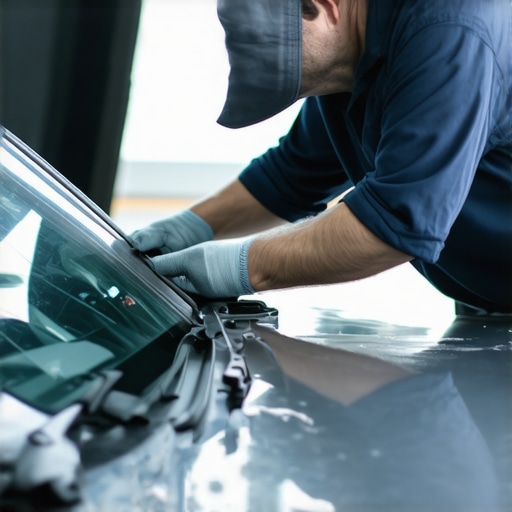
How do you spot these shortcuts in real-time? First, watch their handling of the glazing bead and the sash. If they are prying things off with a screwdriver and leave gouges in the frame, they are not a precisionist. In a proper glass replacement, the sill pan and the flashing tape must be inspected. Even in a mobile chip repair, the ‘frame’ is the surrounding glass. If the technician does not use a vacuum pump to evacuate the air from the chip, they are cutting a major corner. Same-day service often pressures techs to skip the vacuum cycles. Without a vacuum, air is trapped in the break, preventing the resin from reaching the tip of the crack. This trapped air will expand when the sun hits the glass, forcing the crack to spread. Another sign is the ‘flash-off’ time. Every chemical prep agent requires time to evaporate. If the tech wipes a primer and immediately applies the adhesive or resin, they are trapping solvents in the bond. This weakens the polymer chain, leading to a soft, gummy bond that will eventually leak. You want to see a technician who is patient, who checks the temperature of the glass with an infrared thermometer, and who isn’t afraid to tell you that the repair needs to wait thirty minutes for the surface to stabilize. They should be looking at the weep holes in a window frame or the drainage channels in a vehicle’s cowl to ensure that the environment is dry and ready for a permanent bond. If they ‘caulk-and-walk,’ ignoring the underlying sash health or the presence of old, failing sealants, they are not a glazier; they are a salesman in a high-vis vest.
The Math of Quality: ROI vs. Immediate Cost
Many people choose the fastest mobile service because it’s convenient. But the math of glass repair is unforgiving. A properly executed chip repair, with full adhesive prep and moisture evacuation, can last the life of the glass. A corner-cut repair will fail, necessitating a full glass replacement that costs ten times more. The same logic applies to residential windows. If an installer ignores the sill pan or fails to shim the glass properly within the sash, the weight of the glass will eventually cause the frame to sag. This puts stress on the insulated glass unit (IGU) seal, leading to premature fogging. A master glazier knows that the window is an operable part of a larger system. We aren’t just filling a hole; we are managing the interface between the interior and exterior environments. When you see a technician who is meticulous about cleaning the muntins and ensuring the glazing bead is seated with a distinct ‘click,’ you are seeing a technician who respects the trade. Don’t be fooled by the ‘same-day’ marketing. Ask about their prep process. Ask what chemicals they use to decontaminate the glass. Ask about the dew point. If they look at you like you’re speaking a foreign language, they are likely cutting corners. Quality glass work is a slow, methodical process of managing surface chemistry and environmental physics. Anything less is just a temporary patch on a permanent problem.”,