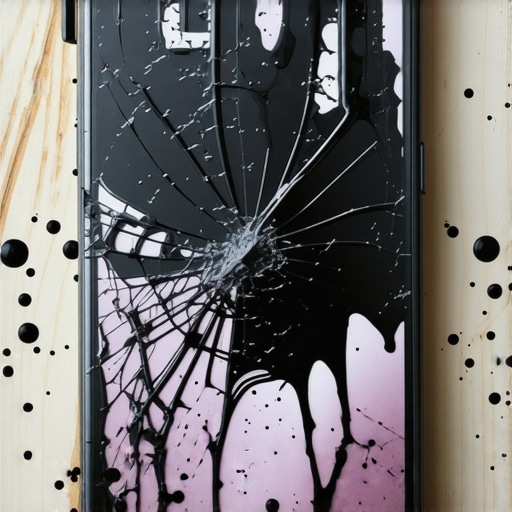
Why your phone screen has black ink-like spots after a fall
You dropped it. The moment the device hits the concrete, you are not just looking at a broken piece of tech: you are witnessing a structural failure of a high-performance laminate. As a master glazier with a quarter-century in the field, I look at that spreading black blob and I do not see ‘ink.’ I see a breached pressure seal and a catastrophic loss of internal structural integrity. In the world of architectural glazing, when a vacuum-sealed unit fails, we call it a ‘blown seal.’ In the world of mobile electronics, those black ink-like spots are the visual evidence of a dying Liquid Crystal Display (LCD) or a ruptured Organic Light Emitting Diode (OLED) substrate. Understanding why this happens requires us to look past the surface and zoom into the molecular level of the glass and the fluid dynamics of the display layers.
“Installation is just as critical as the window performance itself. A high-performance window installed poorly will fail.” – AAMA Installation Masters Guide
I remember a specific case that mirrors this perfectly. A homeowner called me in a panic because their high-end, touch-integrated smart home hub, which was essentially a 15-inch tablet mounted into a custom walnut frame, started developing these exact black plumes. I walked in with my hygrometer and showed them that the ambient humidity in their kitchen was 65 percent. It wasn’t just the impact that caused the spots; it was the fact that a tiny, microscopic hairline fracture had allowed the humid air to reach the sensitive liquid crystal layer. It was not a hardware ‘glitch’: it was a failure of the glazing bead and the perimeter seal. Once that moisture met the liquid crystal, the chemistry changed, and the pixels began to ‘bleed’ into one another. This is the same reality you face when your phone hits the floor. The ‘ink’ is actually the liquid crystal fluid leaking out of its designated sub-pixels and filling the voids between the glass layers.
When we talk about glass, we are talking about a material that is technically a supercooled liquid with immense compressive strength but very poor tensile strength. Your phone screen is likely chemically strengthened through an ion-exchange process, where smaller sodium ions are replaced by larger potassium ions. This creates a state of high compression on the surface. When the phone falls, that surface compression is challenged. If the impact exceeds the ‘Rough Opening’ tolerances of the frame, the glass flexes. If it flexes beyond its limit, a crack forms. But the black spots? That is specifically an ‘internal’ injury. In an LCD, the liquid crystal is sandwiched between two layers of glass. The impact creates a pressure wave that ruptures the microscopic walls containing this fluid. Once ruptured, the fluid is free to migrate. Because the liquid crystal is designed to manipulate light, when it pools in a thick, uncontrolled layer, no light can pass through it correctly, resulting in a black, opaque blotch that looks like an ink stain.
“Glazing systems must be designed to accommodate the movement and thermal expansion of the surrounding materials without compromising the seal.” – ASTM E2112 Standard Practice
In hot climates, such as Texas or Florida, this issue is even more pronounced due to the Solar Heat Gain Coefficient (SHGC). If you leave a phone with a minor ‘chip repair’ needed in a car where the internal temperature reaches 140 degrees Fahrenheit, the glass and the frame expand at different rates. This is why a professional glass installer emphasizes the importance of a ‘same-day’ mobile service for glass issues. If you leave that fracture untreated, thermal stress will cause the crack to migrate. In the South, we worry about Surface #2 (the inner side of the outer pane) because that is where we apply Low-E coatings to reflect the sun. On your phone, that heat causes the liquid crystal fluid to become less viscous, allowing it to flow even faster through the ruptures caused by the fall. The ‘ink’ spot that was a tiny dot in the morning can cover half the screen by sunset because of the thermal expansion of the air trapped inside the display assembly.
The technical term for what you are seeing is ‘LCD Bleeding’ or ‘OLED Oxidation.’ If you have an OLED screen, the ‘ink’ spots are actually even more sinister. OLED pixels are organic compounds that react almost instantly with oxygen. When the glass breaks, even if the crack is invisible to the naked eye, oxygen molecules rush in. These molecules oxidize the organic material, essentially ‘burning’ the pixels out from the inside. This is why the spots on an OLED screen tend to grow in a circular pattern, like a mold colony on a piece of bread. It is a chemical chain reaction that cannot be stopped without a full component replacement. You cannot simply ‘wipe’ this away, and a standard chip repair kit from a big-box store will not touch this. You need a full ‘same-day’ mobile service that involves removing the entire display assembly and ensuring the new unit is seated correctly within the frame’s ‘Rough Opening’ to prevent future stress fractures.
As a glazier, I often see people try to ‘caulk-and-walk’ their way out of a screen repair by putting a plastic protector over the ‘ink’ spots. This is the equivalent of putting duct tape over a cracked window sash. It might stop you from cutting your finger, but it does nothing to address the structural failure of the glass or the ongoing oxidation of the internal components. A real repair involves checking the ‘Sill Pan’ of the device (the bottom internal frame) for any debris that could cause a pressure point. We use ‘Shims’ in the window industry to ensure a window is perfectly level and square; in the mobile world, the frame must be perfectly straight. If the frame was slightly bent during the fall, any new glass installed will be under constant tension and will likely fail again within weeks. This is why the precision of the installer matters more than the brand of the glass itself.
Water management is also a critical factor. Your phone screen is designed with ‘Weep Holes’ of sorts (the speakers and ports), but the screen itself should be a sealed unit. Once the glass is breached and the ink spots appear, the device is no longer water-resistant. Capillary action will pull moisture from your pocket or the air into the display. This moisture will travel along the ‘Flashing Tape’ (the adhesive gaskets) and eventually reach the logic board. This is why immediate intervention from a glass installer is necessary. A ‘same-day’ mobile service is not just about aesthetics: it is about preventing the ‘rot’ of the internal electronics. Just as I tell my clients that a rotting window header is a sign of poor flashing, a black spot on a screen is a sign of a compromised environmental seal. Do not wait for the ‘ink’ to cover the whole screen; the longer you wait, the higher the risk of total device failure due to internal corrosion.