Why cheap resin fails in extreme winter cold
The Chemistry of the Cold Crack
As a master glazier with over 25 years in the field, I have seen every possible failure of glass and sealants known to man. When the temperature drops below zero in regions like Chicago or Minneapolis, the physics of your windows and glass changes fundamentally. One of the most common calls I get during a deep freeze involves the sudden, catastrophic failure of a previous chip repair. A homeowner or driver notices a small bullseye or star-break has suddenly spidered across the entire surface. This is not bad luck; it is a failure of material science. I recall a specific instance where a homeowner called me in a panic because their operable sash glass was ‘sweating’ and then suddenly cracked right where a mobile tech had performed a same-day fix two weeks prior. I walked in with my hygrometer and thermal sensors and showed them that the humidity was nearly 60 percent, but more importantly, the cheap resin used in the repair had a Coefficient of Thermal Expansion that was completely incompatible with the glass. It was not just the window failing; it was the physics of a poor repair meeting the reality of a Northern winter.
“Installation is just as critical as the window performance itself. A high-performance window installed poorly will fail.” – AAMA Installation Masters Guide
The Physics of Thermal Expansion and Contraction
To understand why cheap resin fails, we must look at how glass behaves. Glass is remarkably stable, but it does have a specific rate of expansion. When a glass installer performs a chip repair, they are injecting a liquid polymer into a Rough Opening in the glass structure. High-quality resins are engineered to match the refractive index of the glass, but more importantly, they are designed to mirror the expansion and contraction rates of the glass itself. Cheap resins, often found in ‘DIY’ kits or used by low-cost mobile service operators, are usually simple acrylics or low-grade polymers. In the extreme cold, these materials become incredibly brittle. While the glass is trying to contract slightly, the resin is contracting at a different rate and losing its grip on the Glazing Bead area. This creates a massive amount of internal stress at the point of the repair. If the resin cannot flex, it acts like a wedge, driving the crack further across the pane.
The Moisture Factor and the Dew Point
In cold climates, the U-Factor of your window is king. We want to keep the heat inside and the cold out. However, if a chip repair was not performed in a perfectly dry environment, microscopic amounts of moisture can be trapped inside the glass. When a mobile service technician works on your glass in a driveway during a humid or snowy day, that moisture stays in the repair. As soon as the temperature hits the freezing point, that water expands as it turns to ice. This is the ‘freeze-thaw’ cycle happening inside your glass. A professional glass installer will always use a moisture evaporator or a vacuum-seal process to ensure the cavity is bone dry before the resin is injected. Without this step, the repair is a ticking time bomb. This is especially critical for a Sash that is moved frequently, as the mechanical vibration adds extra stress to an already compromised repair site.
“The selection of a sealant or resin must account for the maximum expected joint movement and the service temperature range.” – ASTM C1193 Standard Guide for Use of Joint Sealants
The Problem with Same-Day Mobile Service in Sub-Zero Temps
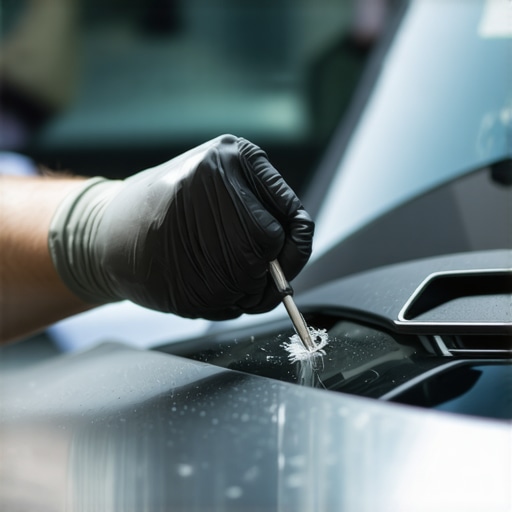
We all love the convenience of same-day mobile service, but the reality is that glass repair requires temperature control. If a technician attempts to cure a UV-resin on a piece of glass that is 10 degrees Fahrenheit, the chemical bond is often incomplete. The resin might look hard, but its molecular chain is weak. In my shop, we ensure the glass is brought up to a stable temperature gradually to avoid thermal shock. If you take a cold pane of glass and suddenly apply the heat of a curing lamp or a heat gun, you risk an immediate stress fracture. This is why the ‘cheap’ fix often ends up being the most expensive one, leading to a full replacement of the operable unit rather than a simple 20-minute mend. You must look at the NFRC ratings for your glass and understand that any repair must maintain those thermal boundaries. A failed resin plug creates a thermal bridge that allows cold to seep through, lowering the efficiency of your entire Rough Opening and leading to the very condensation issues that rot out your Sill Pan and Flashing Tape over time.
Why Material Quality Matters More Than the Price
When you are looking for a glass installer, ask about the ‘shore hardness’ and the ‘high-index’ properties of their resins. A master glazier won’t mind the question. We use resins that are specifically formulated for ‘North’ climate contexts, where the delta between the indoor temperature and the outdoor temperature can be 80 degrees or more. These resins contain silane coupling agents that create a covalent bond with the silica in the glass. This isn’t just ‘glue’ filling a hole; it is a molecular weld. Cheap resins lack these agents. They sit in the crack like a piece of plastic, waiting for the first cold snap to pop out or fail. If you see a price that is too good to be true for a chip repair, remember that you are paying for a temporary mask, not a permanent structural fix. In the world of glazing, we have a saying: you can pay for the science now, or pay for the replacement later.
Conclusion: Protecting Your Investment
Your windows are a vital part of your home’s thermal envelope. Whether it is a Muntin-heavy historic window or a modern high-efficiency unit, the integrity of the glass is paramount. Do not let a minor chip turn into a major headache because of poor material choice. Ensure your glass installer understands the climatic pressures of your region. Insist on high-quality, UV-stable, cold-weather resins that can handle the expansion and contraction cycles of a true winter. A proper repair should be invisible and, more importantly, invincible against the cold.