How to stop your phone from overheating in the car
The Physics of the Dashboard Greenhouse
As a master glazier with a quarter-century in the trade, I have seen every type of failure involving glass, heat, and moisture. People often view the glass in their vehicle as a simple barrier against wind and rain, but in reality, it is a sophisticated thermal filter. When your phone overheats while sitting on your dashboard or mounted to your windshield, you are experiencing a localized failure of thermal management. The glass in your car is not just a window; it is a solar collector. To understand why your device is shutting down, we have to look at the Solar Heat Gain Coefficient (SHGC). In the glazing industry, we define SHGC as the fraction of solar radiation admitted through a window. When you are parked under the midday sun, that windshield is absorbing and re-radiating long-wave infrared energy directly into your cabin and, more importantly, into the dark, heat-absorbent plastic of your phone.
I once sat across from a client who was ready to spend thousands on a new climate control system for his fleet because his drivers’ tablets were constantly failing. I had to play the role of the technical truth-teller. I pulled out my BTU meter and my spectroradiometer to show him the reality of his situation. I measured the energy coming through his standard clear tempered side glass compared to a high-performance laminated unit. The standard glass was letting in nearly 80% of the solar energy. It was not a mechanical failure of the vehicle; it was a fundamental misunderstanding of glass science. Just like a building with too much south-facing glass and no shading, his vehicles were becoming thermal traps. This is the same reason your phone reaches 120 degrees Fahrenheit in minutes. The glass is allowing short-wave radiation to enter, which then hits your phone, warms it up, and is re-emitted as long-wave radiation that cannot easily escape back through the glass. This is the greenhouse effect in a five-passenger microcosm.
“The Solar Heat Gain Coefficient (SHGC) measures the fraction of incident solar radiation admitted through a window, both directly transmitted and absorbed and subsequently released inward. For cooling-dominated climates, a low SHGC is essential to reduce peak cooling loads and improve occupant comfort.” – National Fenestration Rating Council (NFRC)
The Science of Spectral Selectivity
In the world of high-end glass installation, we talk about spectral selectivity. This is the ability of a glazing material to admit as much visible light as possible while blocking the invisible infrared and ultraviolet spectrums that carry heat and cause damage. Your phone overheats because most standard automotive glass is not nearly as spectrally selective as the high-performance Low-E coatings we use in modern residential architecture. When I am shimming a high-performance window into a rough opening, I am thinking about the placement of the Low-E coating. In hot climates, we want that coating on Surface #2 (the inner face of the outer pane) to reflect the sun’s energy before it even enters the air gap. Most car windshields are laminated, meaning they have a layer of Polyvinyl Butyral (PVB) sandwiched between two lites of glass. If that PVB layer is not specifically engineered for thermal rejection, your phone is the one that pays the price. If you want to stop the overheating, you have to address the glass integrity first. This is where a professional glass installer becomes your best ally. If your windshield has a crack or a chip, the thermal stress of the sun hitting that localized area can cause a rapid spread of the damage. Seeking same-day chip repair is not just about visibility; it is about maintaining the structural and thermal envelope of the glass. A mobile service can often perform these repairs on-site, ensuring the lamination remains intact and the glass can continue to handle the thermal expansion and contraction cycles without failing.
Managing the Thermal Load
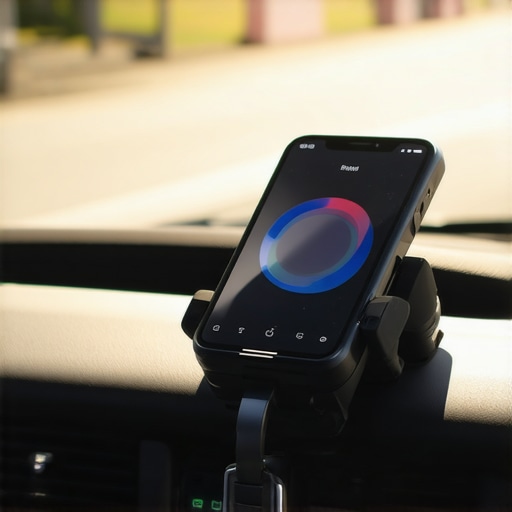
To keep your phone from hitting its thermal limit, you need to think like a glazier. First, understand the orientation. Just as we design buildings to minimize direct solar exposure on the west-facing elevations, you should mount your phone away from the direct path of the sun. If your phone is directly behind the glass, it is in the “glazing pocket” of highest heat. Use the vehicle’s HVAC as a heat sink. In the glazing trade, we use weep holes to manage water and ventilation to manage heat. In your car, directing air from the AC vents onto the back of the phone mimics the convective cooling we use in curtain wall systems. Furthermore, consider the frame of the device. Just as a thermally broken aluminum frame prevents heat transfer in a window, a phone case can either help or hinder heat dissipation. Thick plastic cases act as insulation, trapping the internal heat generated by the battery and processor. In high-heat environments, your phone needs to be able to shed heat as efficiently as a radiator. If you are noticing your phone is constantly hot, check your glass for damage. Even a small stone chip can be the precursor to a total failure under high thermal stress. A mobile service glass installer can assess the health of your glass and perform chip repair to ensure the unit stays strong. Same-day service is vital because thermal expansion in the heat of the day can turn a tiny chip into a full-length crack in hours.
“Installation is just as critical as the window performance itself. A high-performance window installed poorly will fail to meet its rated thermal specifications.” – AAMA Installation Masters Guide
The Importance of Glass Integrity
When I look at a piece of glass, I don’t just see a transparent surface; I see a complex material with specific edge tensions and surface compressions. When you have a chip in your windshield, you have a point of concentrated stress. When the sun beats down on that glass, the area around the chip heats up at a different rate than the rest of the lite. This differential heating is what causes cracks to run. From a thermal management perspective, a compromised windshield is less efficient at reflecting energy and more prone to catastrophic failure. This is why I always emphasize the importance of professional glass installer expertise. Using a mobile service for same-day chip repair is the most effective way to preserve the factory seal of your windshield. Once that factory seal is broken during a full replacement, you have to rely on the installer’s ability to perfectly replicate the bead of urethane. If there is a gap, you get air leaks. If there are air leaks, your climate control cannot maintain the pressure needed to keep the cabin cool, leading back to the original problem: an overheating phone and a miserable driver. We use tools like the glazing bead to hold glass in place in residential frames, but in your car, the adhesive is the structural component. Keeping that glass healthy is the first step in thermal protection.
Practical Steps to Cooling Down
Beyond the glass itself, there are mechanical strategies to employ. First, avoid the dashboard. The dashboard acts as a thermal mass, absorbing heat all day and radiating it directly into anything sitting on it. Second, utilize reflective sunshades when parked. These shades act as a temporary Low-E coating, reflecting radiant energy back out through the glass before it can be absorbed by the interior materials. Third, ensure your glass is clean. Dirt and grime on the surface of the glass can actually increase absorption of solar energy. As a glazier, I always tell people that clear glass is a myth; it is always an active participant in the thermal environment. Finally, if you do get a chip, do not wait. The heat that is killing your phone is the same heat that will expand that chip into a spiderweb across your vision. Contact a glass installer for a mobile service appointment immediately. Same-day chip repair is a fraction of the cost of a full replacement and keeps your vehicle’s thermal envelope intact. By understanding the physics of SHGC and the importance of spectral selectivity, you can move from being a victim of the heat to a master of your environment. Treat your car’s glass with the same respect we give to high-performance architectural glazing, and your electronics will thank you with a much longer lifespan.